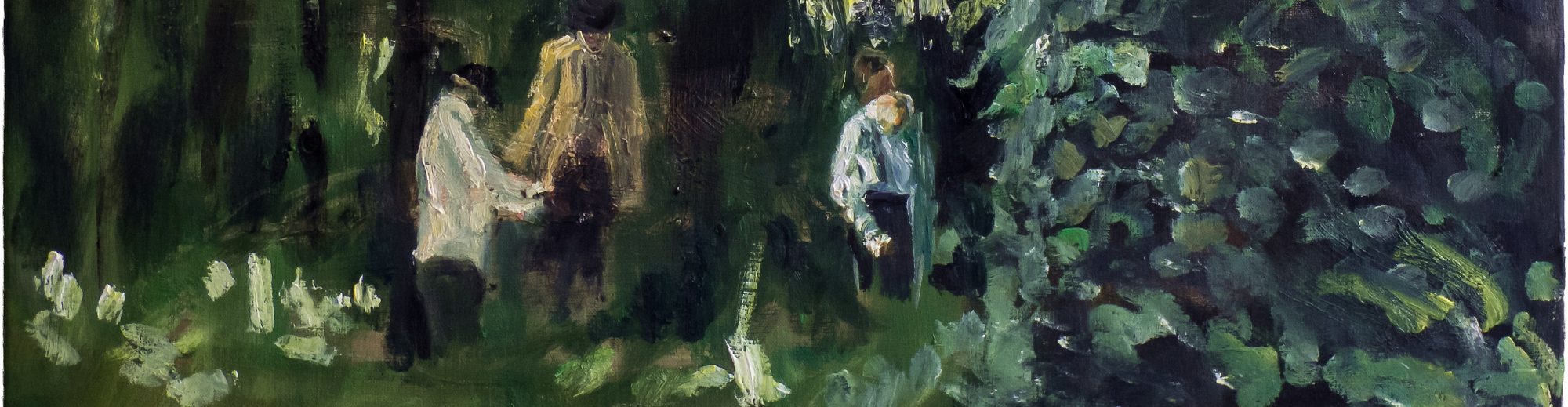
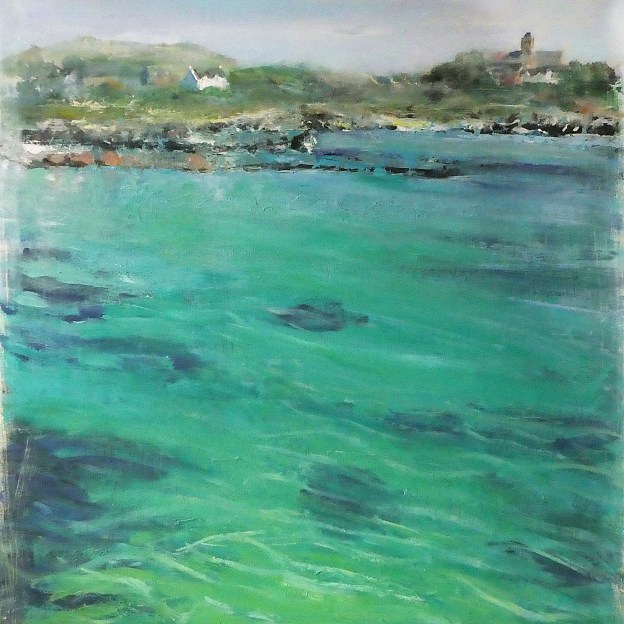
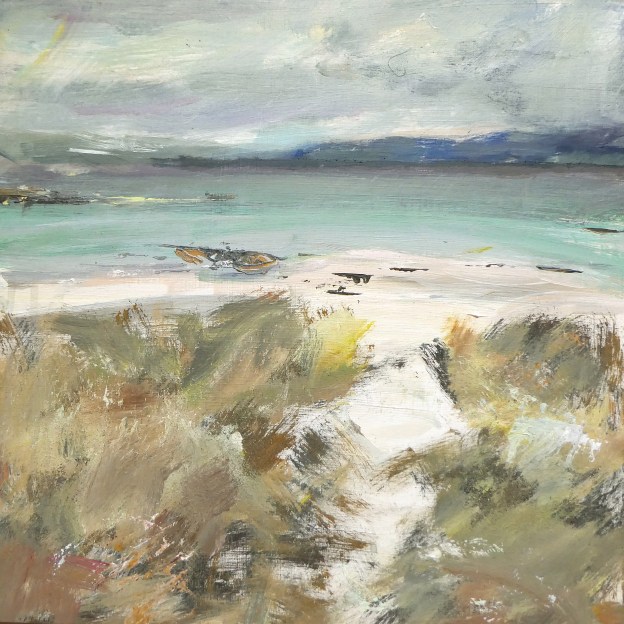
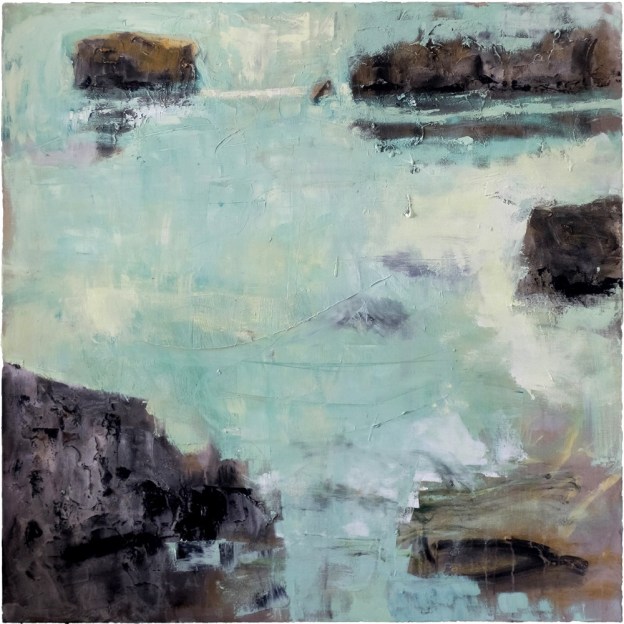
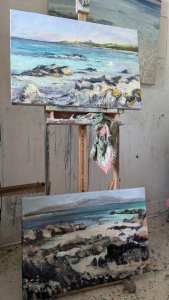
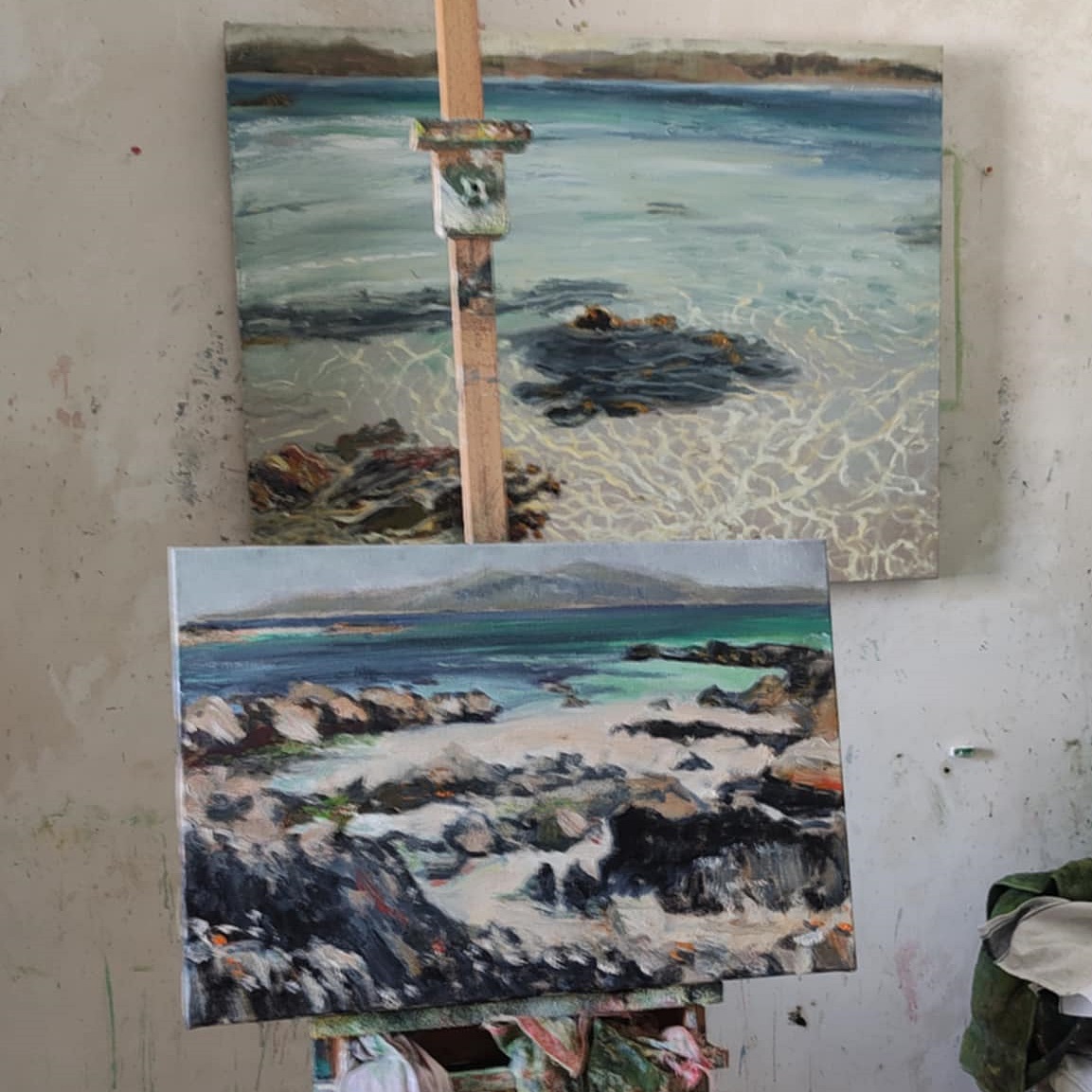
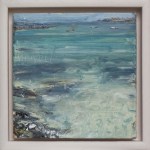
Above: St Ronan’s Bay, Iona. Mixed media on 30 by 30 inch wood. Rose Strang 2026.
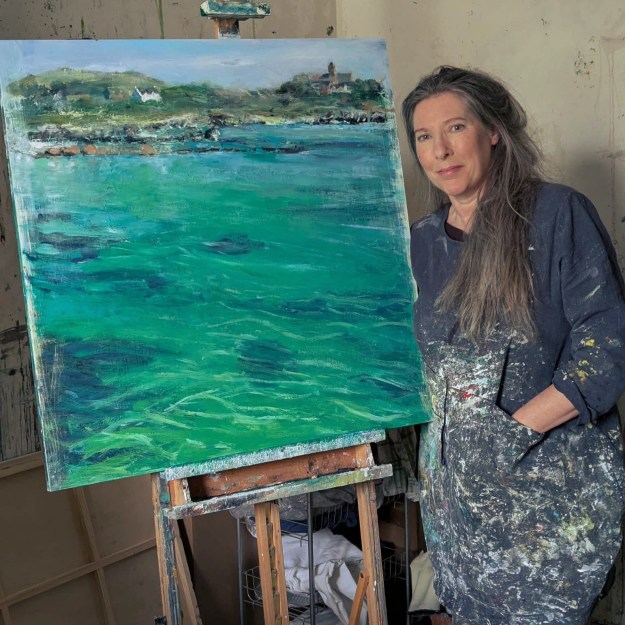
This is the bigger version of St Ronan’s Bay, and this one is for the Graystone Gallery in Edinburgh, possibly Edinburgh’s most popular contemporary art gallery. The owner, Lesley Briggs has an MA in the History of Art and worked with London’s prestigious Whitechapel Gallery
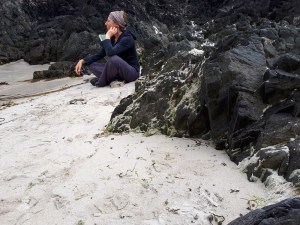
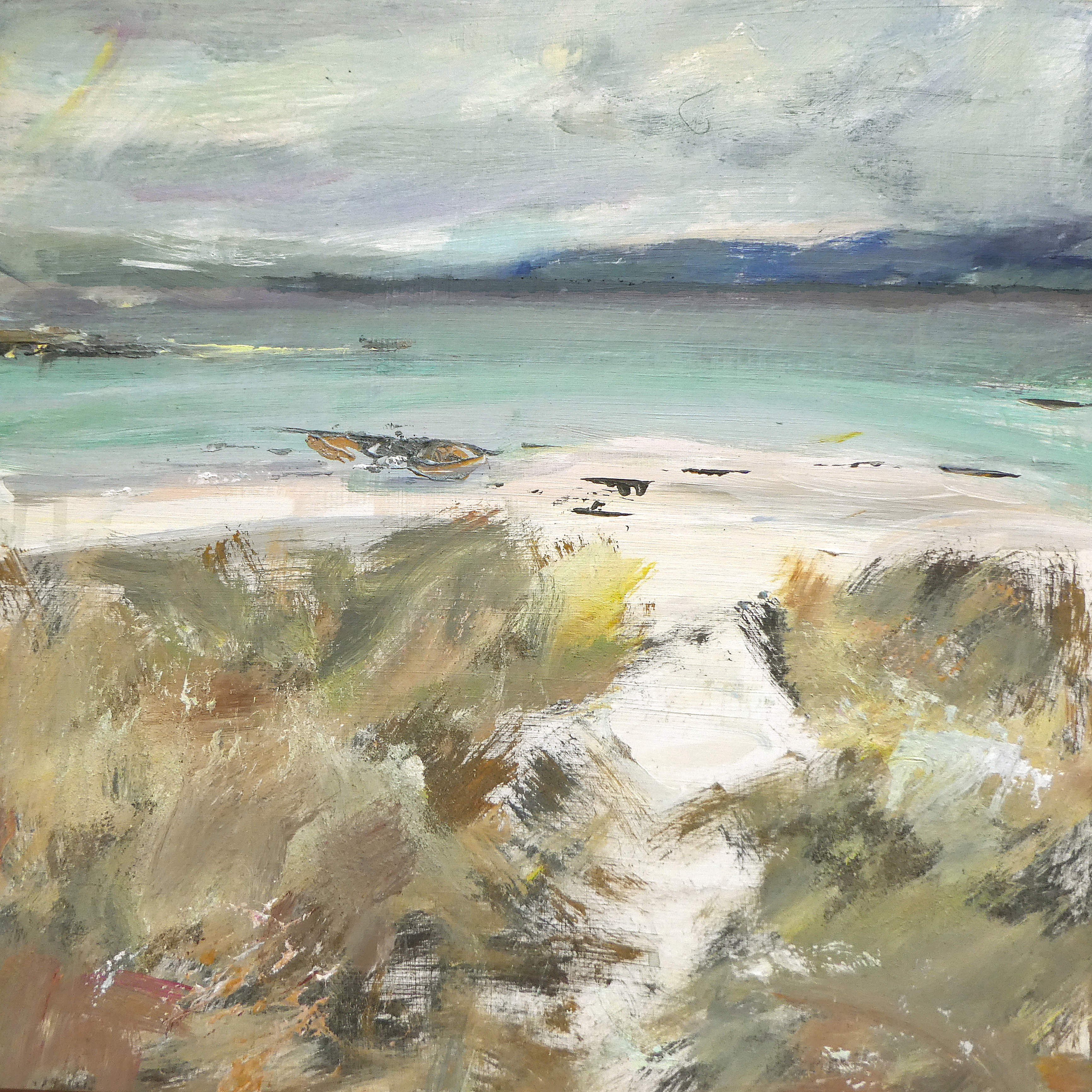
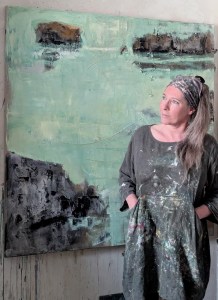
Here’s a zoom-able version and a photo of me with it to show scale…
I remember how excited I was to take a trip to the Whitechapel Gallery when we were art students. Lucian Freud’s work was showing and I was mesmerised by the way he painted the pink skin of a dog’s stomach in one of the paintings, at a typically odd setting and angle. Afterwards we all went to Jimmy’s Greek Taverna in Soho and I ate the loveliest lamb casserole ever. Happy days.
None of that has anything to do with my painting of course. I really fought to make this one translucent and vibrantly green. Layer after layer, building it up, then taking it into the shower to wash it off when I didn’t like it. All worth it to capture that wonderful sea-green of Iona.
If you like the look of this then contact The Graystone Gallery soon. Their summer exhibition launches in July, and people reserve paintings in advance.
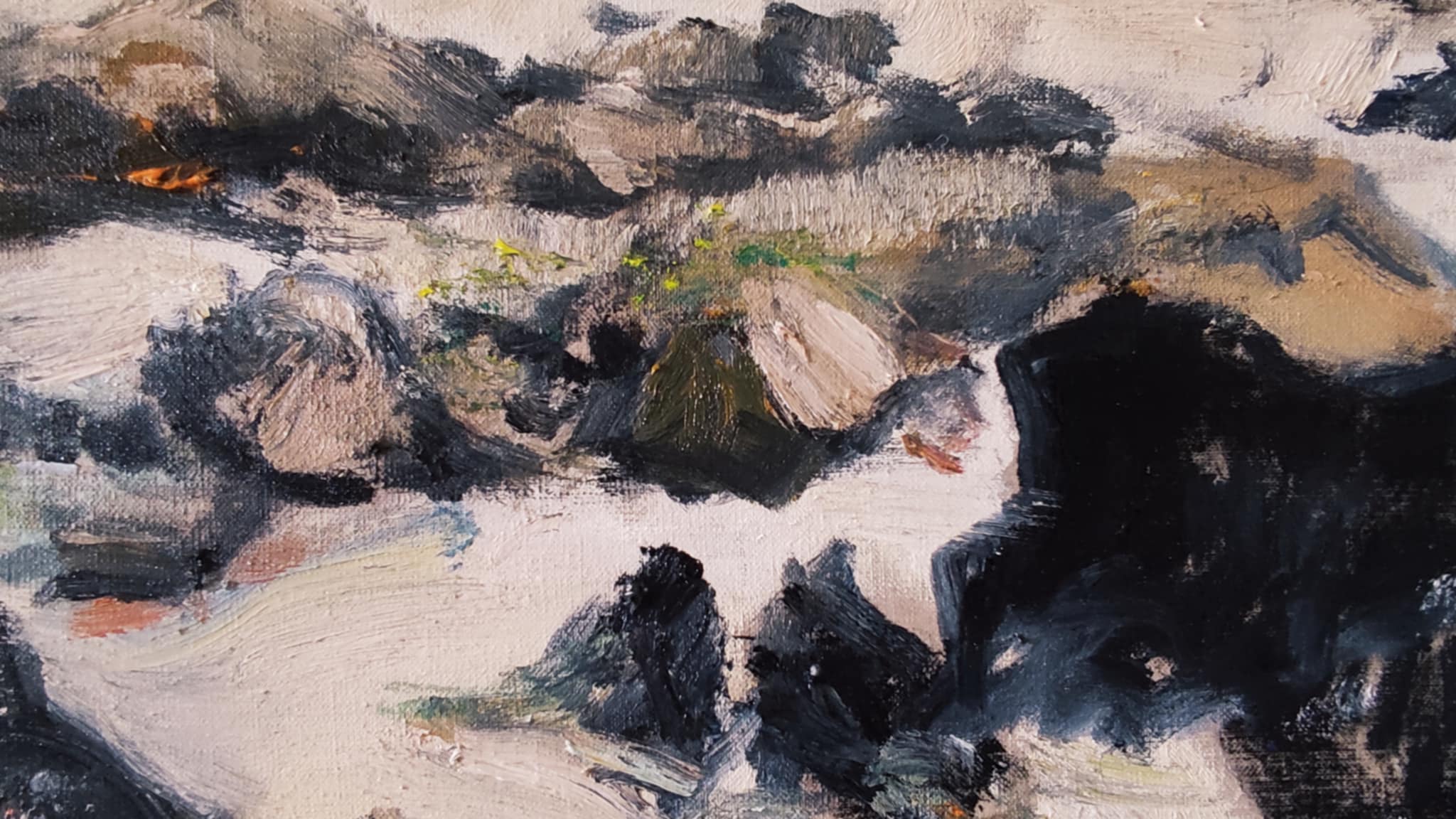
Above: Tràigh Bàn nam Manach (white beach of the monks). Mixed media on 16×16″ wood. Rose Strang 2026
You know this view very well if you’ve walked the beaches of Iona. And what a lovely, poetic name the beach has: Tràigh Bàn nam Manach (pronounced trree baan nam manach). Trill the the ‘r’ like you’re lightly breathing out the word ‘tree’ fast and that gives you that silent but still there ‘gh’ in ‘traigh’). Now read it out with the emphasis in bold above, and you get the poetic rhythm of it.
All the more surprising, then, that this particular beach is named for the monks who died there in one of many Viking massacres that took place around Britain between the 8th to late 10th centuries.
This massacre of fifteen monks and an Abbot took place in AD 986. It’s difficult for us, or the average person at least, to imagine the mindset of either Vikings, or the monks of Iona at that time. 986 seems so long ago to us, and to them too, Calum Cille’s time would have been several centuries ago.
But that mindset endured. Their way of thinking was not so much self-sacrificial. It was more that their vows to protect all that was sacred came before their life itself.They wouldn’t run when attacked.
So if Vikings (whose belief was that fearlessly, skilfully fighting and killing for what you wanted was the pinnacle of human endeavour) decided they liked the look of your land or anything else, they’d just take it. ‘Immovable object meets irresistible force’ you could say.
It’s not what you feel, walking along that beach. In fact, back in 2018 I was painting within the very rocks on which the monks were killed, and I didn’t ‘pick up’ on anything dark there at all.
Those monks were reconciled to their death in ways we find humbling and strange today. Like ancient Japanese poets of Haiku, they attended to the here and now, the Zen of everyday life.
And immediately I’m transported to Iona in the 8th century, where a monk sits at his lectern. Or perhaps outside amongst the marram grass, as he illuminates a manuscript on a lovely day in spring, his hands warmed at last, finding beauty in the way light falls on the margins of his parchment. Feeling gratitude for simple things in the here and now.
‘Tràigh Bàn nam Manach (white beach of the monks)’. Mixed media on 16×16″ wood. Rose Strang 2026
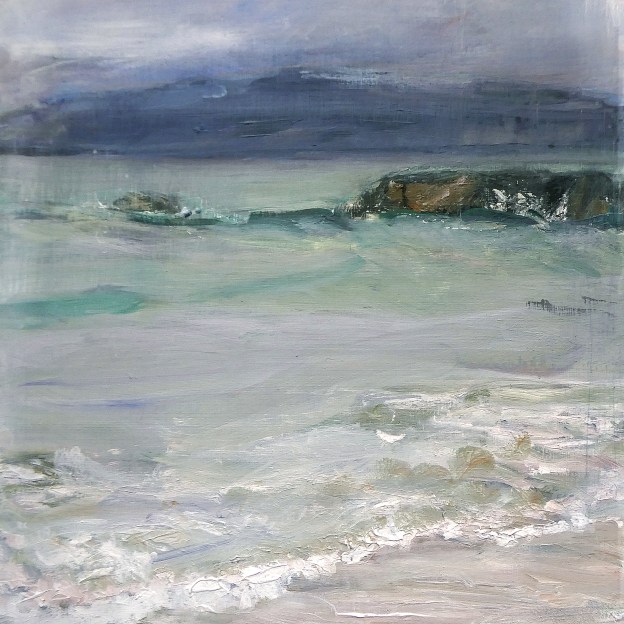
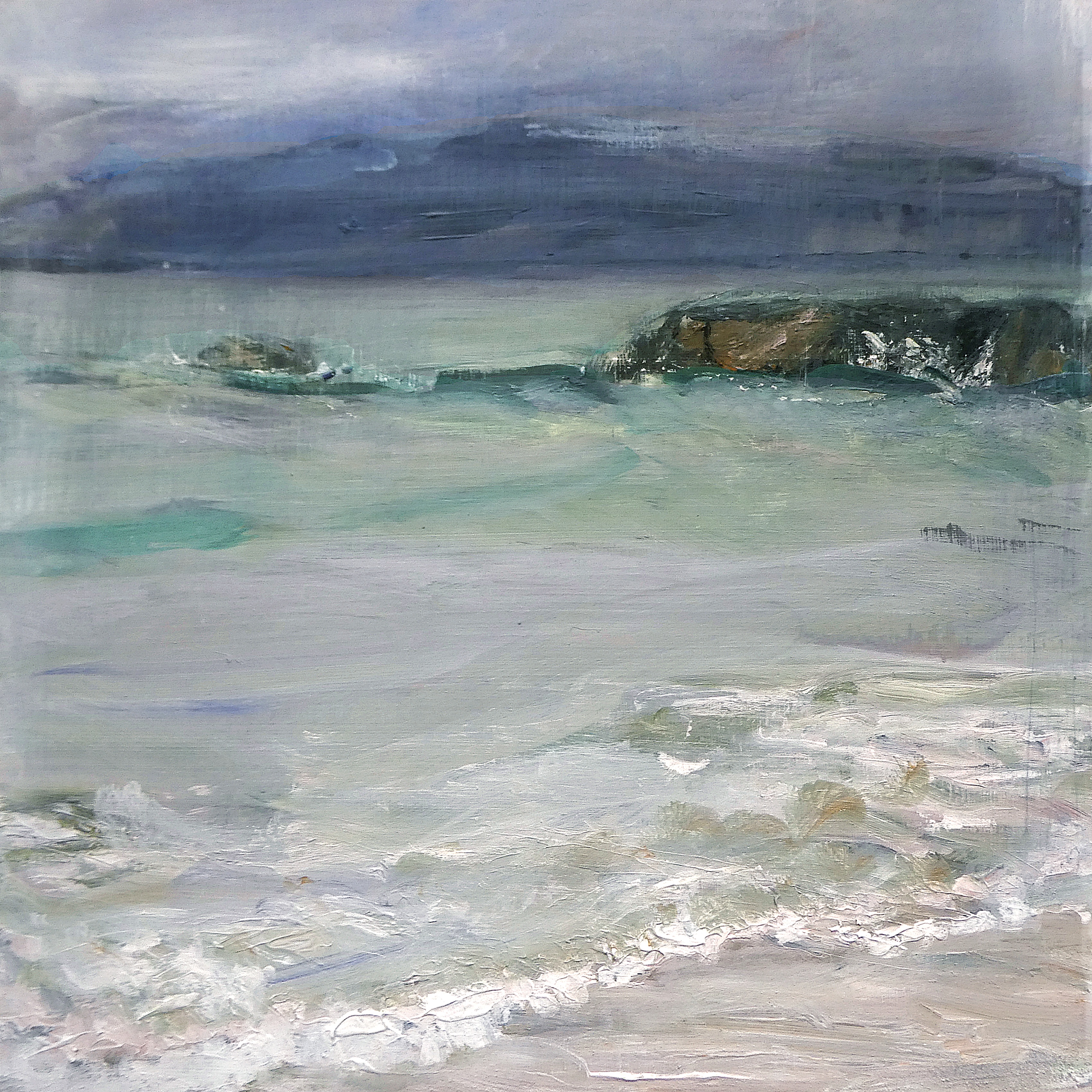
Above: Caol Ì(The Sound of Iona). Mixed media on 16×16″ wood. Rose Strang 2026.
I’ve always found the name of the narrow channel of water between Iona and Mull poetic: The Sound of Iona, or in Scottish Gaelic, Caol Ì. Pronounced ‘Cuhl’ like the ‘u’ in ‘numb’. If you want to get fussy, the ‘L’ is pulled or rolled back in the throat, almost like a Spanish ‘L’. In original Gaelic, it means ‘narrow’ or ‘slender’. and Ì simply means ‘Iona’, which is the original name of Iona, and is pronounced ‘Eee’.
It would have been called ‘Ì Chaluim Chille‘, meaning ‘The Island of the church of Calum Cille from the time Calum Cille arrived on the island but apparently it was always called ‘Ì’.
Hmm, that just means ‘island’ so they must have distinguished it in some way, in the name. Who knows?
Calum Cille was a powerful figure in the history of the Celtic Christian early church, which I’ve written about elsewhere. He was an exiled Irish prince and a well-trained warrior. However, it’s well-documented historically that he led a group of monks according to Christian principles, which you’d imagine would include peaceable ways.
Which brings us back to my painting, which attempts to capture the particular peace of gentle Hebridean rain, standing on Traigh Ban nam Manach (the white shore of the monks) looking towards Mull across the Sound.
In recent years, the Iona Community (an ecumenical Christian group on the island, who run religious programmes through Iona Abbey) have incorporated Celtic pagan forms of worship with Christian, which means a slant towards God in landscape and nature. This is a real Scottish tradition of the Hebrides, since there were not always churches in remote islands, so finding religious meaning in the clouds, the land and light or dark was just what people did.
Here’s a well-known prayer from Iona:
‘Silence.
Be still
and aware of God’s presence
within and all around.’
Here’s the painting again. Wishing you a peaceful week …
‘Caol Ì (Sound of Iona)’. Mixed media on 16×16″ wood. Rose Strang 2026
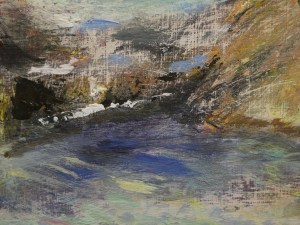
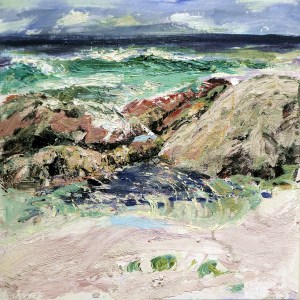
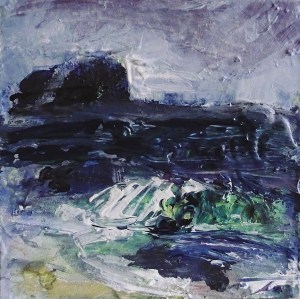
Above: Bac Mòr from Iona. Mixed media on 16×16″ wood. Rose Strang 2026.
Here’s a video of it being painted …
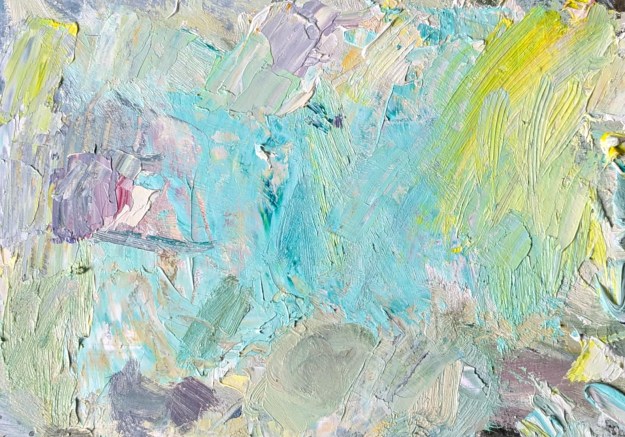
A zoomable version of the painting below, and some details …
Bac Mor from Iona. Mixed media on 16×16″ wood. Rose Strang 2026
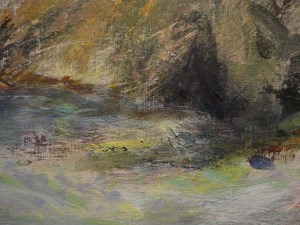
(detail) Bac Mor from Iona. Mixed media on 16×16″ wood. Rose Strang 2026
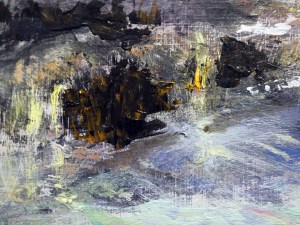
(detail 2) Bac Mor from Iona. Mixed media on 16×16″ wood. Rose Strang 2026
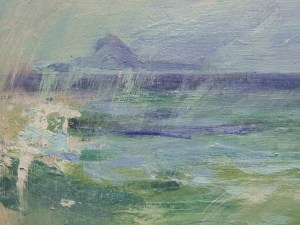
(detail 3) Bac Mor from Iona. Mixed media on 16×16″ wood. Rose Strang 2026
(detail 4) Bac Mor from Iona. Mixed media on 16×16″ wood. Rose Strang 2026
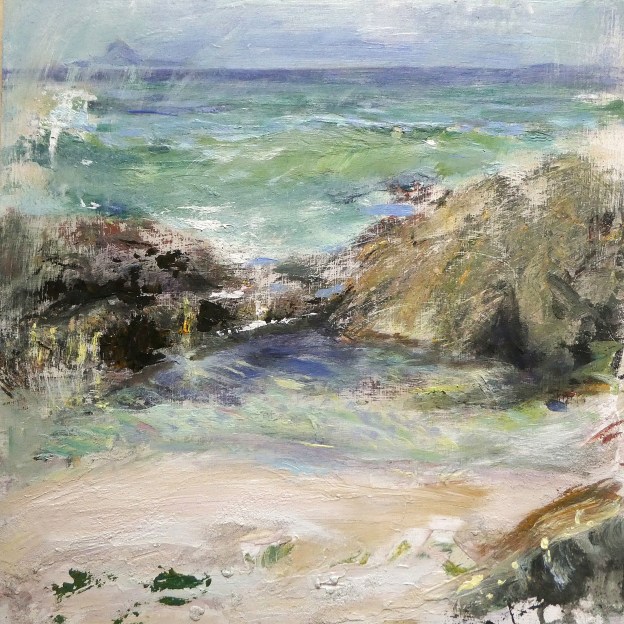
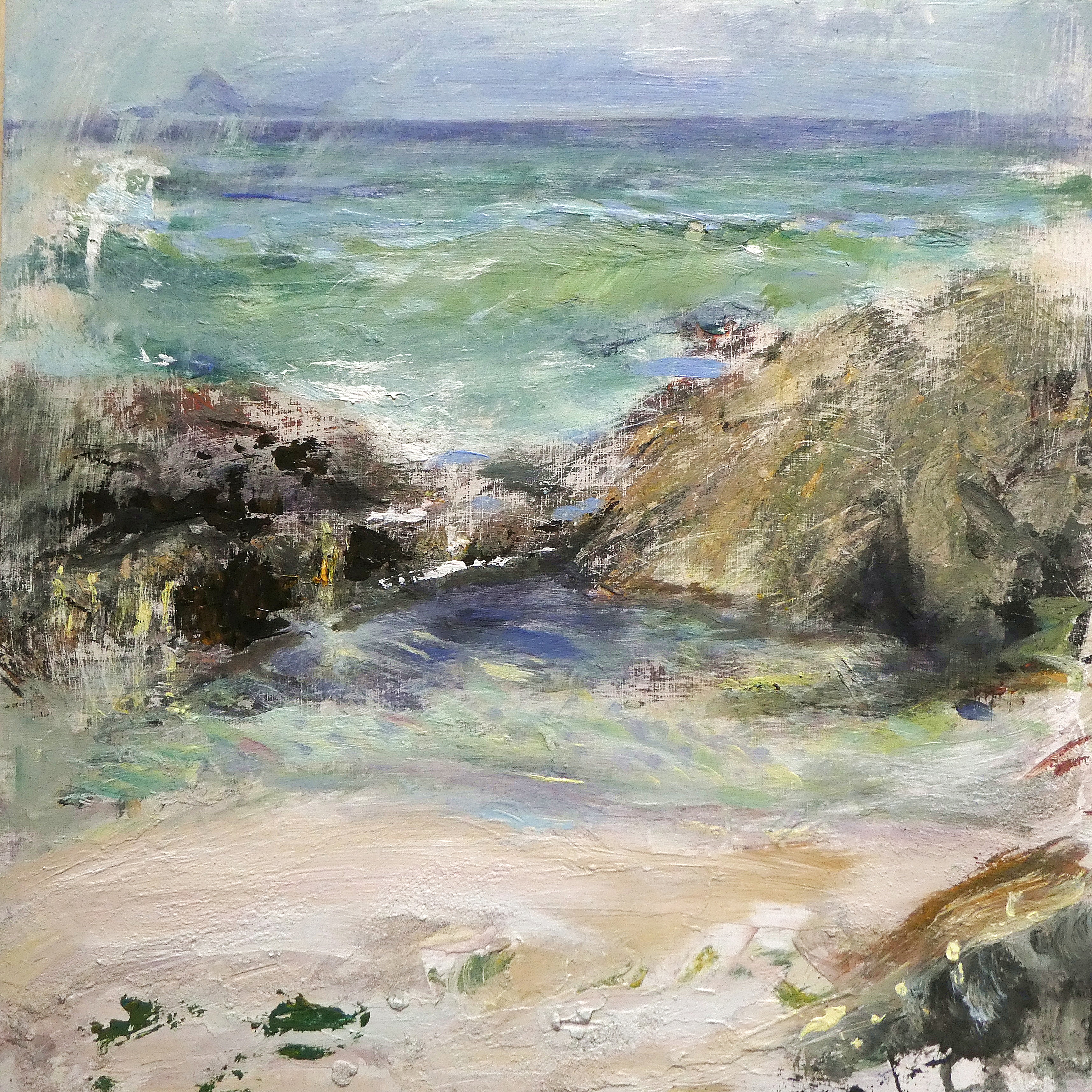
This painting was created half in situ on the north beack of Iona, and half in the studio.
It was quite challenging conditions with the sands crumbling beneath me and waves splashing against the rocks as the tide came in. Great fun, I really do enjoy en plein air painting, and feel less moved by painting in the studio.
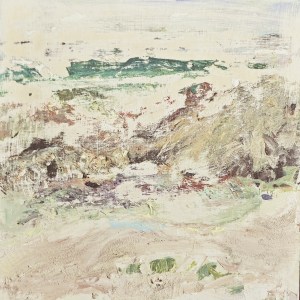
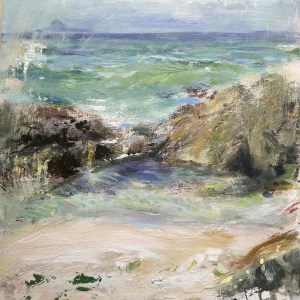
Having said that, this has been improved by scraping back the original, which creates an almost fresco effect, then adding back in some subtler sea tones and details to the rock pool.
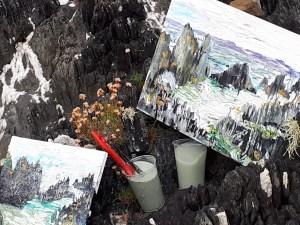
Here are three images showing process. You can see I’ve scraped it back to the plywood beneath in the second one. And you can see how unfinished the first one was, thanks to a rapidly incoming tide …
Bac Mor from Iona. Mixed media on 16×16″ wood. Rose Strang 2026
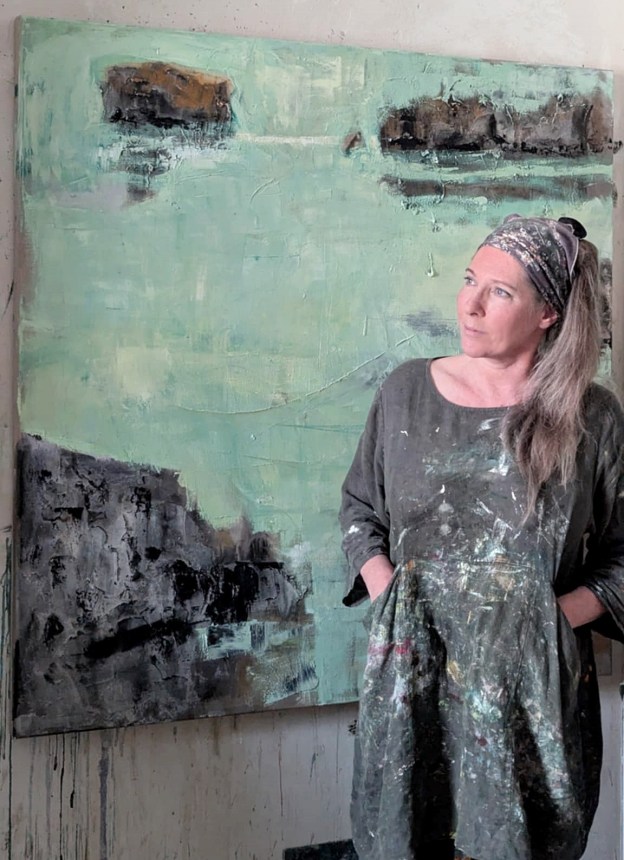
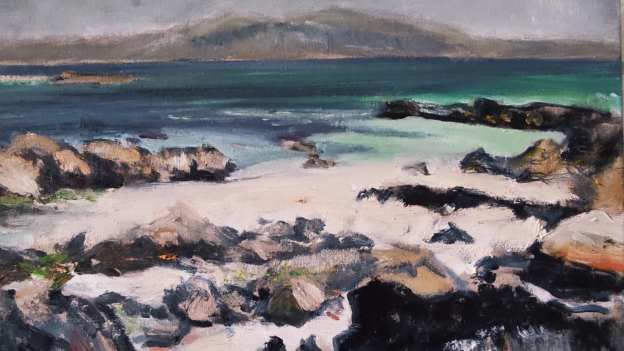
Above. Storm Island. Oil on 50×50″ linen canvas. Rose Strang 2025.
Part of a series in progress for the Graystone Gallery‘s Edinburgh Festival exhibition launching to the public Saturday 19th July 2025 from 1 to 3pm
The photo below includes me to show scale …
The painting’s called Storm Island because it shows a somewhat abstracted view from the north beach of Iona to Eilean Annraidh, which means (you guessed it!) Island of Storm in Gaelic.
It doesn’t look remotely stormy from the shore, it generally looks somewhat tranquil, even mystical in the way that islands do until you’re on them. A sense of untouched purity with its white sand and luminous tuquoise water.
I can never capture in traditonal or realist paintings that feeling of mystery. Abstracting this painting a little, and painting from a place where I’m thinking of colour, shape and texture rather than what’s actually there, maybe gives more of a sense of that feeling.
The foreground suggests a rockpool. The rock pools on the north beach of Iona are incredible sometimes, you feel you’ve stumbled upon some sort of dragon’s lair, with this lime green water among the jagged jet black rocks.
I have one more of these semi abstract works to finish this week, then the series for theGraystone Galleryis complete. The exhibition launches with a preview on Saturday 19th July from 1 to 3pm. Hope to see you there!
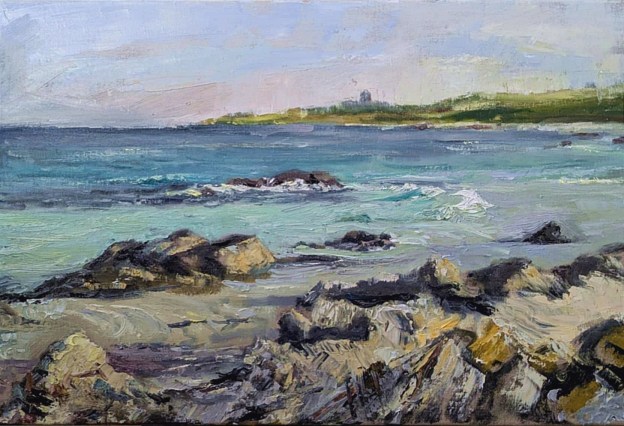
Above: Iona Abbey from North Beach. Oil on 30×20″ linen canvas. Rose Strang 2025
Today’s painting, above, is one of two landscapes for the upcoming Graystone Galleryexhibition in Edinburgh which launches on Saturday 19th July this year from 1 to 3pm
I’m taking these two landscapes as a starting point for two much larger abstract works for the Graystone, about which I’m very excited as I really awant to play with colour, mood and texture, not just views of Iona, lovely as those are to paint!
Just looking at my palette at the end of today is an inspiration!
Above: North Beach Iona, May. Oil on 30×20 inch linen canvas. Rose Strang 2025
Lots of exciting new projects coming up!
The painting above is one of a series I’m creating for the Graystone Gallery, Edinburgh for their Edinburgh Festival exhibition, which launches on Saturday July 19th from 1 to 3pm
The painting below is for the Limetree Gallery‘s upcoming Summer Exhibition which launches 3rd July. You can preview or reserve paintings now by contacting them on their website.
(If you’re interested in buying or reserving one of the paintings please contact the galleries direct on the links in the above paragraph, thank you).
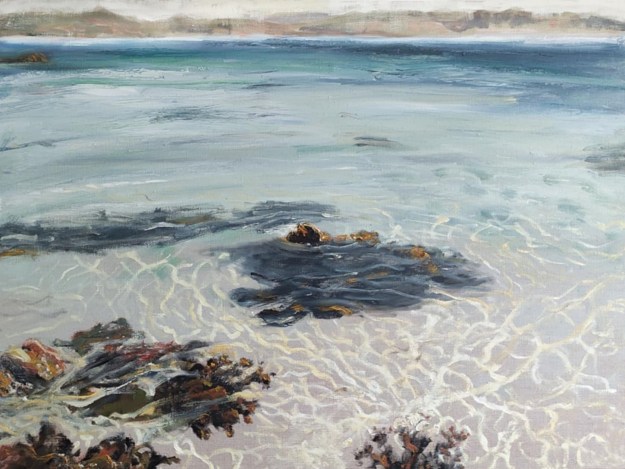
‘Sea Light, Iona’. Oil on 40 x 30 inch linen canvas. Rose Strang 2025
I have another three at larger sizes for the Graystone coming up. Readers of the blog will know how much Iona means to me, and to thousands of other people who visit the island every year. It’s a special place I’ve been visiting now for about thirty four years and I’d say it’s one of my biggest inspirations as an artist.
The next larger paintings will be a bit more abstract, but I know that people find these paintings of turquoise sparkling water joyful, and so do I!
This series is doubly special since my partner Adam and I prepared the canvases ourselves with sretcher bars and raw linen.
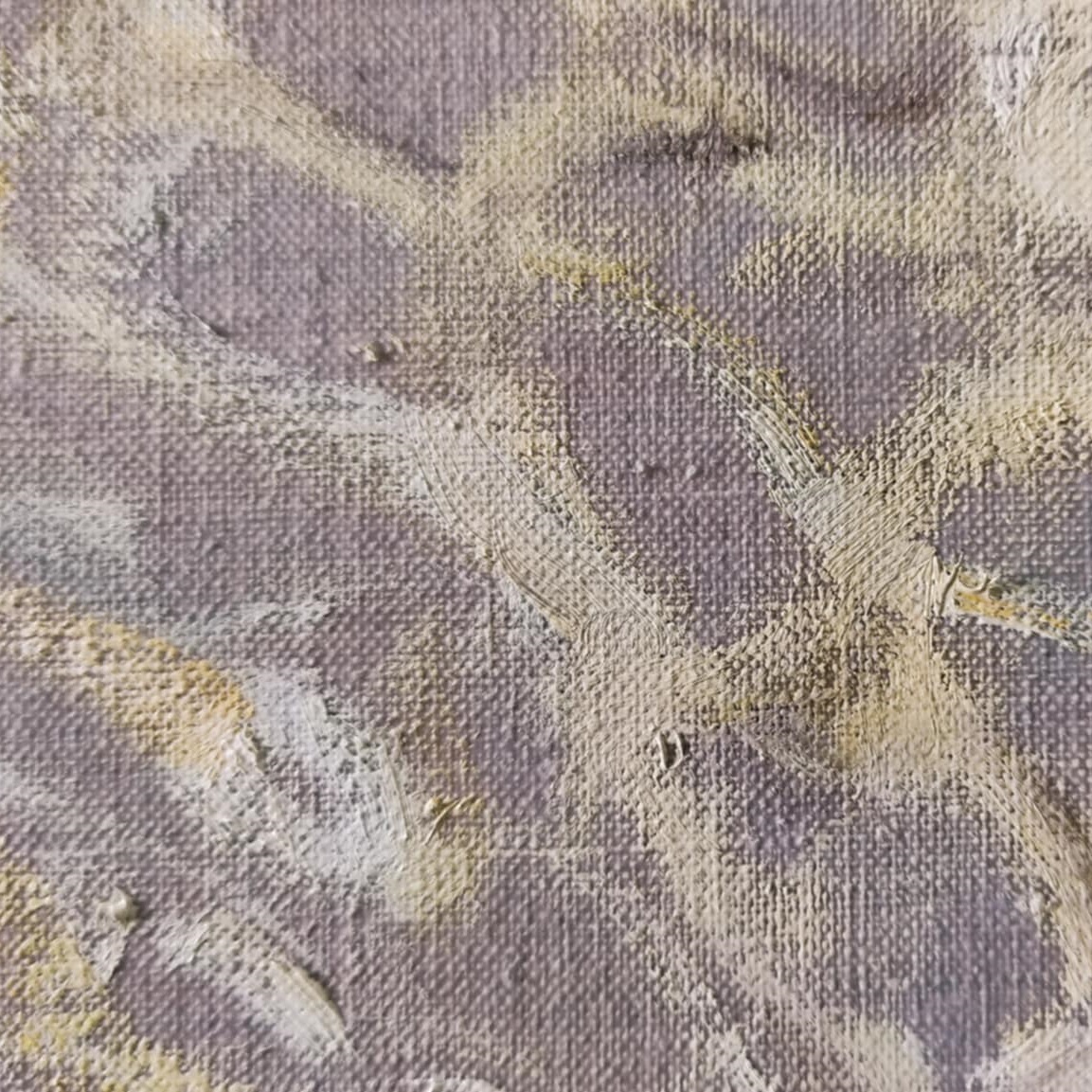
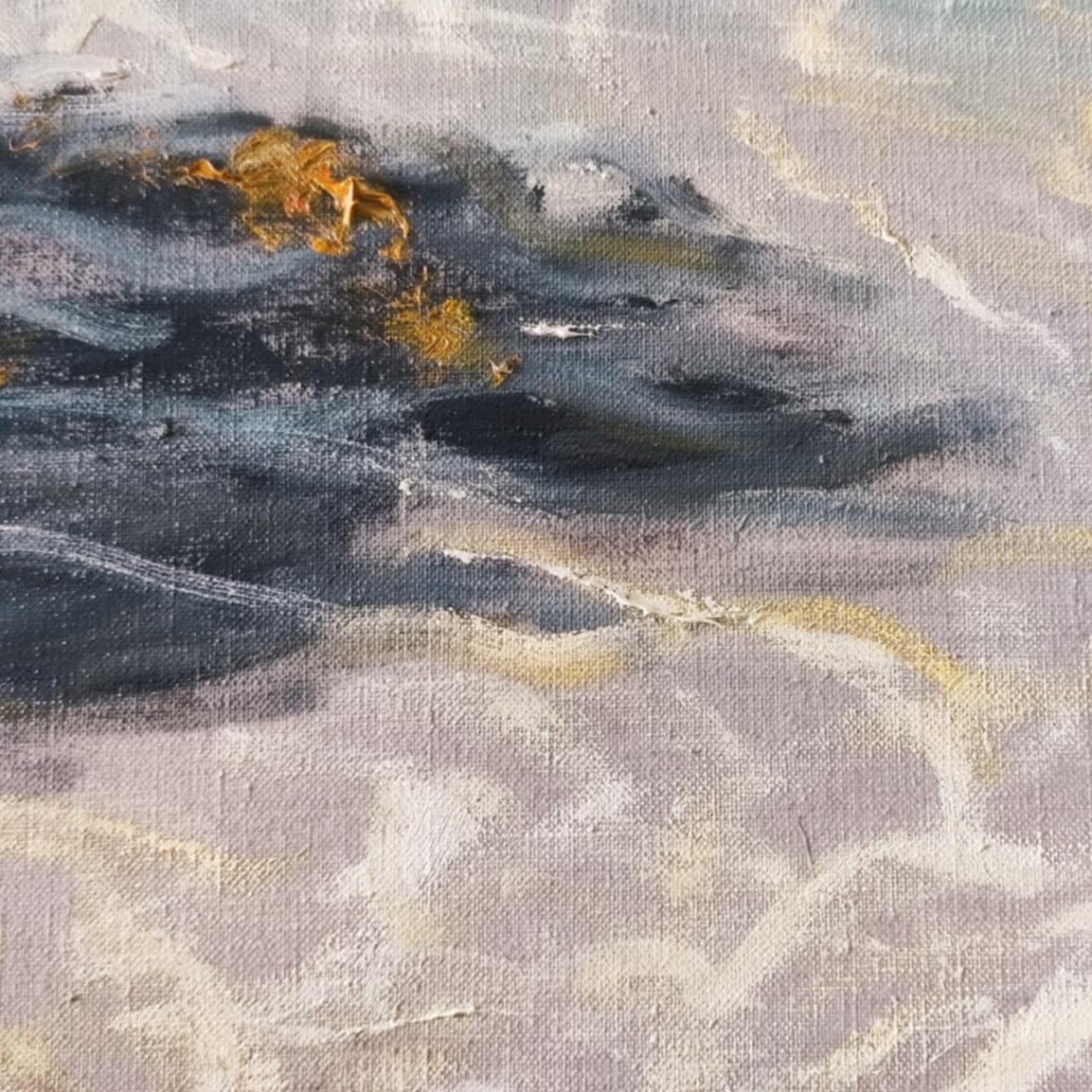
I’ve kept the lovely texture and colour of the linen by using clear gesso. If you look at the close ups of ‘Sea Light, Iona’ and ‘Iona North Beach, May’ below, you can see the unpainted canvas …
Place-names can tell you so much about the history of a place. If you find an old enough map of the Isle of Iona you can see that, tiny though the island is (three by one and a half miles) it has been inhabited by people for thousands of years.
Cnoc an Oran, for example – ‘hill of song’ in Scottish Gaelic, or Sìthean Mòr – ‘hill of the angels’ as it’s translated, though Sìthean also translates as ‘fairies’. Back in about 500AD when an exiled Irish prince, St. Columba (or Collum Cille as he was known) arrived here to set up a religious community, he would have encountered the ancient remains of previous dwellers going back to the iron and bronze ages. Iona has always been a an important spiritual place.
Map of Hy (Iona) 1874
Known as ‘The Dove’ Collum Cille seems to have been anything but! (Maybe this was an early example of sarcasm). He banned women from the island, saying; wherever there are cows there are women and wherever there are women there’s trouble, or words to that effect. He was known as a powerful political negotiator across Scotland. ‘You wouldnae mess wi him’ as Scots might say!
He did set up a Christian settlement though, and one of his followers, named Adomnán, wrote of the miracles conducted by Collum Cille, which included facing down a sea monster (it’s since been speculated that it was in fact Nessie).
I first visited Iona in my early twenties seeking, I suppose, spiritual understanding. I did find it a deeply affecting place, which is why I’ve returned so many times since then. On that first trip, I visited the craggy south end of the island, where the rusting machinery remains of an 18th century marble quarry still exist.
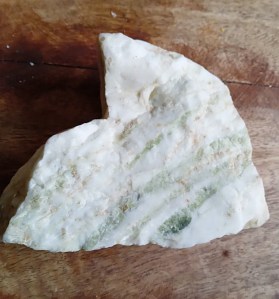
The beautiful lucent white marble is streaked with deep grass-green serpentine and it made the perfect material for the alter that was created for the abbey in the early 1900’s when the abbey was restored. For hundreds of years, children of the island have sold little pebbles of the sea-washed marble to visitors for luck, they still do today.
On my first visit though, I decided to take a slightly larger piece, about 4×5 inches – a large chip from the marble quarry cuttings. It has travelled everywhere with me, you could say it’s been ‘my rock’! Though I think it’s time for me to return it to its home on Iona by way of a ‘thank you’ for everything the island has given me.
It sounds trite or contrived in the usual way of island sayings, when you read that ‘Iona always gives you what you need’, but I’ve found that to be true. There was the sense of spiritual discovery and wonderment in landscape in the first place- an inspiration for me to paint landscape – as well as the more difficult times when I’ve been struggling with life and visited the island to contemplate.
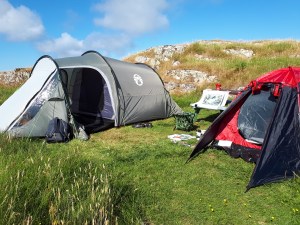
Contemplation sounds peaceful but those visits were turbulent in a variety of ways. For example the time I spent 21 days in a tent by myself, feeling that I needed a break from noise and people. In fact it made me deeply appreciate people since my main companions for those 21 days were spiders, a drove of slugs crawling over my tent, midges, a corncrake whose harsh mating call kept me awake half the night, and a team of baa-ing sheep who decided that my airing sleeping bag was a good place to urinate. (That’s a stench that never washes out, the sleeping bag was indeed a wash-out after that!)
Luckily the campsite owner had a stash of beautiful wool-lined sleeping bags and didn’t bat an eye when I told him of my predicament, lending me one of these for the rest of my stay.
Two tents, one to live in and one for paintings
There was also the time I stayed there in the wintry months, as part of an artist’s residency project. During that fortnight I shared a dwelling space with some very troubled people. Iona attracts pilgrims from across the world who desperately seek healing for emotional or physical wounds. It’s not easy to deal with that sometimes and I found that the atmosphere, combined with a few of the demons of my past, haunted me for months to come.
On the other hand, each day brought blessings: the endless beauty and colours of the landscape, the turbulent energy and colours of the tide changing at twilight, which inspired a series of paintings titled October Tide, then there were fellow creatives who arrived with songs, music and ideas, and new friendships …
Mary McCormick, a grounded and unassuming women in her 70’s from the American mid west, was someone who observed without judgement or drama. She loved to collect small pebbles from her daily walks, pour them into a little dish and invite us to admire them, sharing her photos of the day with residents around the kitchen table. If the conversation veered into turbulent waters, she’d succinctly say her piece with calming compassion and just leave it there, resonating with understated wisdom.
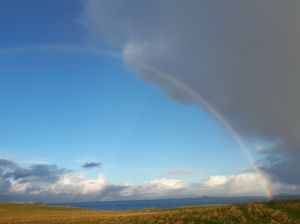
One day we walked to SìtheanMor, ‘The Hill of Angels/Fairies’ and she said that she’d heard in a book that you had to listen here for nature, or God, or for whatever beliefs you had, to give you an important message. I stood for a while, watching a wash of slate grey cloud blowing across a dazzling blue sky – it looked like a painting in progress – and the phrase ‘You are meant to enjoy it’ came to mind.
Mary at the north beach
Rainbows and clouds over the north beach
Afterwards we dropped in to the Columba Hotel and I told Mary about the troubled thoughts that had been stirred up by time spent on the island this time and the company, or demands as I felt, of emotionally troubled people. I’d felt so upset I’d taken to hiding in my room in the evenings, worried that I’d affect others with my mood, that I was ‘losing it’. Mary immediately exclaimed ‘Oh, no Rose! ..’ jumping up from her place next to the log fire and coming over to hug me, ‘You’re the most grounded person here, you’ve been a friend during my time here’. My worries felt washed away. We’ve stayed friends since then of course, though Mary is now back in the US, writing, exploring grasslands of the Midwest and finding opportunities to be involved in her main occupation of landscape gardening.
During the residency I’d been reading the poems of Virgil, and on my return I began to explore Medieval philosophy, which led to a new series of paintings about the planets as understood in Medieval cosmology. It was an incredibly enriching time when I read Planet Narniaby the author Michael Ward, which explores the planetary influence in the works of C.S. Lewis.
Sketch. Iona 2018
Virgil
Sketch. Iona 2018
I found that contemplating the influence of each planet changed me. Working through the ideas connected with Saturn for example – winter, introspection, hard lessons, death … (my dad had died just two years before) during the months of December and January 2018, led to a new understanding of how to live life – you’re meant to enjoy it.
Spring arrived at the same time that I was painting Jupiter, which alligns with the change from winter to spring – winter passed, guilt forgiven as C.S. Lewis writes in his Planets poem on the subject of Jupiter – and with it a new relationship.
Last year my partner Adam presented me with an engagement ring that he’d designed himself, made with a small piece of the Ionian marble (my rock, that I’d found on my first trip to Iona in the early 90s!) After celebrating, we discussed where we’d like to get married, but each idea was fraught with planning troubles – we wanted to get married in the countryside, but how would we bring all our relatives from different parts of Britain to the celebration?
In the end, it made most sense for just the two of us to go away to get married, what’s known these days as ‘an elopement wedding’. It was Adam who suggested the obvious – ‘how about Iona?’ I was struck by the fact that I was surprised (and delighted) by the idea. Back in my twenties I’d thought to myself ‘I’d like to get married here, if I ever get married’. Somehow that dream had been buried in the back of my mind until Adam took the idea out, gave it a dust and – there it was!
And so we’ll be in Iona this May (the green, fertile month of love, art and expression, as understood in Medieval cosmology). Inspiration for my next series of paintings. I’m going to take my Iona rock back to the south end of the island and leave it there as a thank you to Iona.
I hope someone else discovers it, and that it brings them enjoyment … C.S Lewis says it better than I can:
“Meditation in a Toolshed” By C. S. Lewis.
I was standing today in the dark toolshed. The sun was shining outside and through the crack at the top of the door there came a sunbeam. From where I stood that beam of light, with the specks of dust floating in it, was the most striking thing in the place. Everything else was almost pitch-black. I was seeing the beam, not seeing things by it. Then I moved, so that the beam fell on my eyes. Instantly the whole previous picture vanished. I saw no toolshed, and (above all) no beam. Instead I saw, framed in the irregular cranny at the top of the door, green leaves moving on the branches of a tree outside and beyond that, 90 odd million miles away, the sun. Looking along the beam, and looking at the beam are very different experiences.
And from ‘Surprised by Joy’, C.S.Lewis:
In other words, the enjoyment and the contemplation of our inner activities are incompatible. You cannot hope and also think about hoping at the same moment; for in hope we look to hope’s object and we interrupt this by (so to speak) turning round to look at the hope itself. (…) The surest way of spoiling a pleasure was to start examining your satisfaction. But if so, it followed that all introspection is in one respect misleading. In introspection, we try to look ‘inside ourselves’ and see what is going on. But nearly everything that was going on a moment before is stopped by the very act of our turning to look at it. Unfortunately, this does not mean that introspection finds nothing. On the contrary, it finds precisely what is left behind by the suspension of all our normal activities; and what is left behind is mainly mental images and physical sensations. The great error is to mistake this mere sediment for the activities themselves.
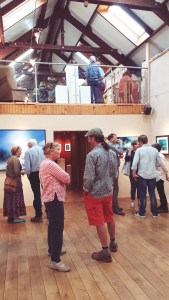
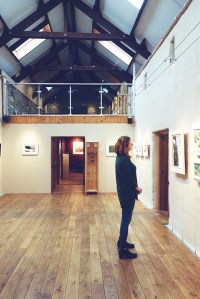
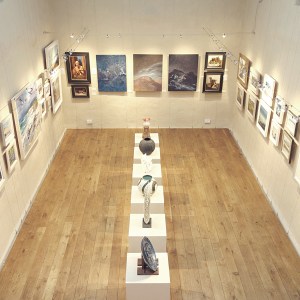
I’m delighted to be exhibiting again with the Resipole Gallery, one of Scotland’s most respected (and most remote!) galleries. I’ve sold many paintings there over the years and they are now showing my latest series, created this summer on the isle of Iona. It’s a delight to show in the same gallery as artists I’ve admired for many years including Anna King, Lottie Glob, and Kate Foster.
Here are the three paintings (below), and this link takes you to my page on the Resipole website where you can view or buy the paintings Resipole Gallery, Rose Strang
Sold. Turquoise Shallows. North End of Iona. Oil on 6×6″ wood. Rose Strang 2021
Sold. Sun and Rain, Cnocoran. Oil on 6×6″ wood. Rose Strang 2021
Sold. Misty Evening. North End of Iona. Oil on 6×6″ wood. Rose Strang 2021
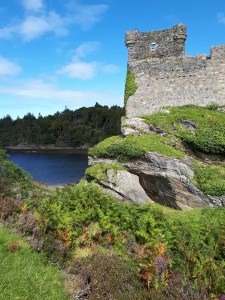
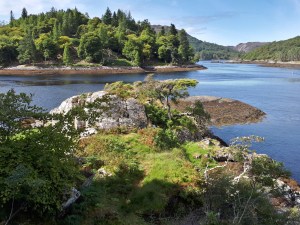
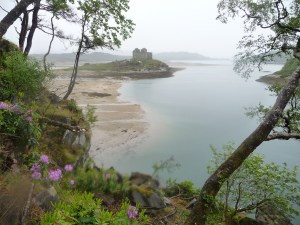
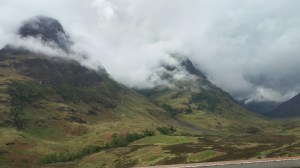
Resipole Studios and Gallery is situated on the Ardnamurchan peninsula on the west coast and I’ve travelled there many times since the early 1990’s, most recently in 2019 when I attended an exhibition opening. The drive to Ardnamurchan is surely one of the most dramatic in Europe! Here are a few of my photos …