Category Archives: Uncategorized

Forest of Fairhill 6

Above: Birch Trees. Fairhill 2. 18th April. Charcoal on A4 paper. Rose Strang 2026

A gaggle of geese greeted us today at Fairhill, one chased after me for a while with its neck extended and tongue out, hissing like a wild cat. The ground was covered in rook-droppings from the Scots Pines above us. The whole energy had picked up and as soon as we walked into the trees I could feel the humidity and scents of late spring rising up from the grass. All of nature waking up.

(I’m taking notes and writing a blog post each time I go to Fairhill, which is a piece of forest land owned and managed by the Life Science Centre, which is informed by Goethean science and philosophy. My trips to Fairhill are my record of a Goethean approach to observation – bringing a deeper awareness and understanding of nature. Sketching is an important part).

The resident hare greeted us at the edge of the birch forest and bounded off, its black ear tips visible every so often. We went back to the same spot. I looked for my tightly coiled fern from last time, but there were so many, after just one week, all popping up their spiral heads in varying states of unfurling.

I sketched a couple of those and the birch forest in pencil first. Then three sketches in charcoal.

It sounds obvious, but I was really aware of the fact that efforts to draw or sketch trees weren’t working, what worked was drawing the patches of light, pattern and shade. This is drawing level 1, but it’s interesting how I forget! I wanted to sketch  birch leaves, but two hours had past, it was 5pm and time to head to Gifford.

To say it was a beautiful day is inadequate. I felt like I’d been dropped into a film about a rural idyll, one that would win awards for amazing cinematogrpahy. but better because of all the scents. Adam recorded the sounds of Fairhill as we came in – crawing rooks, swaying trees, hissing geese. It will make a great soundtrack for an exhibition at some point maybe.

Gifford was a continuation of the being-dropped-in-a-film mood, with 1940s music playing, old crackelure-d paintings and super-polite friendly staff who asked us how our day had been and plied us with afternoon scones.

I meant to write more about Goblin Ha near Gifford. I’ll do that next time.

At the moment I’m building up feature pages about our Traces project. I’m keeping it password protected while we develop the project and organise a private screening of the film and showing of paintings. If you’re interested in learning more, here’s a link to an essay about the ideas behind the Traces project, and here’s an interview with me, about Traces, by art collector and author Robert de Mey.

If these resonate with you, and you’d like get in touch about it, contact me and I’ll send a link to the password protected page. rose.strang@gmail.com


The Medieval Way of Seeing, an essay by Rose Strang

Above: detail from Forest of Luffness 1. Oil on 30×30″ canvas. Rose Strang 2025 (photograph: Adam Brewster)

The following is an essay by Rose Strang, to accompany a project called Traces. More information at the end of the essay.


The Medieval Way of Seeing (by Rose Strang, 2026)

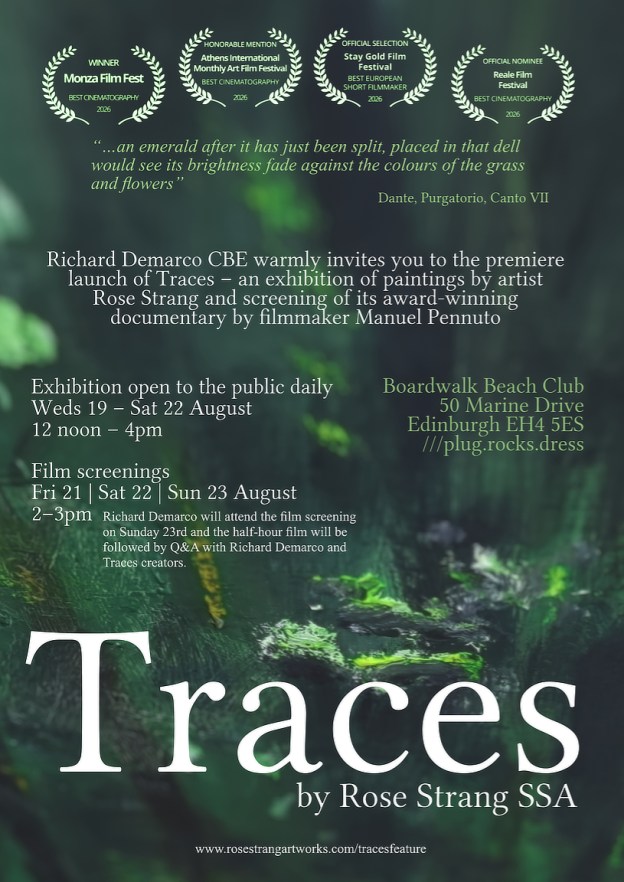
Gold and fine silver, carmine and leaded white, indigo, lignite bright and clear, an emerald after it has just been split, placed in that dell would see their brightness fade against the colours of the grass and flowers.

Dante Alighieri, Purgatorio, Canto VIII

 In some sort of crude sense, which no vulgarity, no humour, no overstatement can quite extinguish, the physicists have known sin; and this is a knowledge which they cannot lose. Robert Oppenheimer (1947 lecture “Physics in the Contemporary World”.)

Why does a ruined friary, or an 800-year-old crusader effigy matter now? What can the medieval way of understanding the cosmos offer our fragmented present?

This was the challenge presented to everyone who took part in a contemplative journey to Luffness in June 2024.

The medieval mind operated with a fundamentally different framework to ours. It integrated layers of reality, perception, and imagination: a thing could be matter and meaning, physical and symbolic, particular and universal. The medieval worldview saw reality as symphonic; a synthesis where all is connected within overall harmony. This is exemplified in medieval cosmological thought and in their application of cosmological symbolism to interpret the material and spiritual worlds.

That the Medieval era also saw acts of terrible violence overshadows this harmonious view of the cosmos. Extensive evidence of brutality has perhaps come to represent the medieval past more than the visions that characterised co-existing peaceable realities, as indeed these forces co-exist today.

Dante described Purgatory’s valley, where emeralds, split open, might fade against the almost unbearably luminous grass. Six centuries later Rutherford, Cockcroft and Walton were credited with splitting the atom. Oppenheimer then developed this into the atom bomb, subsequently observing that ‘knowledge of sin’ cannot be lost. How can we, all of us, navigate threshold states between the desire to know more, to control, and to refrain?

The medieval belief was this: life is best understood not solely through intellect but through the whole spectrum of human response. Science offers facts; the medieval mind accepted facts alongside ‘the cloud of unknowing’. They embraced paradox.

Our rejection of the medieval view of the universe has diminished our capacity to understand ideas as interconnected, layered, or able to exist in parallel.

Contemporary education trains us to see one layer at a time: the scientist sees cells, the economist resources, the tourist scenery. We fragment knowledge into competing specialisations, each claiming exclusive truth, creating a selective amnesia, and an inability to integrate complexity. When science operates on materialist grounds alone, divorced from ethical dimension, we begin to understand what the physicist’s “knowledge of sin” might mean: technologies of destruction, power without wisdom.
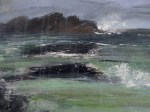
These ideas become material in the ‘threshold trilogy’ of Traces, which embodies this tension. Created following winter visits to the friary at Luffness, it explores the opposing forces of historical violence and spiritual seeking.

In one painting a wraithlike figure emerges from catastrophe , hovering above charred remains. The faint presence of David de Lindsay (the figure commemorated by the stone effigy at Luffness Friary) hovers in liminal blue depths, imagining home while he dies from battle wounds in the Egyptian Crusades of the thirteenth century.
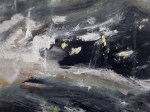
These works explore unpalatable contradictions: crusader as perpetrator and penitent, Christianity used as instrument of conquest, or

aspiration towards grace. When we perceive only one dimension of reality at a time, we no longer navigate paradox or recognise that multiple truths might coexist without contradiction. We lose the integrative thinking that prevents us reducing complexity into simplistic binaries. In an era of intensifying polarisation (political, cultural, epistemological) this loss is profound.

An 800-year-old crusader effigy matters because it embodies the very complexity we’ve lost. The medieval crusades were brutal exercises of power, yet the medieval mind also gave us the ability to synthesise different ways of understanding the world.

When contemporary extremists adopt crusader imagery, they enable fragmented thinking by taking a symbol and flattening it to single meaning, stripping away the complexity that the medieval world embraced. Recovering more complex ways of knowing is essential, if we are to understand the reductionist thinking that feeds fundamentalist beliefs and cynicism.

David de Lindsay‘s motivations towards fighting in the crusades, or founding a friary and seeking redemption, cannot be understood through contemporary either/or thinking. The Forest paintings of Traces document the pilgrimage to this effigy with Richard Demarco, whose lifelong philosophy embodies this medieval integrative approach. In these paintings, figures remain deliberately small within the cathedral-like forest, dwarfed by something larger than themselves.

Traces demonstrates this medieval capacity to perceive multiple dimensions simultaneously. The forest paintings show intergenerational pilgrimage just as Traces, the documentary film, captures Richard Demarco at 93 and the youngest member of the group – baby Atlas (the son of my niece, Emma Mases-Strang and her partner Manuel Pennuto, who created the documentary).
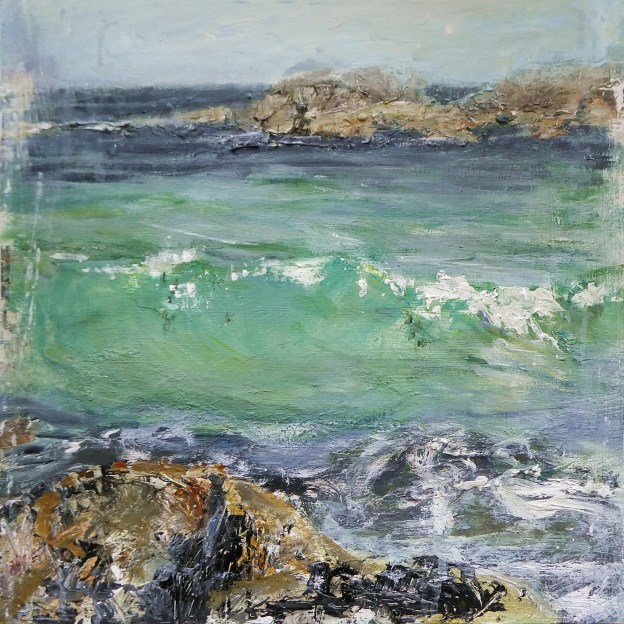
During the day at Luffness, Richard asked the new parents; “Will you tell Atlas about me when I’m gone?” In the documentary Richard and Atlas alone look directly at the camera. Breaking the fourth wall, they seem to ask the viewer a question; what, in the end, passes between us and those who come after?

Time becomes symphonic: the 800-year-old effigy, Demarco’s enduring memory of post-war Europe and the friary’s broken arch, which stands as the project’s central symbol of our fractured present.  Yet, the act of walking there together, witnessing what is past, what exists and what we leave to posterity, enacts a medieval way of seeing and a way to seek deeper truth through shared acts of pilgrimage.

Rose Strang 2026

Quotes

Oppenheimer, J.R., 1947. Physics in the Contemporary World. Available at: https://www.oxfordreference.com/display/10.1093/acref/9780191826719.001.0001/q-oro-ed4-00007996

Dante Alighieri, Purgatorio, Canto VII, quoted in Jason M. Baxter, The Medieval Mind of C. S. Lewis: How Great Books Shaped a Great Mind. InterVarsity Press, 2022), page 50.

Bibliography

Lewis, C. S. The Discarded Image. Cambridge: Cambridge University Press, repr.2013

Ward, Michael. Planet Narnia. The Seven Heavens in the Imagination of C.S. Lewis. Oxford University Press. 2008.

Baxter, Jason M. The Medieval Mind of C. S. Lewis: How Great Books Shaped a Great Mind. InterVarsity Press, 2022.

Traces is a project in development, featuring paintings by Rose Strang and a documentary film by Manuel Pennuto.

A password-protected page contains the film trailer, a lead painting, and full information about the project, including details for curators and venue partners. Access is freely available on request: please write to rose.strang@gmail.com for the password.

Fairhill and Goblin Ha’

Above: Birch Trees. Fairhill. 18th April. Charcoal on A4 paper. Rose Strang 2026

The same hare that greeted us at Fairhill appeared on cue as we arrived, bounding through the birches.

Given that I was there to let nature speak to me, rather than impose my big artist’s ego onto the scene, I decided to follow it! It veered off just before the willow shelter, I looked down and saw a tightly curled fern amidst the swaying slender birches and though ‘this’ll do’.

This is my first litle foray into a Goethean approach to observation. At the first stage – you just draw exactly what you see.  A bit like going back to art college. I enjoyed it though. There’s no harm in slowing down to simply observe.

It struck me how both the fern and the birches grow up in spurts, with each burst of energy marked by a band, or leaf. The fern looked so tightly coiled, almost hairy-looking with its fronds, slightly unsettling. These bands showing growth are most marked in bamboo, which reminded me of Crouching Tiger, Hidden Dragon. The way the bamboos swayed so mysteriously, just like the sun-dappled birches that swayed above my head as I drew. And again there was that strange sensation I had last time, the noise of the trees almost sounding like speech. Maybe there was a birch forest here hundreds of years ago, when it was called Fairy Hill, and this sussuration (which to the human ear, seeking patterns, sounds almost like voices) led to the name of the place.

Adam painted a watercolour, then, our legs stiffened up by kneeling on the damp moss (we’re getting too old for all this kneeling and will bring fold-out stools next time!) we decided to head off in search of Goblin Ha’ in the valley of Yester. As we drove off, the large hare ran alongside to see us off!

We searched for Goblin Ha’ last Sunday in the pouring rain and mud. And when I say mud, I mean that there were serious levels and amounts of it. This weekend the sun was out thankfully, but the mud was still in full force.


I’d been begining to wonder if this ha’ (meaning ‘hall’) was even real. Last week as we returned to the car drenched and puggled, I was speculating on whether it might just be an elaborate hoax by the people who own the Yester estate. Maybe they film us struggling through the mud for entertainment, and the images of the hall I’d see online were ai.

Well …

We found it!

More on Fairhill and its mysterious surrounds in a couple of weeks.

Spring Exhibition

Above: Birch Trees and Willow Shelter 2. Mixed media on 14×14″ wood 2. Rose Strang 2026

Newly framed and ready to go. These three paintings of the Fairhill woodland near Yester Valley, East Lothian will be part of the spring group exhibition at The Limetree Gallery, Bristol, opening Saturday 25th April.

For enquiries please contact Limetree Gallery directly on this link – Contact

All paintings are on 14 by 14 inch wood in lime-washed obeche-wood frames.

#painting #scottishartist #woodland #pleinair #oilpainting #birchtrees #limetreegallery #edinburghartist #forestpainting

Forest of Fairhill 5

Above: Through Trees. Fairhill. Mixed media on 20×30″ wood pane. Rose Strang 2026.

Adam and I visited the forest of Pishwanton/Fairhill this weekend for the first time in a few years. I’ve been there many times over a decade or so.

It was a truly beautiful day, silvery spring light on the birch trees and amidst the trees, buildings made of mostly natural, unchanged materials. The architecture working in harmony with the landscape.

Some details of my painting ..


It does feel special there, and it inspires you to find out who’s behind such a place.

I discovered that Dr Mary Colquhoun was the founder of  Pishwanton and the Life Science Centre back in the 1990s. She studied biology through a Goethean lens, and was a pioneer of Goethean science in the UK.

More recently the Life Science Centre merged with The Ruskin Mill Centre for Research and is now part of the Ruskin Mill Trust group – working with principles grounded in Goethean Science and inspiration from John Ruskin, William Morris and Rudolf Steiner.

Steiner was inspired by Goethe, but is often described as a ‘pseudo-scientist’ (which I always find amusing – surely all the interesting folk are described as pseudoscientists!) I’m an artist – an observer and describer – not qualified to conclude anything scientific. It seems, though, that though Steiner went a little off-piste with Goethe’s original thesis, his ideas are still interesting to explore. His beliefs are part personal faith, and part inspired by Goethean ideas of observation. Contemplating plants, for example, over time.

It was interesting visiting Pishwanton this weekend for the first time in a few years. I’d remembered it as peaceful, but it’s better described as restorative, bringing peace through a sense of harmony, rather than the idea of actual quiet, since one of Scotland’s best known rookeries is there among the Scots Pines at the entrance, raucously guarding the way by announcing our arrival! We saw a large hare bounding off in surprise.

At first, you encounter the more workaday elements of the place as you wander further in, past the Scots Pines. There’s a very Shire-like, turf-covered workshop/ meeting building, vegetable plots, composting and woodwork areas nearby.

All the doors were shut, since it was a Sunday, though they’d kindly left the loos open, and little shelters for cats, or strays. I noticed how fresh and lovely the loos were (organic building material and absence of chemical nasties!)

As you wander over the hill though, you start to sense why this place was originally named Fairy Hill. It’s now called Fairhill (which may or may not be a classic case of Reformation re-naming, since the Reformation viewed anything to do with Pagan, country or folk reverence for nature as the work of the devil!)

Whether the name change was deliberate or simply practical, that attentiveness to the land persists here, or rather has had new life breathed into it by the Life Science Centre. (Fairhil had become a dumping ground before the Life Science Centre took it over).

We humans turn anything into pattern; knots in wood become faces, a piece of toast looks like someone famous. That phenomenon includes sounds – wind in trees can sound like voices. The forest at Fairhill sounds and feels so alive it’s easy to imagine the Goethean idea of Urpflanze – the original, primal form of plants, or their archetype.

Steiner later interpreted this as the spirit of the plant (dryad-like consciousness) but Goethe was careful to avoid the realms of the supernatural because, although he had an artist’s imagination, he also  considered his observations as scientific. It’s true to say, though, that Goethe saw the phenomenon of Urpflanze as unexplainable – a primal force.

It’s a place of ambiguity, a way of thinking that feels comfortable to the creative mind, full of possibility, stimulating to the imagination. It’s also perhaps more honest in a way, since science shows us aspects of how things are made, how our world operates to some extent, but often  it’s the principles or experiences that science can’t explain that are the more meaningful, or important to us, ultimately.

Goethe felt that this unexplainable life-force was only perceivable through long, patient observation. His way of exploring and observing led him to understand that boundaries, between fields of science and art, for example, limited our understanding.

All of which chimes with threads I’ve been following as an artist throughout my life. Explorations which started at art college with studies of Kant, Novalis and German Romanticism, through to more recent explorations of the medieval philosophers’ way of viewing, or contemplating the world.

I’ll explore more of that next week, but in the meantime, if you’re interested in medieval philosophy you can read a piece I wrote as part of the Traces project here.

Forest of Fairhill 4

Above: Wood Cabin. Fairhill. Mixed media on 14×8″ wood. Rose Strang 2026

Today’s painting featuring spring in the foreswt of Pishwanton/Fairhill, following on from the previous three posts. This is a series I’m drawn to paint not just because spring emerging is such a joyful time of year, but also because of the location – Fairhill, in East Lothian.

It’s a piece of land that was formerly used as a tip, which was rescued by the Life Science Centre who decided to experiment with sustainable cultivating approaches isnpired by Steiner principles of observation and connectedness.

When I feel a bit less puggled (it’s been a busy day) I’ll write more, suffice to say for the moment that the principles of observation they describe chime with me, and the way I want to understand the subjects I paint. Not just visually, but in myriad ways. More of that next week.


Forest of Fairhill 3

Above: ‘Birch Forest’. Fairhill. Mixed media on 14×14″ wood. Rose Strang 2026.

Today’s painting of birch trees in the forest of Pishwanton/Fairhill in East Lothian follows on from the last two posts depicting birch forests emerging from winter. I love trees, and it’s so inspiring to learn about this place, which in cared for by the Life Science Centre in Scotland.

I’m delving into the philosophy behind the Life Science Centre, and it really resonates with the way I approach painting, especially the nature of observation.

I have some projects to get on with right now, but I’ll explore more of that in the next blog.

Forest of Fairhill 2

Above: Today’s painting of birch trees in the forest of Pishwanton/Fairhill in East Lothian.

In the previous post I introduced the first painting in this series, explaining the odd name of the forest. The more I find out about this place, the more fascinating it becomes. For example, as well as the nearby ‘witch knowe’ – a witches hill, I discovered that the area now called Pishwanton (after the nearby river) is called Fairhill.

Quite pedestrian-sounding, a bit new-build estate maybe, but in fact it’s a new version of the original ‘Fairy Hill’. It seems the area was originally a place set aside for the ‘good people’, fairies in other words. Then in recent years it was used as a tipping site for rubbish and waste, until the Life Science Trust bought the land and returned it to original health.

I discovered all of this through the Life Science Centre’s website

It makes me want to deepen my understanding of their philosophy, which really feels like an antidote to all the destruction we’re witnessing in the world. I hope to get to know the area more. What began as an instinctive response – to paint the first signs of spring in these young birch forests, is growing into a genuine interest. Who knows where it will take me this year!


Forest of Fairhill

Above. Birch Trees and Willow Shelter. Mixed media on 14×14″ wood. Rose Strang 2026.

This painting is inspired by the birch forests of Pishwanton at Fairhill, which is situated next to a gushing stream and a hill where witches used to gather. In old Scots ‘pish’ means a fast flowing stream and ‘wanton’ means abundant. So there you are, that explains the strange place name!

Pishwanton is owned by the Life Science Trust and everything there is created, grown or built according to Steiner principles about harmony and conservation. Just being there feels more gentle, not in a precious sort of way – just the way that nothing jars, visually or to the nose.

I’ve visited a lot over the years, and now I’m creating a little series of paintings inspired by the arrival of spring in Pishwanton. I feel we could all do with the harmony of Pishwanton just now. Here are a couple of details from the painting ..

Tonight I’m off to see an exhibition in Edinburgh of drawings by Matthew Collings, he did a wonderful series of documentaries in the 1990s about art. He creates paintings with his wife Emma Briggs, and he also draws, very prolifically. I bought one of his sketches a couple of years ago. It’s a self portrait of Matthew Collings drawing a sketch of the artist Frank Auerbach after Auerbach died.  Although Collings says the drawings are instinctive, to me it speaks of mortality. I don’t know if it was intentional, but in the sketch Collings looks semi transparent, as if if disappearing from existence. I find it both moving and uplifting, and I love the colours. I took quite a while choosing the frame with Jamie from Edinburgh’s Detail Framing and I think it looks wonderful floating above the shipwreck n my bookcase, along from a sea triptych I painted a year or so ago.

The subject matter Collings chooses is simply what he experiences each day; memories or current situations and experiences. For the past year of so the best part of his drawings have been about the war on Gaza, tso he work is often harrowing, capturing the brutality visited upon innocent civilians by our world leaders. I’ll post more about the exhibition tomorrow.