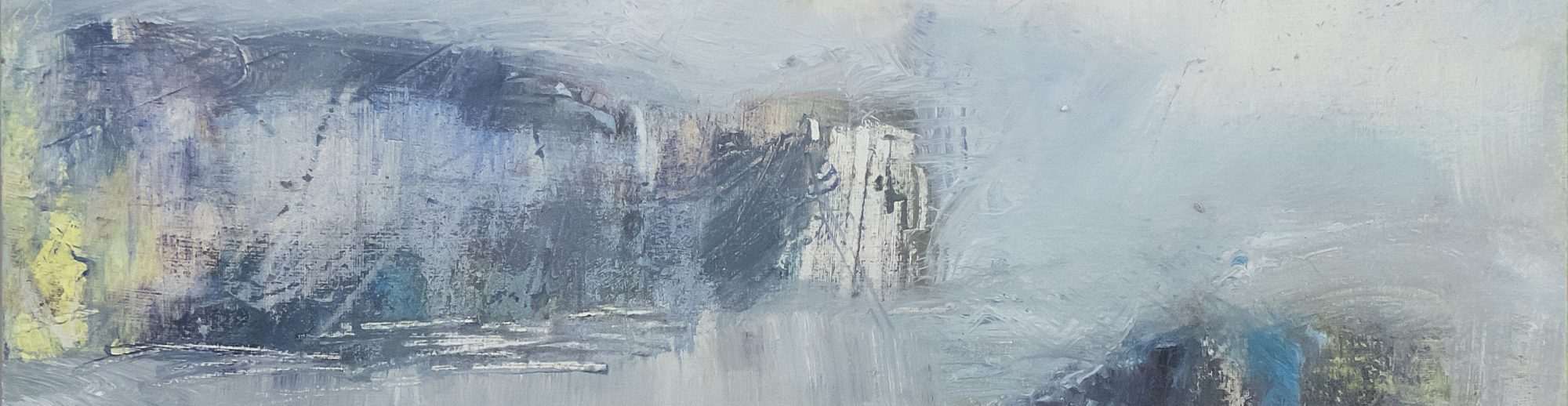
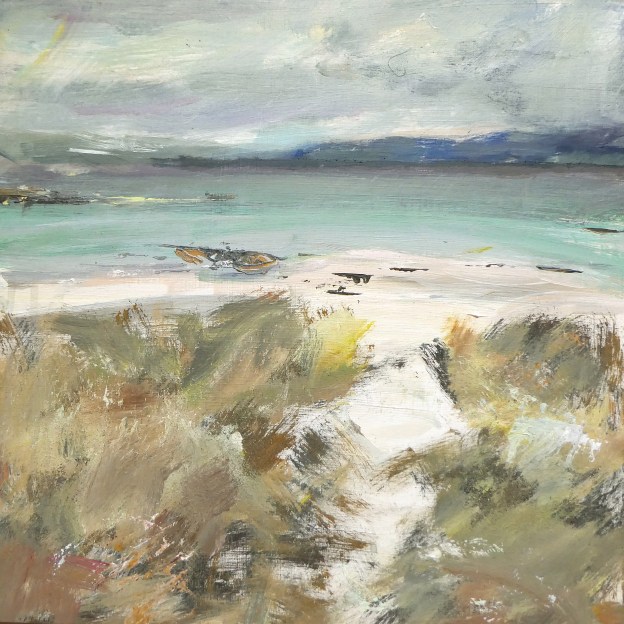
Above: Tràigh Bàn nam Manach (white beach of the monks). Mixed media on 16×16″ wood. Rose Strang 2026
You know this view very well if you’ve walked the beaches of Iona. And what a lovely, poetic name the beach has: Tràigh Bàn nam Manach (pronounced trree baan nam manach). Trill the the ‘r’ like you’re lightly breathing out the word ‘tree’ fast and that gives you that silent but still there ‘gh’ in ‘traigh’). Now read it out with the emphasis in bold above, and you get the poetic rhythm of it.
All the more surprising, then, that this particular beach is named for the monks who died there in one of many Viking massacres that took place around Britain between the 8th to late 10th centuries.
This massacre of fifteen monks and an Abbot took place in AD 986. It’s difficult for us, or the average person at least, to imagine the mindset of either Vikings, or the monks of Iona at that time. 986 seems so long ago to us, and to them too, Calum Cille’s time would have been several centuries ago.
But that mindset endured. Their way of thinking was not so much self-sacrificial. It was more that their vows to protect all that was sacred came before their life itself.They wouldn’t run when attacked.
So if Vikings (whose belief was that fearlessly, skilfully fighting and killing for what you wanted was the pinnacle of human endeavour) decided they liked the look of your land or anything else, they’d just take it. ‘Immovable object meets irresistible force’ you could say.
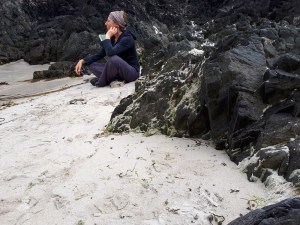
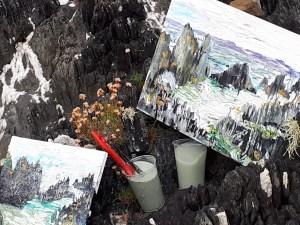
It’s not what you feel, walking along that beach. In fact, back in 2018 I was painting within the very rocks on which the monks were killed, and I didn’t ‘pick up’ on anything dark there at all.
Those monks were reconciled to their death in ways we find humbling and strange today. Like ancient Japanese poets of Haiku, they attended to the here and now, the Zen of everyday life.
Years ago I bought a collection of Irish verse from ancient to modern times and my favourites were those anonymous, very early, Haiku-like monastic verses, take this one for example:
How lovely it is today!
The sunlight breaks and flickers
on the margin of my book
And immediately I’m transported to Iona in the 8th century, where a monk sits at his lectern. Or perhaps outside amongst the marram grass, as he illuminates a manuscript on a lovely day in spring, his hands warmed at last, finding beauty in the way light falls on the margins of his parchment. Feeling gratitude for simple things in the here and now.
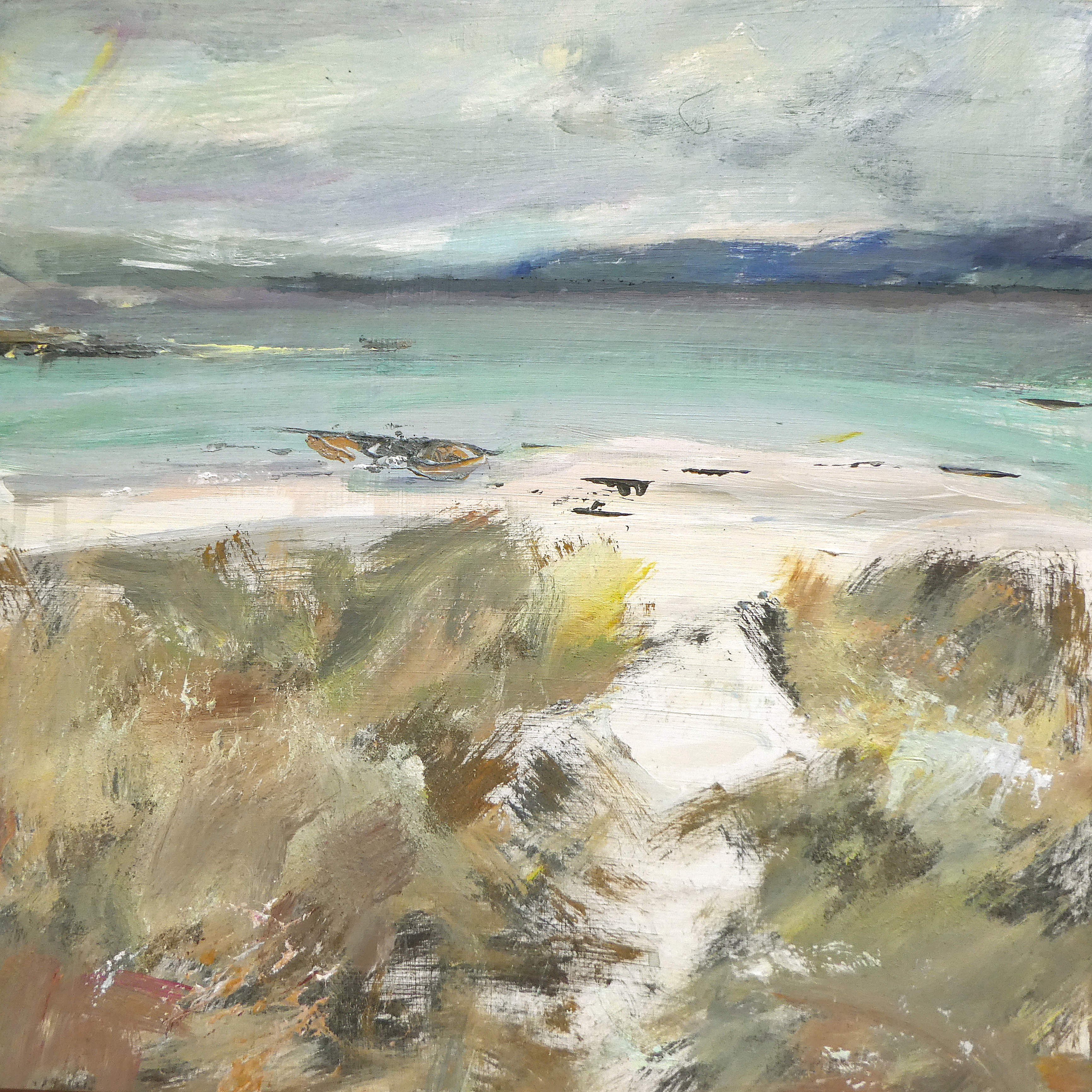
‘Tràigh Bàn nam Manach (white beach of the monks)’. Mixed media on 16×16″ wood. Rose Strang 2026

