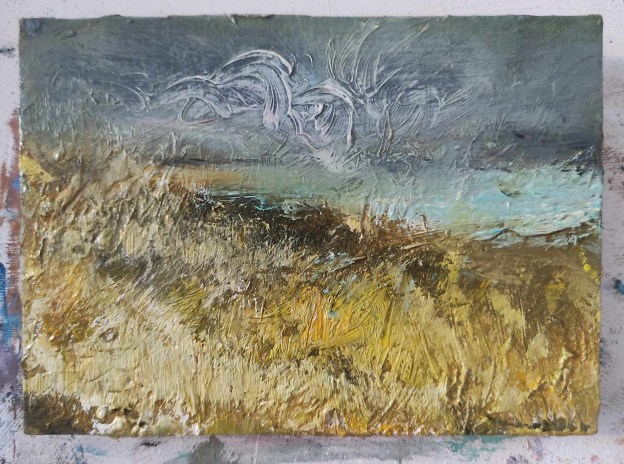
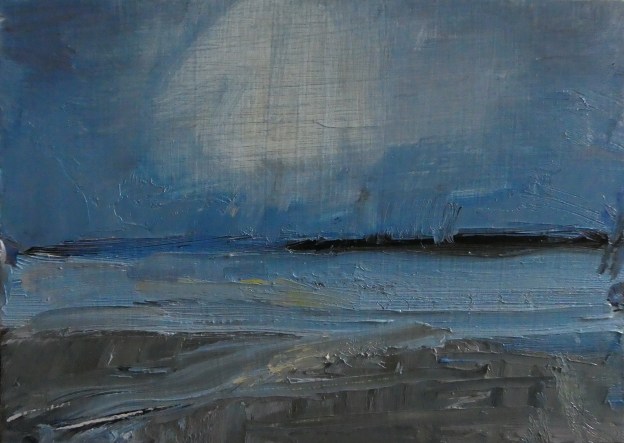
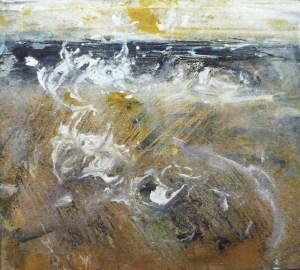
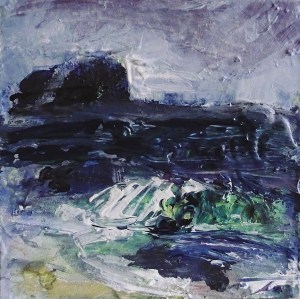
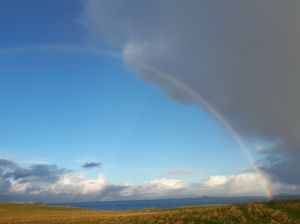
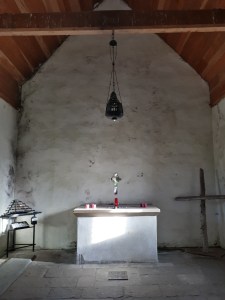
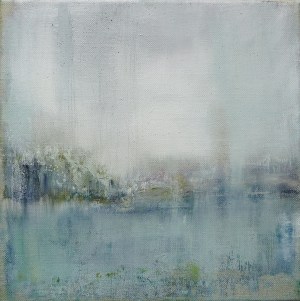
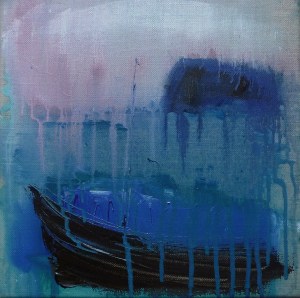
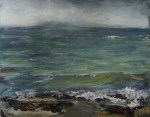
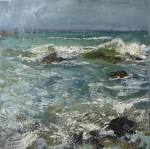
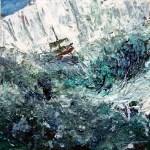
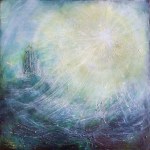
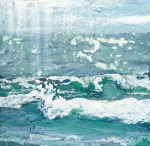
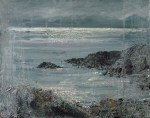
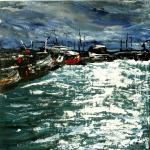
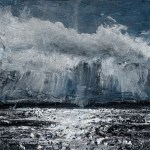
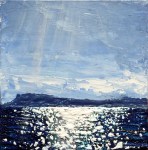
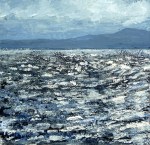
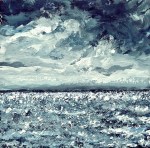
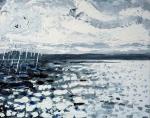
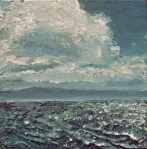
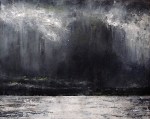
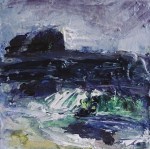
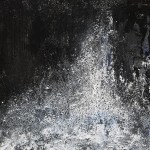
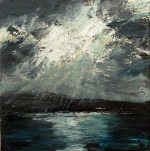
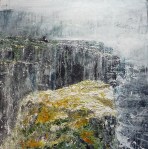
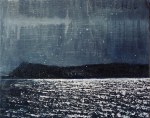
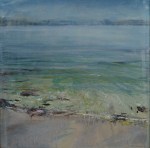
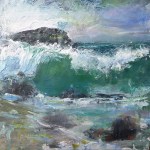
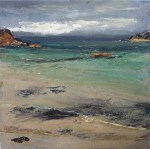
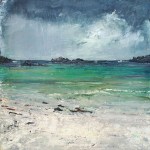
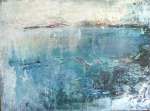
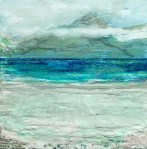
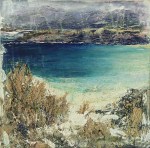
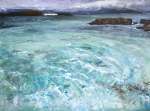
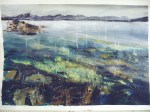
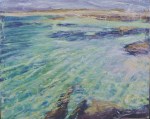
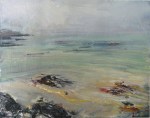
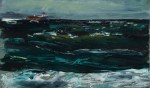
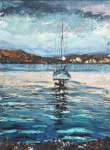
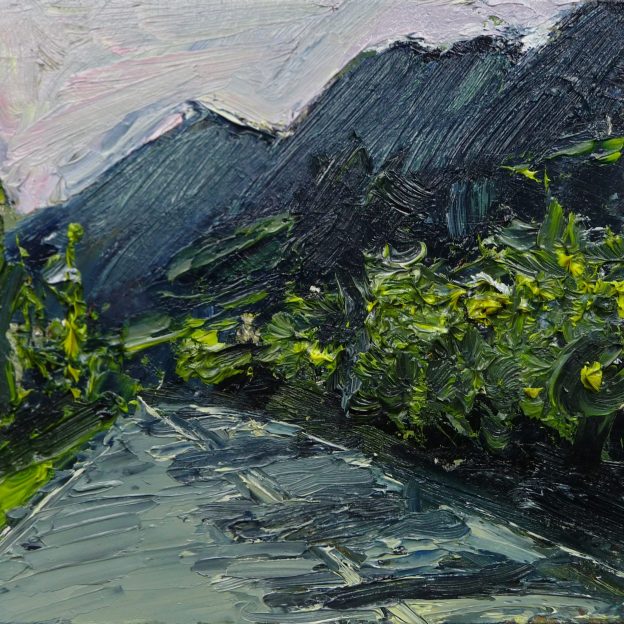
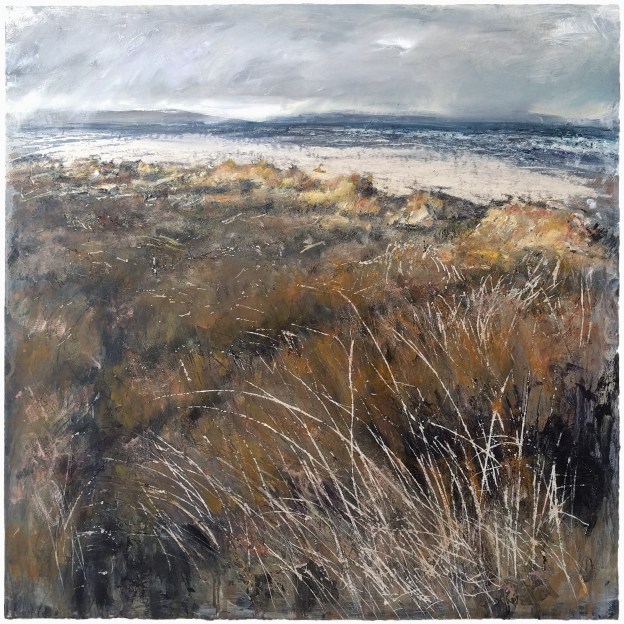
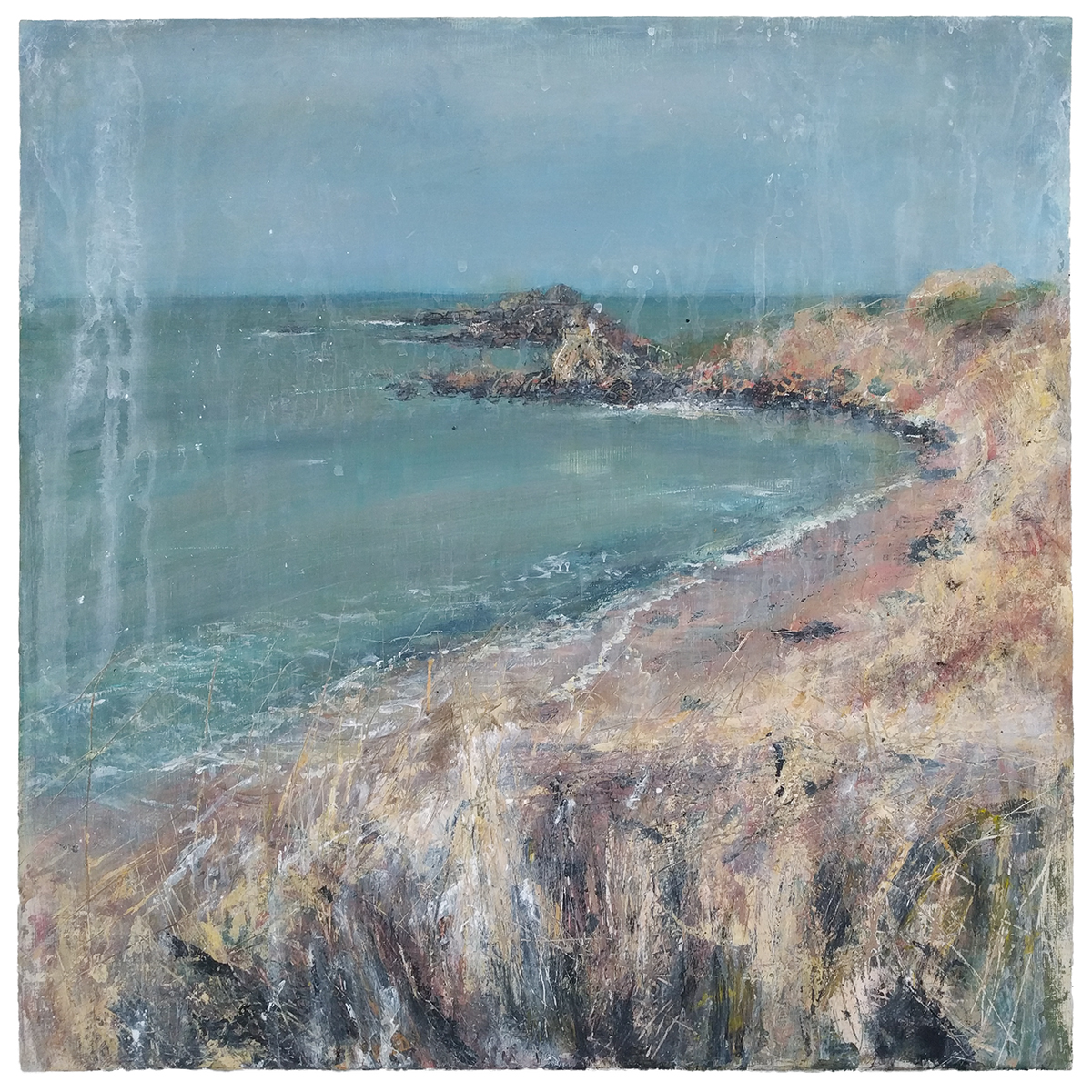
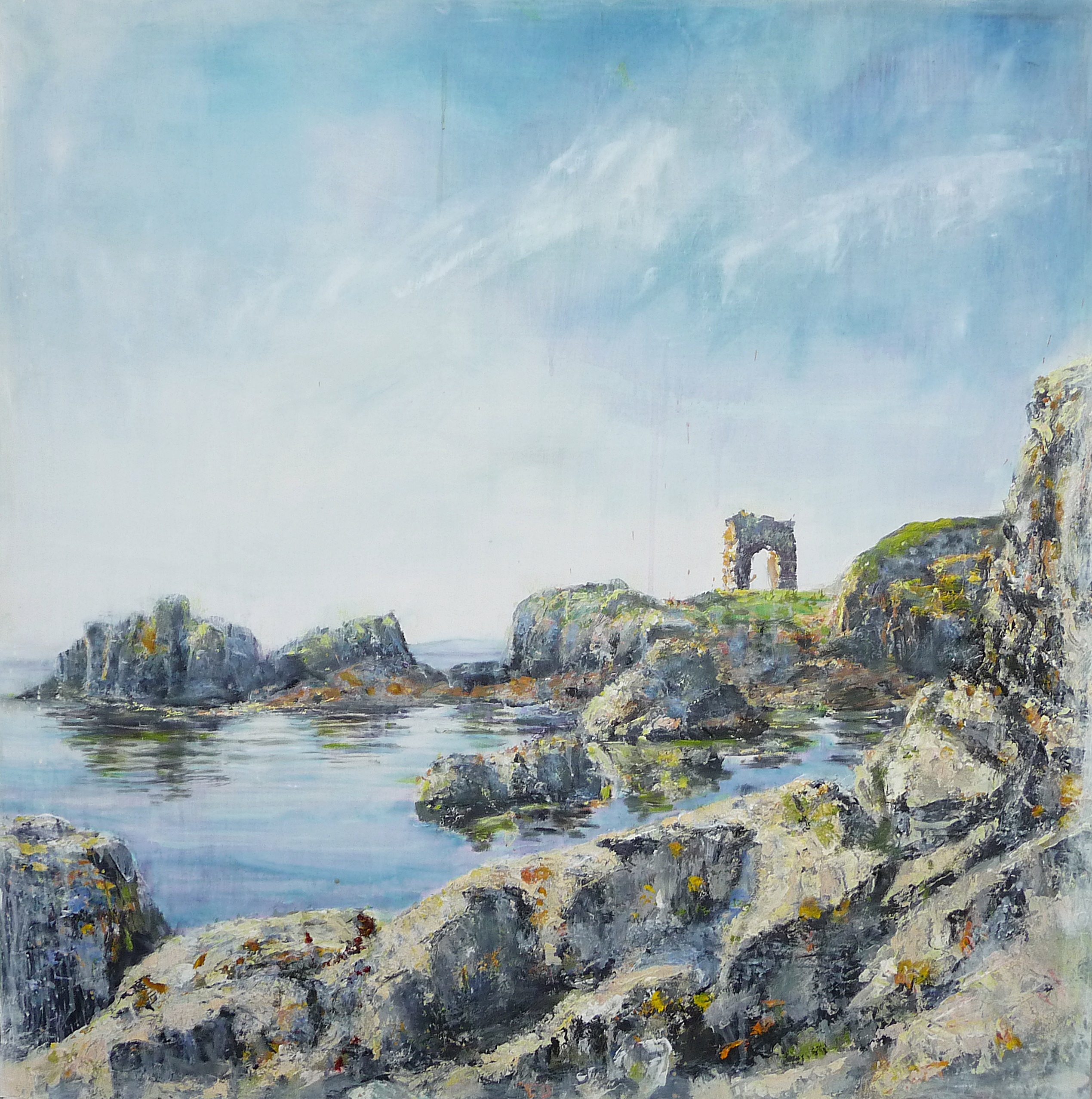
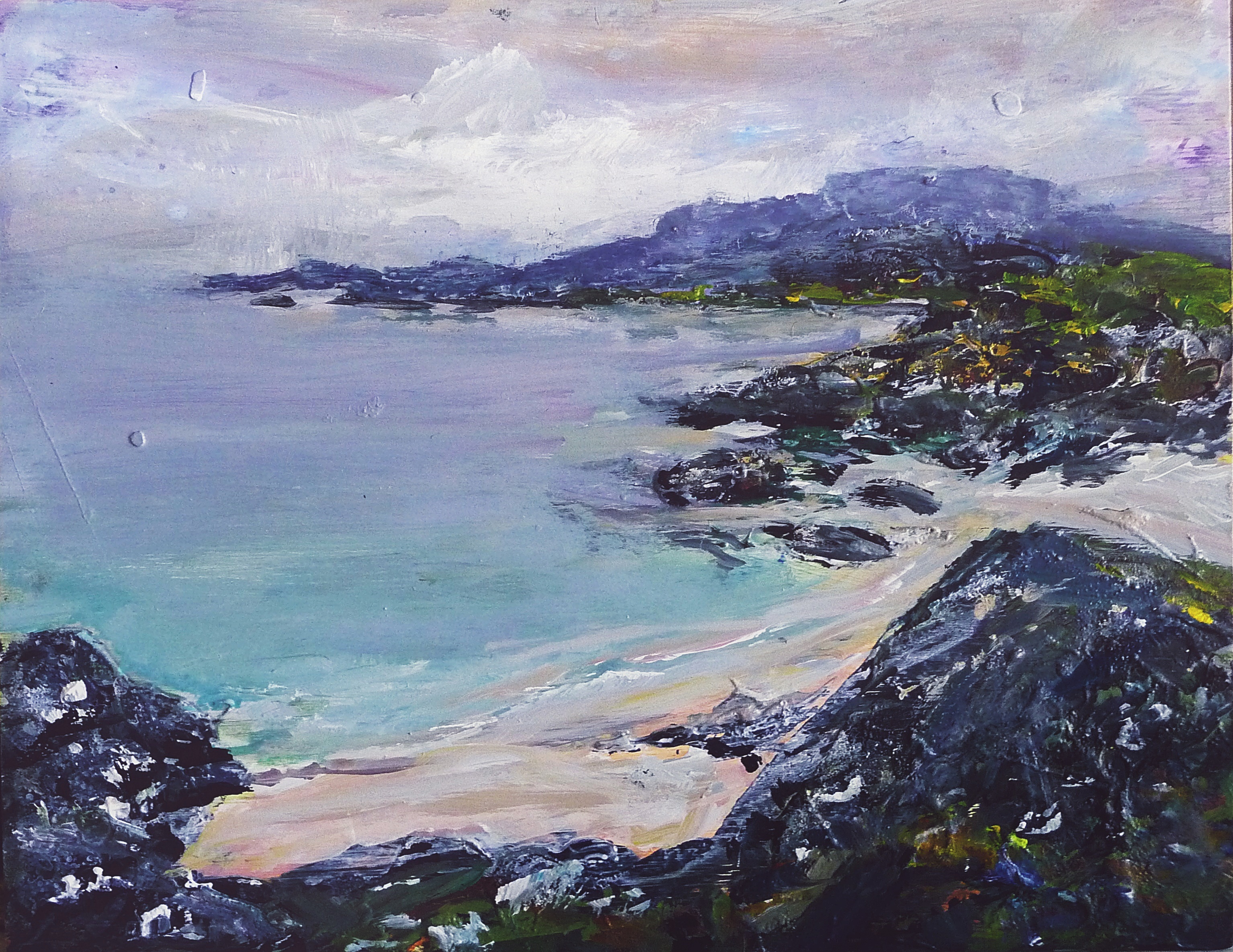
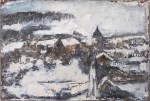
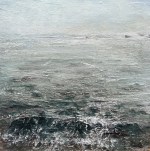
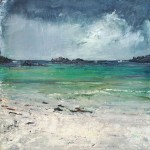
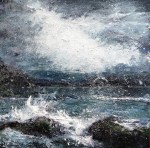
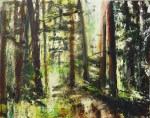
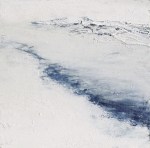
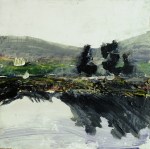
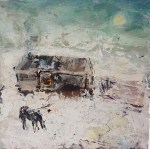
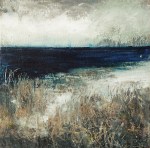
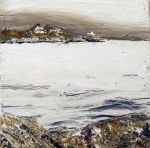
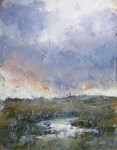
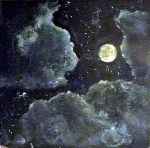
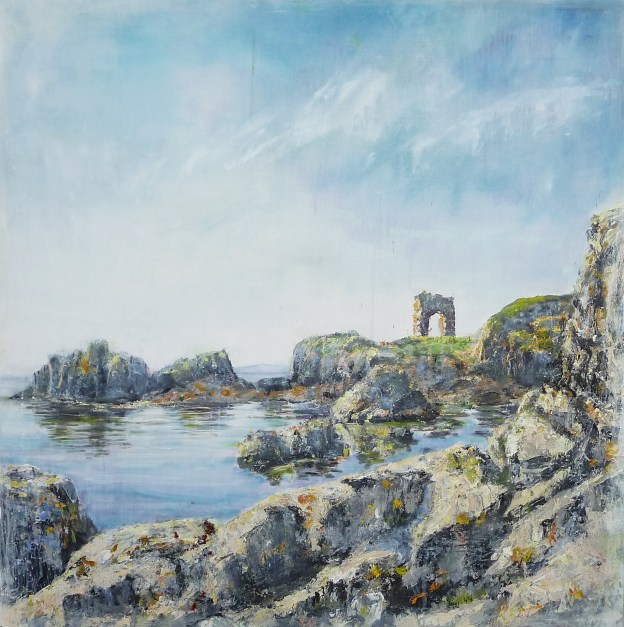
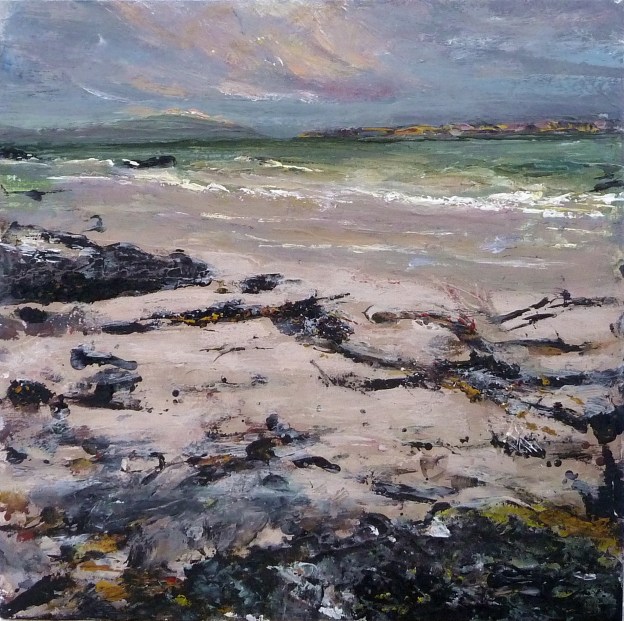
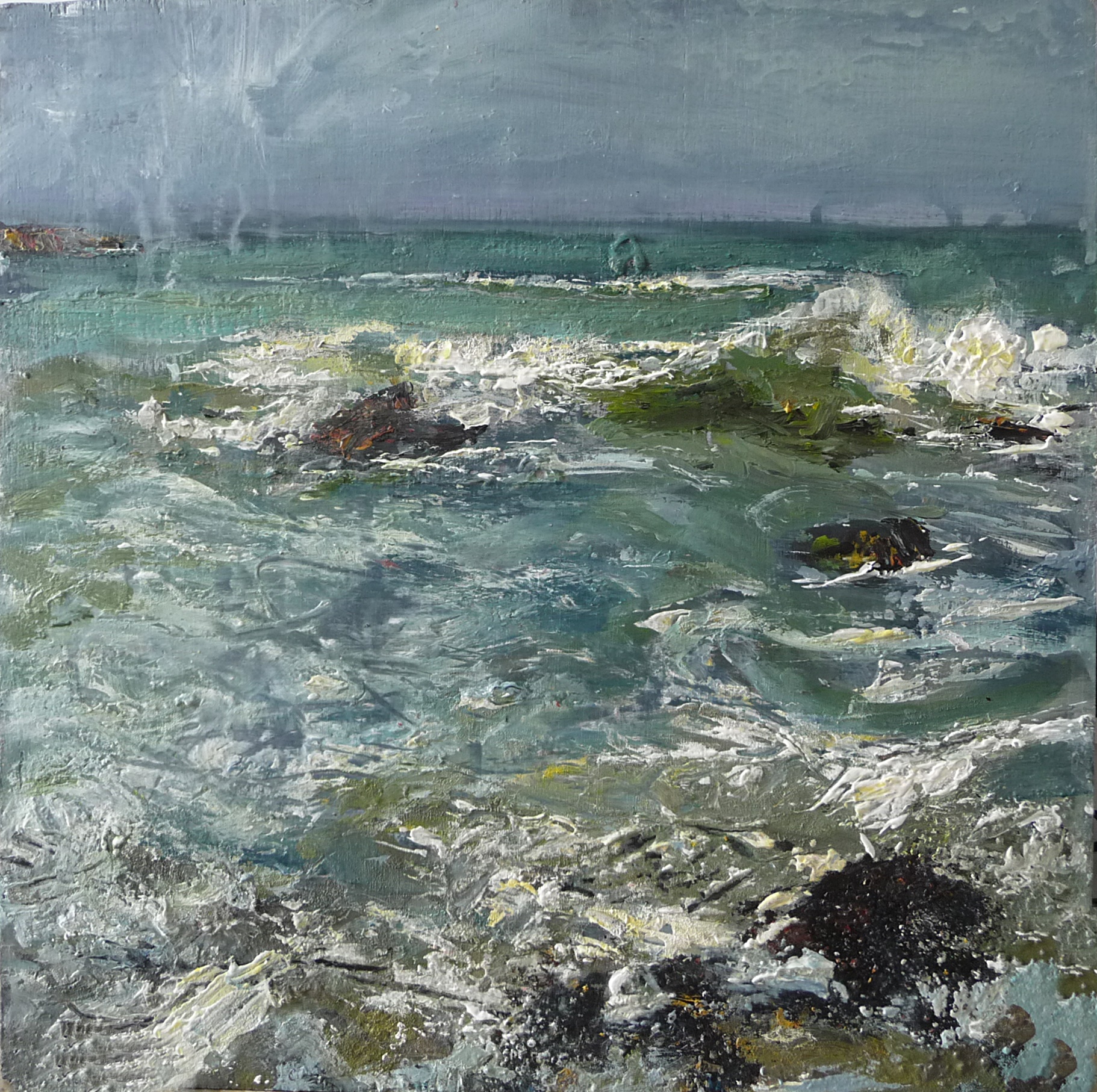
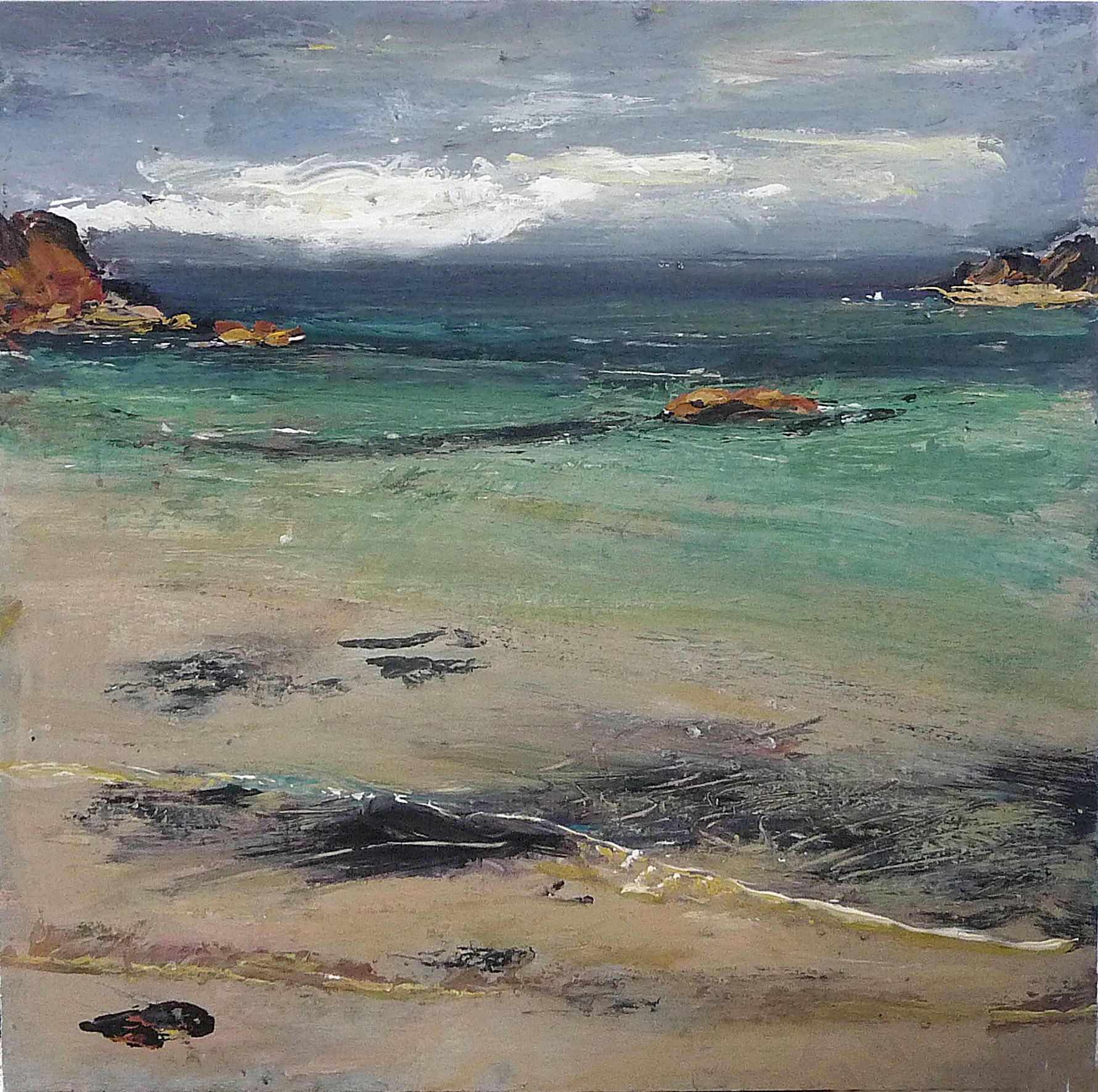
Above: Aberlefdi. Winter I. Oil on 8×5.5″ wood. Rose Strang 2024
These are some oil sketches I’ve been working on as part of a general series this year which explores the history and landscape of Aberlady in the south of Scotland.
Part of the series is a deeper look at the the history of a Carmelite monastery near Aberlady, but the paintings also reflect my love of a landscape that’s deeply familar to me.
I think there’s something dreamlike about Aberlady. It might be the sheer sense of space in sky, sand and sea, but I think it’s also something I find in particular on the east coast of Scotland. Looking out to the north sea towards Norway and Denmark, there’s something haunting about the fact that about 8000 years ago we’d have been looking at Doggerland, before the series of great landslides called the Storegga Slides occurred, creating the north sea. It looks and feels very different to the soft light of the west coast of Scotland.
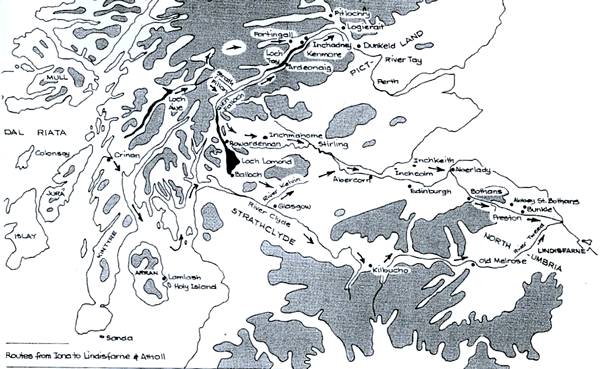
Whenever I look at paths or horizons in this landscape, I also think of journeys, and the fact that not so long ago in the days when Aberlady was called Aberlefdi (hence the title of this series of small landscapes) it was an important stop on the pilgrim route between the Isle of Iona and Lindisfarne, or Holy Isle as it’s also known. That was in around 700AD when one of St Columba’s followers called St Aiden was tasked with setting up a new monastery on Lindisfarne.
When you camp over night near Aberlady you experience all the moods of the seasons; the burnished gold of marram grass and sand in winter, the soft green of the sea and grass in June when the larks and rabbits are at their busiest, or the thunder, lightning and rainstorms on humid late summer nights.
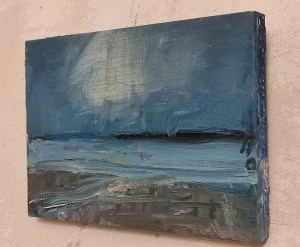
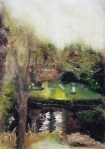
Above Aberlady Sketches 1. Oil on 5×7″ wood. Rose Strang 2024
A start to the year and a new project with this small, twilit painting of Aberlady.
It’s a project a long time in waiting. I was beginning to explore ideas back in early 2020 when the obvious event struck, causing a small panic about income, but then three painting commissions came at me from out of the blue and I’ve been busy ever since it seems.
The Village of Aberlady is not a place you’d describe as mysterious or dramatic, unless you knew it well. The first impression is of a very pretty, conventional village, perfect for the rich retirees. A train used to stop here but the railway was dismantled in the 1970’s. There are one or two shops, a couple of inns and a takeaway.
Aberlady Main Street
So why am I so obsessed with painting a series about my response to this place? Well, I’ll be painting and writing about ‘why’ for the rest of 2024!
The most obvious appeal, beyond the village itself, is of course the nature reserve that stretches across a mile or two of grassland and dunes to an expanse of glittering sand reaching far out to sea at low tide. It’s one of the very few places I’ll swim in Scotland. In August when the sea has become less cold and has flowed back in across the warm sand, bathing here in shallow water is almost bath-like. Plus there’s hardly anyone around since, compared to the amount of people at North Berwick further south along the coast, relatively few will walk the two miles to the sea. There are of course hundreds and thousands of birds, and deer, rabbits galore and any amount of other species I don’t know about.
Aberlady November 2016
Aberlady September 2021
Aberlady, June 2017
Aberlady August 2020
The appeal for most people visiting Aberlady these days is peace in nature. One thing that fascinates me though is the way places change in importance over several hundred years, depending on their function. Think of St Andrews in Fife, it was the ecclesiastical centre of Scotland hunreds of years ago. Now it’s known as the home of Scotland’s oldest university, and for its golf course. (also made more famous by the royal romance I suppose. I was attending post graduate art studies there at the same time as Will and Kate but never bumped into them, not quite moving in the same circles!) Or think of York, known now for its olde worlde timber-framed buildings and awe-inspiring York Minster – when in the past it was the centre of power in England.
Going farther back in time, Aberlady was a place that had to defend itself from violent attack, and going even further back to the 7th century it was the last stop for pilgrims on their way from Iona to Lindisfarne.
Beneath its pleasant exterior I find Aberlady to be a place of deep mystery and drama. It’s something you can’t see, but rather it’s something you feel after years of immersing yourself in its landscape and history.
Hence why I’ll be working towards a series of paintings this year to explore my fascination with Aberlefdi, as it was originally named – a mixture of Pictish aber meaning river mouth and Lef, the name of a Viking warrior whose remains are interred beneath Luffness House in Aberlady Bay. That’s just one little detail in the whole story though.
More to follow in the coming weeks as the light improves and I can really get into painting this series …
Place-names can tell you so much about the history of a place. If you find an old enough map of the Isle of Iona you can see that, tiny though the island is (three by one and a half miles) it has been inhabited by people for thousands of years.
Cnoc an Oran, for example – ‘hill of song’ in Scottish Gaelic, or Sìthean Mòr – ‘hill of the angels’ as it’s translated, though Sìthean also translates as ‘fairies’. Back in about 500AD when an exiled Irish prince, St. Columba (or Collum Cille as he was known) arrived here to set up a religious community, he would have encountered the ancient remains of previous dwellers going back to the iron and bronze ages. Iona has always been a an important spiritual place.
Map of Hy (Iona) 1874
Known as ‘The Dove’ Collum Cille seems to have been anything but! (Maybe this was an early example of sarcasm). He banned women from the island, saying; wherever there are cows there are women and wherever there are women there’s trouble, or words to that effect. He was known as a powerful political negotiator across Scotland. ‘You wouldnae mess wi him’ as Scots might say!
He did set up a Christian settlement though, and one of his followers, named Adomnán, wrote of the miracles conducted by Collum Cille, which included facing down a sea monster (it’s since been speculated that it was in fact Nessie).
I first visited Iona in my early twenties seeking, I suppose, spiritual understanding. I did find it a deeply affecting place, which is why I’ve returned so many times since then. On that first trip, I visited the craggy south end of the island, where the rusting machinery remains of an 18th century marble quarry still exist.
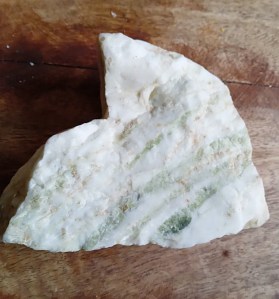
The beautiful lucent white marble is streaked with deep grass-green serpentine and it made the perfect material for the alter that was created for the abbey in the early 1900’s when the abbey was restored. For hundreds of years, children of the island have sold little pebbles of the sea-washed marble to visitors for luck, they still do today.
On my first visit though, I decided to take a slightly larger piece, about 4×5 inches – a large chip from the marble quarry cuttings. It has travelled everywhere with me, you could say it’s been ‘my rock’! Though I think it’s time for me to return it to its home on Iona by way of a ‘thank you’ for everything the island has given me.
It sounds trite or contrived in the usual way of island sayings, when you read that ‘Iona always gives you what you need’, but I’ve found that to be true. There was the sense of spiritual discovery and wonderment in landscape in the first place- an inspiration for me to paint landscape – as well as the more difficult times when I’ve been struggling with life and visited the island to contemplate.
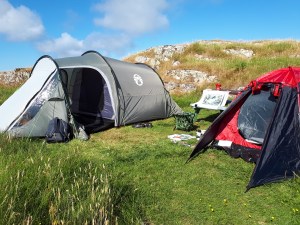
Contemplation sounds peaceful but those visits were turbulent in a variety of ways. For example the time I spent 21 days in a tent by myself, feeling that I needed a break from noise and people. In fact it made me deeply appreciate people since my main companions for those 21 days were spiders, a drove of slugs crawling over my tent, midges, a corncrake whose harsh mating call kept me awake half the night, and a team of baa-ing sheep who decided that my airing sleeping bag was a good place to urinate. (That’s a stench that never washes out, the sleeping bag was indeed a wash-out after that!)
Luckily the campsite owner had a stash of beautiful wool-lined sleeping bags and didn’t bat an eye when I told him of my predicament, lending me one of these for the rest of my stay.
Two tents, one to live in and one for paintings
There was also the time I stayed there in the wintry months, as part of an artist’s residency project. During that fortnight I shared a dwelling space with some very troubled people. Iona attracts pilgrims from across the world who desperately seek healing for emotional or physical wounds. It’s not easy to deal with that sometimes and I found that the atmosphere, combined with a few of the demons of my past, haunted me for months to come.
On the other hand, each day brought blessings: the endless beauty and colours of the landscape, the turbulent energy and colours of the tide changing at twilight, which inspired a series of paintings titled October Tide, then there were fellow creatives who arrived with songs, music and ideas, and new friendships …
Mary McCormick, a grounded and unassuming women in her 70’s from the American mid west, was someone who observed without judgement or drama. She loved to collect small pebbles from her daily walks, pour them into a little dish and invite us to admire them, sharing her photos of the day with residents around the kitchen table. If the conversation veered into turbulent waters, she’d succinctly say her piece with calming compassion and just leave it there, resonating with understated wisdom.
One day we walked to SìtheanMor, ‘The Hill of Angels/Fairies’ and she said that she’d heard in a book that you had to listen here for nature, or God, or for whatever beliefs you had, to give you an important message. I stood for a while, watching a wash of slate grey cloud blowing across a dazzling blue sky – it looked like a painting in progress – and the phrase ‘You are meant to enjoy it’ came to mind.
Mary at the north beach
Rainbows and clouds over the north beach
Afterwards we dropped in to the Columba Hotel and I told Mary about the troubled thoughts that had been stirred up by time spent on the island this time and the company, or demands as I felt, of emotionally troubled people. I’d felt so upset I’d taken to hiding in my room in the evenings, worried that I’d affect others with my mood, that I was ‘losing it’. Mary immediately exclaimed ‘Oh, no Rose! ..’ jumping up from her place next to the log fire and coming over to hug me, ‘You’re the most grounded person here, you’ve been a friend during my time here’. My worries felt washed away. We’ve stayed friends since then of course, though Mary is now back in the US, writing, exploring grasslands of the Midwest and finding opportunities to be involved in her main occupation of landscape gardening.
During the residency I’d been reading the poems of Virgil, and on my return I began to explore Medieval philosophy, which led to a new series of paintings about the planets as understood in Medieval cosmology. It was an incredibly enriching time when I read Planet Narniaby the author Michael Ward, which explores the planetary influence in the works of C.S. Lewis.
Sketch. Iona 2018
Virgil
Sketch. Iona 2018
I found that contemplating the influence of each planet changed me. Working through the ideas connected with Saturn for example – winter, introspection, hard lessons, death … (my dad had died just two years before) during the months of December and January 2018, led to a new understanding of how to live life – you’re meant to enjoy it.
Spring arrived at the same time that I was painting Jupiter, which alligns with the change from winter to spring – winter passed, guilt forgiven as C.S. Lewis writes in his Planets poem on the subject of Jupiter – and with it a new relationship.
Last year my partner Adam presented me with an engagement ring that he’d designed himself, made with a small piece of the Ionian marble (my rock, that I’d found on my first trip to Iona in the early 90s!) After celebrating, we discussed where we’d like to get married, but each idea was fraught with planning troubles – we wanted to get married in the countryside, but how would we bring all our relatives from different parts of Britain to the celebration?
In the end, it made most sense for just the two of us to go away to get married, what’s known these days as ‘an elopement wedding’. It was Adam who suggested the obvious – ‘how about Iona?’ I was struck by the fact that I was surprised (and delighted) by the idea. Back in my twenties I’d thought to myself ‘I’d like to get married here, if I ever get married’. Somehow that dream had been buried in the back of my mind until Adam took the idea out, gave it a dust and – there it was!
And so we’ll be in Iona this May (the green, fertile month of love, art and expression, as understood in Medieval cosmology). Inspiration for my next series of paintings. I’m going to take my Iona rock back to the south end of the island and leave it there as a thank you to Iona.
I hope someone else discovers it, and that it brings them enjoyment … C.S Lewis says it better than I can:
“Meditation in a Toolshed” By C. S. Lewis.
I was standing today in the dark toolshed. The sun was shining outside and through the crack at the top of the door there came a sunbeam. From where I stood that beam of light, with the specks of dust floating in it, was the most striking thing in the place. Everything else was almost pitch-black. I was seeing the beam, not seeing things by it. Then I moved, so that the beam fell on my eyes. Instantly the whole previous picture vanished. I saw no toolshed, and (above all) no beam. Instead I saw, framed in the irregular cranny at the top of the door, green leaves moving on the branches of a tree outside and beyond that, 90 odd million miles away, the sun. Looking along the beam, and looking at the beam are very different experiences.
And from ‘Surprised by Joy’, C.S.Lewis:
In other words, the enjoyment and the contemplation of our inner activities are incompatible. You cannot hope and also think about hoping at the same moment; for in hope we look to hope’s object and we interrupt this by (so to speak) turning round to look at the hope itself. (…) The surest way of spoiling a pleasure was to start examining your satisfaction. But if so, it followed that all introspection is in one respect misleading. In introspection, we try to look ‘inside ourselves’ and see what is going on. But nearly everything that was going on a moment before is stopped by the very act of our turning to look at it. Unfortunately, this does not mean that introspection finds nothing. On the contrary, it finds precisely what is left behind by the suspension of all our normal activities; and what is left behind is mainly mental images and physical sensations. The great error is to mistake this mere sediment for the activities themselves.
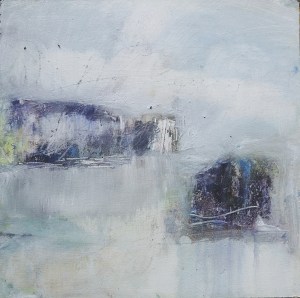
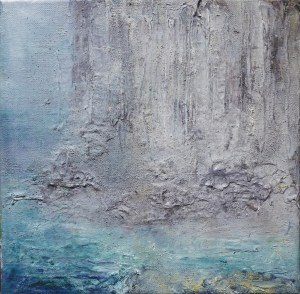
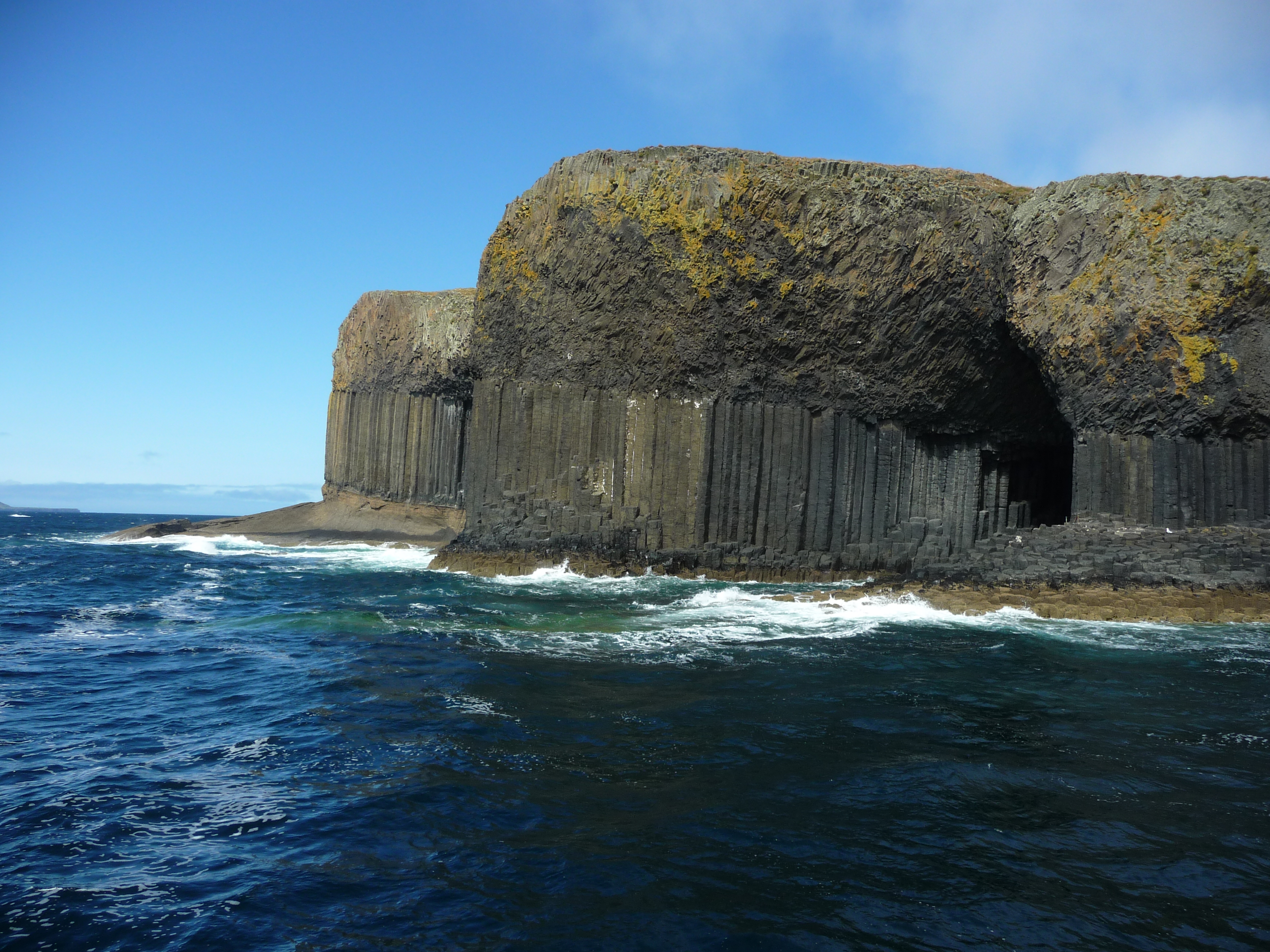
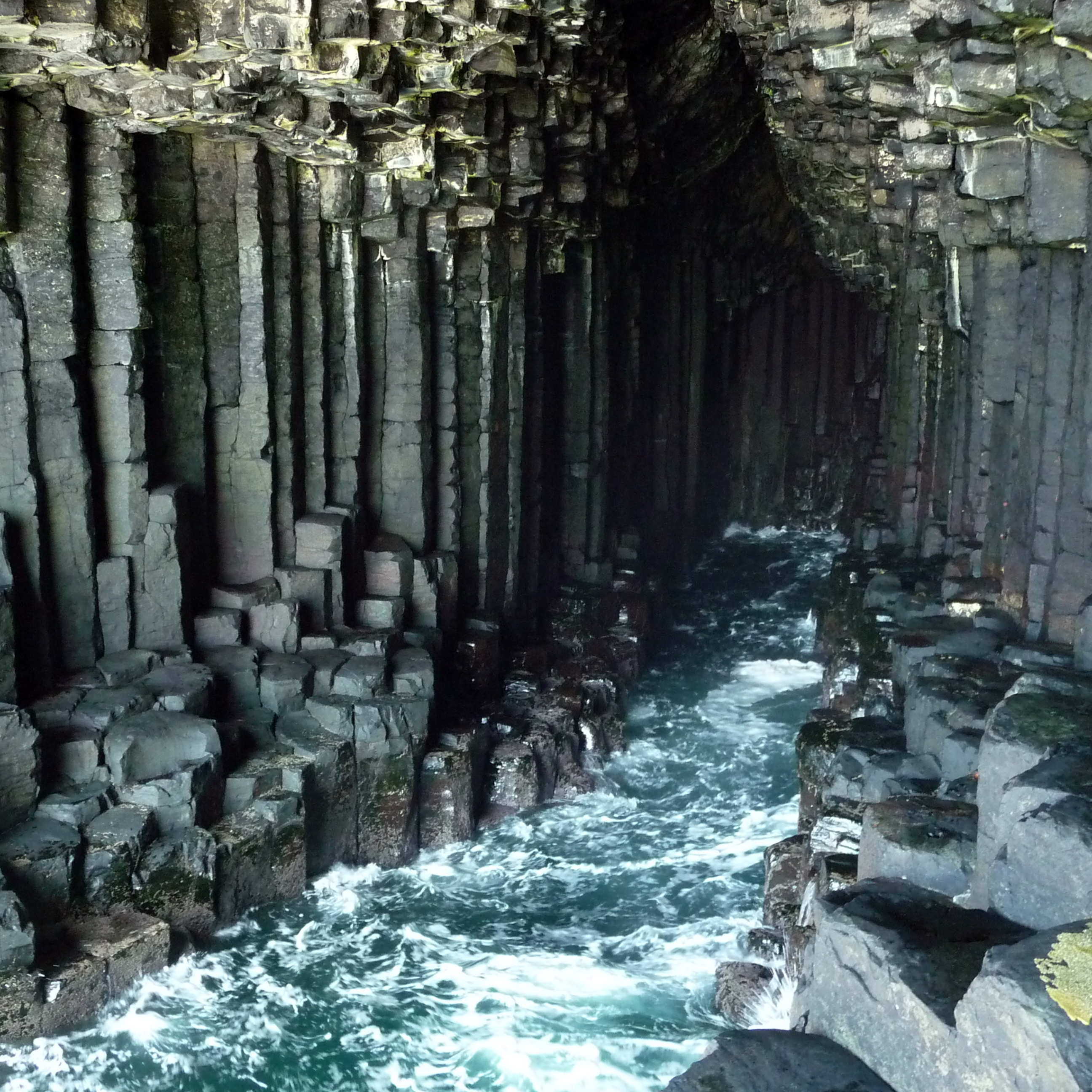
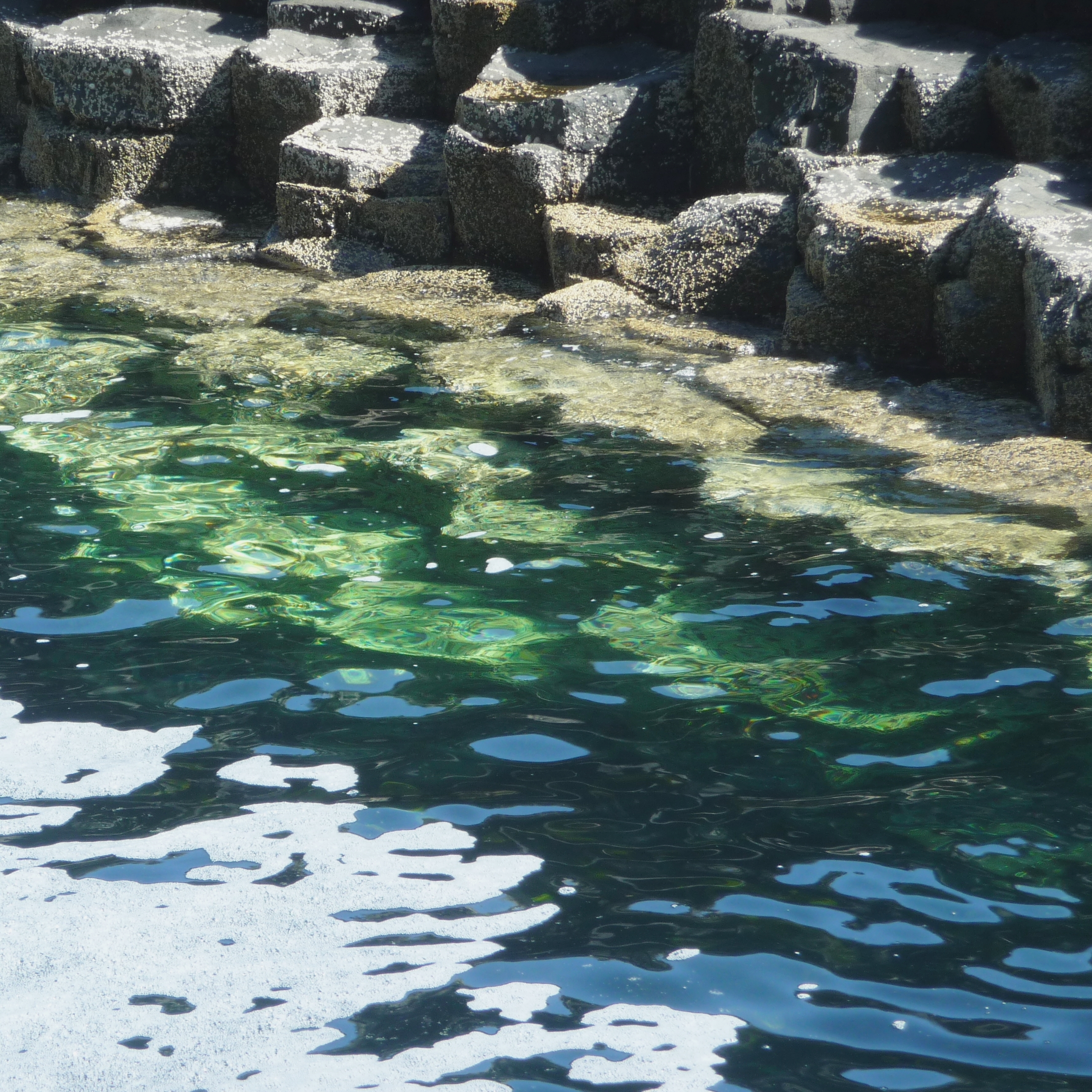
This series is inspired by a trip to the islands of Iona and Staffa last year. Although I’ve been visiting Iona since about 1991, I’d never been to Staffa – surely one of the wonders of the world with its astonishing hexagonal basaltic columns and sea caves surging with green water.
Iona to Staffa 1. Oil on 12 x 12 inch linen. Rose Strang 2022
Iona to Staffa 2. Oil on 12 x 12 inch linen. Rose Strang 2022
Iona to Staffa 3. Oil on 12 x 12 inch wood Rose Strang 2022
Iona to Staffa 4. Oil on 12 x 12 inch linen. Rose Strang 2022
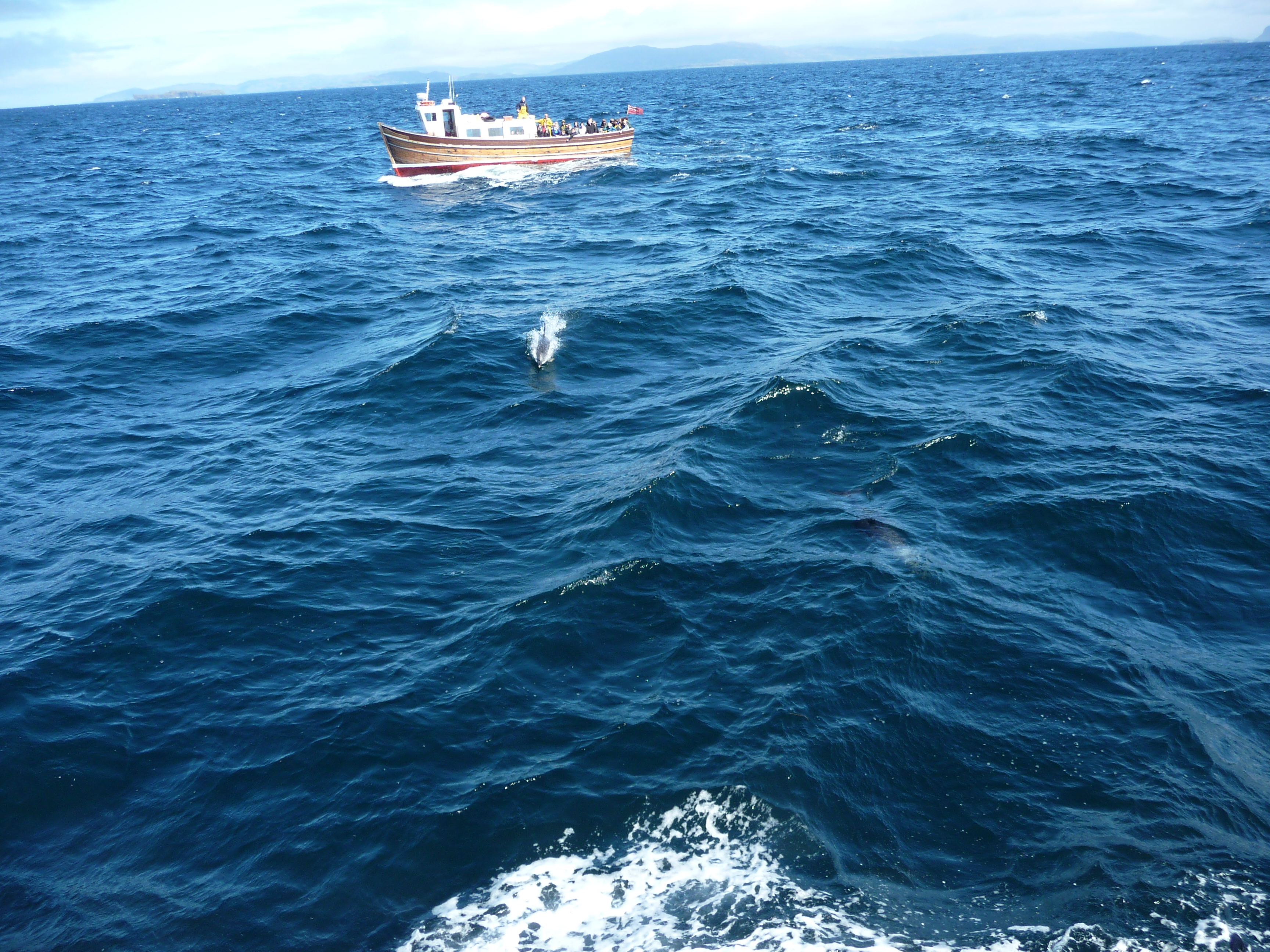
At first I wanted to capture something of the feel of the journey, which was in fact quite wild – in a small boat on a tumultuous sea in dazzling sunshine – we even saw dolphins! It was the underlying sense of myth that stayed with me though.
Iona’s spiritual history is well-known – St Columba, an Irish prince said to be exiled because of a violent dispute, travelled to Iona and began a life of spiritual contemplation with a group of monks back in the 6th century. His journeys around Scotland are remembered in history, also in tales of miracles. He was no doubt a complicated human being who’d lived a violent life in Ireland, who changed during his time on Iona – devoting his life to religion.
The island itself was said to have a druidic past. This is part speculation as those times weren’t recorded in written language in the same way as Christian history was. Place names around the island do suggest this pre-Christian history though. It’s suggested that the Book of Kells was written by monks on Iona some time in the 9th century, but the book is now at Trinity College Dublin. Some believe the book was created in Kells, Ireland, but if you consider the fact that part of north-east Ireland and the west coast of Scotland were essentially one nation at the time, called Dalriada or Dál Riata, then it could make sense that the book might be written in the peace of Iona and taken to Kells when Iona was later attacked by Vikings.
Monks were drawn to such places at this time in the past, in the spirit of the ‘Desert Fathers and Mothers’ – a tradition inspired by Jesus’s contemplation in the desert. Basically, anywhere remote and removed from society was seen as ‘desert’ – a place to contemplate God.
Staffa, which is about 7 miles from Iona, has a mythical history stretching far back into the mists of time! It’s other name is Fingal’s Cave – inspired the myth of Fingal (Fin means light and forms part of the name of the port on Mull from where you travel to Iona – Fionphort) from ancient celtic stories. This can be a confusing subject because there was in fact a series of poems called ‘Ossian’s Tale’, created by author James MacPherson, about Fingal, but this series of poems was discovered to be ‘fake’ – not the work of a real person called Fingal from the ancient Celtic past. The stories were gathered from ancient Celtic poems though, and so it is a fascinating work.
I won’t get too detailed here about the confusion of myth, and translations from original Scottish Gaelic myths and stories by McPherson – Ossian’s Tale does mention numerous place names that still exist, and which made up Dalriada in Scotland and north-east Ireland in the third century. The myths probably refer to an ancient warrior, said to be a giant, who created Staffa as a stepping stone from Ireland to Scotland. This refers to ‘The Giant’s Causeway’ on the coast of northern Ireland which shares the same hexagonal basaltic stone features as Staffa.
Well, that’s a lot of info, which may give an idea of why I wanted to capture a sense of myth from my trip to Staffa from Iona! It doesn’t really explain the way I feel about such an experience though. Suffice to say, it stimulates my imagination and despite the numerous tourists that throng the islands these days, I still feel the spiritual pull of these places.
I used to visualise lying in a wooden boat in the crystal clear green water of the Sound of Iona, rocking gently on the waves in the sun. Where Iona feels gentle, Staffa feels almost overwhelmingly dramatic – you feel you’ve taken part in a real life myth when you travel there.
I’ll end this post with some of my photos of Staffa …
Above: Pisces Moon, Isle of Iona. Mixed media on 10×10″ wood panel. Rose Strang 2018.
As I’m currently painting a private commission which must remain secret until October 2021, I thought I’d post themed blogs in the meantime. Today’s theme is Sea.
In the next few weeks I’ll also share my paintings on the themes of trees, mountains, portraits, winter, abstraction, imagination and collaborations
Our emotional and physiological response to the ocean means that it’s one of the most painted themes in fine art. Capturing a visceral sense of its translucence, movement, moods and light is challenging and there are limitless approaches. To enhance your viewing pleasure, here are a couple of music pieces that conjure moods of the sea! A beautiful song by Ishbel MacAskill: An Ataireachd Ard and a timeless sound from the Hebrides: Lewisian Psalm Singing
I’ve headed each set below with these terms: Movement, turbulence. Light, sun. Night, dark moods. Colour, translucence.
Movement, turbulence
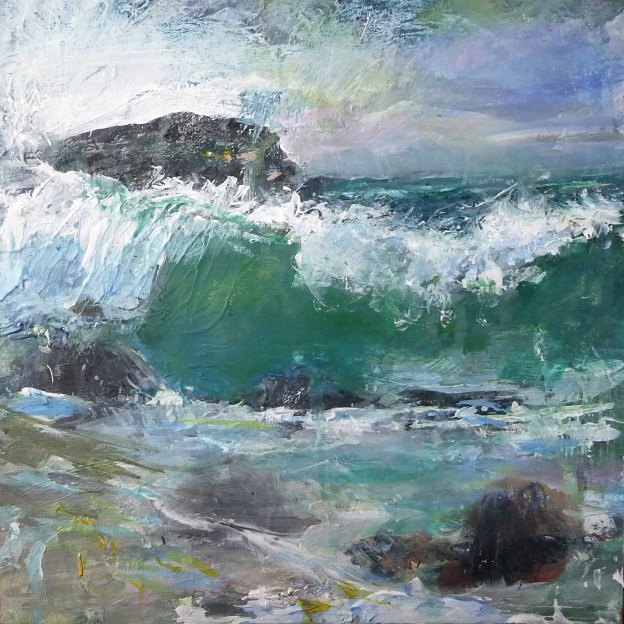
Painting movement is best achieved by making a mess I find! I try to keep the paint loose – as soon as I lose that freeness of brushstrokes it disappears. I’ve noticed that if anyone’s watching this process it looks stressful – just as it seems I’ve carefully captured a moving wave it’s time to mess that up and recreate it in looser strokes. This is one of the advantages of working in oils or acrylics, with watercolour you have to strategise more carefully. In the process of messing it up several times though, texture and interest is created.
One of the best compliments I ever recieved as an artist was when the curator of French fine art from Scotland’s National Gallery bought two of my paintings and compared them to Courbet, Encouraging praise indeed – Courbet was an Impressionist known for his wild waves. An example of Courbet’s waves on this link; Courbet
Sold. ‘Waves in the Rain, Singing Sands Bay’. Acrylic and ink on 40×30″ canvas. Rose Strang 2014
Sold. ‘Wave, Singing Sands Bay’. Acrylic on 20×16″ canvas. Rose Strang 2014
Sold. ‘Ardban,. Green Waves. Oil on14x11″ wood. Rose Strang 2020
Sold. ‘Wave. North Berwick’. Mixed media on 5×5″ wood. Rose Strang 2012
Light, sun
Every landscape artist is obsessed with the way light creates landscape. Capturing the essentials of light on sea is a constant challenge. Some artists simply make a precise copy from a photo, but that usually just creates a flatness and lack of energy and there seems not much point in recreating a photo, except for practice. The artists I most admire are those who can say everything about light with very little – something I still struggle with. One of my favourites in that regard is Alex Katz. His paintings appear simple until you realise how much he expresses with minimal marks. Alex Katz painting here – Katz
Sold. ‘Lindisfarne Series No. 2’. Acrylic on 5×5″ wood
Eigg Series No. 50. Acrylic, ink, salt and varnish on 5×5″ wood
‘Orkney Light’. Acrylic on 20×16″ canvas
Eigg Series. No 3. Acrylic, ink and salt on 5×5 inch wood
Night, dark moods
Probably the least commercial works are those that explore a more sombre mood. That doesn’t change my fascination with the subject though – it’s poetic and inspiring. We see landscape by light, so when there’s minimal light it has an emotional effect – we seek the light in the painting with a heightened focus. When painting in the introspective winter months, it’s instinctive to paint in a darker or more monochrome pallete. (subtleties of colour can be really difficult in the dark light of a Scottish winter). Tacita Dean, a hugely talented artist, captures an ominous mood in her chalk on blackboard works, yet there’s a romance to them that speaks of our long history of sea tales. Tacita Dean
Sold. ‘Stormy Sky, Lindisfarne’. Mixed media on 20×15″ canvas. Rose Strang 2014
‘Black’ Ink, acrylic and salt on 5×5″ wood. Rose Strang 2013
Sold. ‘Moonlight on Eigg’. Acrylic on 20×16″ canvas. Rose Strang 2014
Colour, translucence
Nothing expresses the unique quality of a particular sea more than colour and transclucency. The sea on Iona on Scotland’s west coast is transparent, impossibly turquoise and clear, whereas on the east coast it’s more opaque and grey-toned, even in bright sunlight. This is down to light (sun rise and sunset in east or west) pollution and geology – the sand on Iona is pinkish white, in North Berwick it’s warm brownish yellow. Go farther south to Cornwall and the sea is still magically green or turquoise but with less gem-like clarity because of a warmer-toned sun. Capturing clarity in paint is a case of clean contrasts and layers of colour. Also I find that a well-placed blob of seaweed in the shallows with just a hint of sunlit white froth on top can work well! Basically though it’s a challenge, and again I wish I could say more with less. Hockney’s paintings come to mind, view more here Hockney
Joan Eardley’s paintings of the sea have beautiful subtlety of colour and texture, to my mind, unmatched. One of her paintings on this link Eardley
Lastly, the Scottish Colourists are the yardstick by which artists are measured in terms of understanding sea and colour! Colourists
Sold. ‘Ardban Morning Sun’. Oil on 19 x 19″ wood. Rose Strang 2020
‘North Berwick, Summer’. Mixed media on 18×18″ wood panel. Rose Strang 2020. (NFS, Private Commission).
‘Sunrise, Ruby Bay. Fife. Acrylic and oil on 36×36″ wood panel. Rose Strang 2020. (private commission)
‘Traigh Luskentir 3’. Mixed media on 16×16″ wood panel.. Rose Strang 2017
‘Tràigh na Buirgh, Harris’. Mixed media on 9.5×9.5″ wood panel. Rose Strang 2017
Sold. ‘Sanna Bay. Turquoise’. Mixed media on 20×16″ wood board. Rose Strang 2019.
‘Oil Tanker Near North Berwick’. Oil on 19×11 inch wood panel. Rose Strang 2020
Sold. ‘Birthe Marie, St Ronan’s Bay. (Isle of Iona)’. Mixed media on 16×12″ wood panel. Rose Strang 2018
In a few days I’ll share images and links to artworks on the theme of trees.
‘Ardban. Green Sea’. Oil on 17×11″ wood. Rose Strang 2020
Above, today’s paintings for the Applecross Series which launches at the Limetree Gallery, Bristol on 31st October. The featured painting at the top is ‘Road. Kintail’. Oil on 7×5″ wood.
I’m quite excited about ‘Road. Kintail’ as I love taking photos and sketching while in the car (as a passenger of course!) The road itself provides great perspective and it’s fun trying to sketch or photograph in a moving car. This has that optimistic holiday feel – going somewhere. I wonder if it will appeal to others the same way it does me.
I’m persevering with the oil paints. I love the effects but it’s so messy – I spend half my energy cleaning up at the end of the day!
That’s it for the week. My partner and I are designing a dress this weekend – our new creative adventure – oil-paint-covered hands and expensive fabric do not mix!
Above, Aberlady Dunes. Mixed media on 30×30 inch wood panel. Rose Strang April 2020. (Private Commission).
Lockdown has been a good time to focus on private commissions. I’ve found it grounding and uplifting to focus on painting, and I think most people find art uplifting – a solace in strange and anxious times.
I accept most landscape commissions, even if it’s from a photo of someone’s favourite landscape, as long as I’ve been there and experienced that particular light, I’m able to paint it. I don’t aim for photo-realism. I deliberately keep brushwork as loose and expressive as possible and paint quickly for the sense of energy I’d feel if I was in situ. Painting En plein air is ideal of course, but with experience you can bring that same energy to painting in the studio.
The first commission this year – Aberlady Dunes – (above) was commissioned by a friend of the family who liked one of my previous smaller paintings of Aberlady. He’d lived on Lindisfarne some years ago and loved the sense of space -stretching to the horizon across the marram grass to the sea and sand beyond.
North Berwick, Summer was commissioned by a doctor who lives in England who’d seen Aberlady Dunes and wondered if I could capture a stretch of his favourite coast near North Berwick, but on a smaller scale. I chose a spot that’s very familiar to me, just past the headland south of the town. It has many happy associations since I’ve been going there with family and friends since childhood, so it was a pleasure to paint.
‘North Berwick, Summer’. Mixed media on 18×18″ wood panel. Rose Strang 2020. (Private Commission).
The most recent – Sunrise, Ruby Bay, Fife captures sunrise on Ruby Bay on the east coast of Scotland. It’s very large and I decided to experiment with acrylics and oils together with this one. I think I’m onto something as it came together in a very atmospheric way in the end. You can read more about painting it Here
‘Sunrise, Ruby Bay. Fife. Acrylic and oil on 36×36″ wood panel. Rose Strang 2020. (private commission)
To me, the difference in light between the east and west coast of Scotland is very clear – especially at dawn or sunrise. This painting below shows dawn on the west coast – far more diffused, since the sun, rising from the east, doesn’t touch the sea till later – you see the sun’s warmth more in the under-lit clouds.
‘Dawn, Ardtoe’. Mixed media on 14×11″ wood panel. Rose Strang, 2019. £495
If you like the look of these paintings and are interested in commissioning me, you can contact me at rose.strang@gmail.com
I’ll be happy to discuss price with you (the painting price varies according to size of course) and what mood or atmosphere you’re looking for. Below are a few more of my paintings showing a myriad of moods and atmosphere! …
Sold. ‘Edinburgh Snow (Arthur’s Seat and Royal Mile from Regent Road). Mixed media on 24×16″ found wood panel. Rose Strang 2018. (un-framed £375)
‘Storm coming, Goirtean Beag Beach, West Coast of Iona. Mixed media on 10×10″ wood panel. Rose Strang, August 2018
‘Stormy Sea 2’. Acrylic and ink on 10×10″ wood
‘Glentress’. Acrylic on 20×16″ canvas. Rose Strang 2014
Sold. ‘Water of Leith. 9’. Oil on 7×5″ wood. Rose Strang, 2020.
‘Dusk, Sanna Bay’. Mixed media on 14×11″ wood panel. Rose Strang, 2019. £495
NFS ‘Water of Leith. 7’. (Diptyque) Oil on 7×5″ wood. Rose Strang, May 2020.
NFS ‘Water of Leith. 8’. (Diptyque)Oil on 7×5″ wood. Rose Strang, May 2020.
Sold. ‘Stormy Sky, Lindisfarne’. Mixed media on 20×15″ canvas. Rose Strang 2014
Above: Sunrise, Ruby Bay. Fife. Acrylic and oil on 36×36″ wood panel. Rose Strang 2020.
Below, some details from the painting …
This latest private painting commission is of Ruby Bay in Fife, on the east coast of Scotland. It’s so-called because if you sift through the small pebbles in the bay you can find tiny little garnets, not rubies as such but very like them!
Ruby Bay is on the Fife coastal path, near Elie Bay. It’s a beautiful stretch of coast- the most famous beach on that stretch being St Andrews (of Chariots of Fire fame). The tower, built in 1779, is called Lady’s Tower as it was used by Lady Janet Anstruther (Janet Fall) as a bathing tower – a rich person’s beach hut if you like!
I wanted to capture the classic cool tones of an east coast sunrise – clear, cool and only slightly hazy. Looking at this painting in real life (it’s bigger than it seems form the photo at thirty six by thirty six inches) you sense movement from a calm tide about to recede from its high point. The lilac tones of pre-dawn are just about disappearing, replaced by clear turquoise. Lemon-yellow sunlight is just kissing the tips of the rocks, tower and grass.
The painting took about six days. It was started with gesso to lay down composition and background texture, then acrylics to get contrasts, the acid tones of lichen and the built up layers of rough-textured rock. Lastly I used oils for the sea and sky, and the cool light blue in the shadows.
It’s been a pleasure to paint – complicated and with varying textures, but I think I’ve captured the calm and the pure light of sunrise in the east. I’m quite keen now to have another go on smaller wood panel to create a more abstract version.
The photos below show most stages of the painting …
‘Traigh Bhan. Waves. Iona’. Mixed media on 12×12 inch wood board. Rose Strang 2020
‘Traigh Bhan. Turquoise Sea. Iona’. Mixed media on 12×12 inch wood board. Rose Strang 2020
Above, the completed series of ‘Traigh Ban, Iona’. Traigh Ban is Scottish Gaelic for ‘white strand’ and is pronounced ‘try ban’. It’s the stretch of beach at the north-east end of the Isle of Iona, off the west coast of Scotland. (Set as featured image at the top is Traigh Ban, Early Evening. Iona.)
I’ve painted Iona many times in the past few years, most recently during a winter artist’s residency in 2018. It’s an island famed for its religious history and its particular beauty. That’s a somewhat anodyne sounding statement, so to be more expressive – when I’m there I often feel that the colours are too luminous to be real – everything looks like a ridiculously beautiful painting – it feels in a way superfluous to paint it, until you realise photography doesn’t capture it.
When the Limetree Gallery asked me for paintings for their summer exhibition, Iona was my first choice. I can’t be there this year as planned due to lockdown, but you can be sure it’s the first place I’ll visit when it’s possible. I had planned an arts project there this year with my partner (an animator, watercolourist and musician) and Devo, a filmmaker from New York, so these paintings are a bit of therapy for me in the meantime! We’d hoped to respond to the island’s beauty, atmosphere and history in numerous ways, so I hope that will go ahead in the not too distant future.
They’ll be available from the Limetree Gallery soon, but if you’re interested in reserving one, you can contact them from their website on this link – Limetree Gallery.
The gallery (and its partner gallery in Long Melford Suffolk) is owned and run by Sue and Stephen – I’ve thoroughly enjoyed working with them over the years. We’ve had fun times and interesting conversations whenever there’s been a chance to meet in person, so as I’m currently enjoying an early evening gin and tonic I’ll raise a glass to Sue and Stephen – long may your galleries continue to show and sell great work!
In progress. ‘Sanna Sundown’ and at top – Traigh Bhan Nam Monach, Iona
Today’s paintings in progress for the Limetree Gallery, Bristol. Traigh Bhan Nam Monach, Iona is complete. Sanna Sundown needs a bit more work. ‘Traigh Bhan Nam Monach’ means ‘white strand of the monks’.
How much would I like to be on that beach on Iona right now! I’d planned an arts project with my partner and a filmmaker from New York which would have been happening this month. (Sigh). Painting that crystal-clear turquoise sea was therapy anyway!
I went very loose and ‘painterly’ with these as I think that will work well for the Limetree Gallery. The brushwork is very spontaneous with just a few areas of detailed focus – it makes the eye work more and Limetree art buyers seem to enjoy this painterly approach that lets the viewer see more of the artist’s hand in the brushwork.
Needless to say, I enjoyed painting them and I’m happy with Iona, once I had that little sun-lit ripple at the bottom I was pretty much finished. I like the freshness of these and look forward to completing Sanna and another painting, tomorrow.