Author Archives: rosestrang

Unknown's avatar

About rosestrang

Artist, Painter

Planets series in progress – 3

(In progress) January. Nightscape. Oil on 40x40" wood panel. Rose Strang

(In progress) January. Nightscape. Oil on 40×40″ wood panel. Rose Strang

Above, today’s progress on ‘January. Nightscape’, which needs a few more days work …

As mentioned in the last two posts, I’m working on a series inspired by the Medieval view of the planets and cosmos – a complicated yet harmonious and imaginatively inspiring view of the ‘heavens’ as they were known.

My current painting in progress is on the theme of Saturn and its related qualities. (the themes of this post are also entirely related incidentally!)

I’m currently reading Michael Ward’s ‘Planet Narnia’ in which he describes and explores his discovery that each of C.S. Lewis’s Narnia Chronicles correspond to each of the seven planets.

In Medieval times these were:

Sol (Sun), Luna (Moon), Mercury, Mars, Venus, Jupiter and Saturn. (Neptune, Uranus and Pluto weren’t viewable with the naked eye).

‘Planet’ meant ‘wandering star’, so they classed the sun and moon as planets in that sense. These were the objects in the night sky that moved in regular patterns, against a fixed, un-moving backdrop of stars, which were mapped into recognisable patterns or constellations. This was a world-wide practice of course, given that watching planets and stars enabled people to predict seasons, or navigate seas and so on.

Names of the constellations varied around the world, but it’s fascinating to read about the equally varying myths that surrounded, for example, constellations such as Orion. I’m exploring western ideas and mythology for now though, which is enough to be going on with!

I’m currently absorbing a wealth of complicated information about the Medieval view of the cosmos, from a variety of sources – not just Michael Ward’s excellent book, but also books, ideas and explanations suggested by several people I’ve encountered in the last five months or so. The mythology is enchanting, and my exploration has led me back to the Narniad, but by way of explanation on how I became interested ..

In October 2018 I was heading off to Iona for a two week artist’s residency at the Iona Youth Hostel at Lagandorain. Knowing about my interest in symbology someone had lent me a copy of Agrippa’s Three Books of Occult Philosophy. It was an important book of its time and valuabe now for its insight into Renaissance philisophical ideas about magic and religion. The magical aspects weren’t so much of interest to me as the symbols relating to the cosmos, but a verse by Virgil in the intro enchanted me:

The Number and the Nature of those

things, Cal’d Elements, what Fire, Earth,

Aire forth brings: From whence the Heavens

their beginnings had; Whence Tide, whence

Rainbow, in gay colours clad. What makes

the Clouds that gathered are, and black, To

send forth Lightnings, and a Thundring

crack; What doth the Nightly Flames, and

Comets make; What makes the Earth to

swell, and then to quake: What is the seed of

Metals, and of Gold What Vertues, Wealth,

doth Nature’s Coffer hold.

Rainbow on Iona, Rose Strang Oct’ 2018

Dipping randomly into the book, it also explored the planets, and influence or phases of the moon. Chatting about this with the manager at Iona Hostel, he mentioned that he used a mobile app called ‘Skymap’ to observe phases of the moon, also that on this evening the moon was entering full moon phase, and going  from Pisces to Aries.

I forgot all about that, carried on with my painting, then, at about 5:20, went to clean up and have a lie down for half an hour. I couldn’t rest though and after ten minutes, feeling emotionally agitated and restless, I decided to take the two minute walk to the north beach of the island.

If you’ve observed the sea at high tide, or during changes in tide, you’ll maybe have observed the strange shifting effect – it looks almost hallucinogenic. I stood entranced, gazing at the sea for half an hour until it got dark, then returned to the hostel, checked the Skymap app and realised that the moon became full at precisely 5:45pm. I’d walked on to the beach at about 5:40pm!

North Beach Iona. Photo, Rose Strang October 2018.

Sold. ‘Pisces Moon, Isle of Iona’. Mixed media on 10×10 inch wood panel. Rose Strang 2018 (£450)

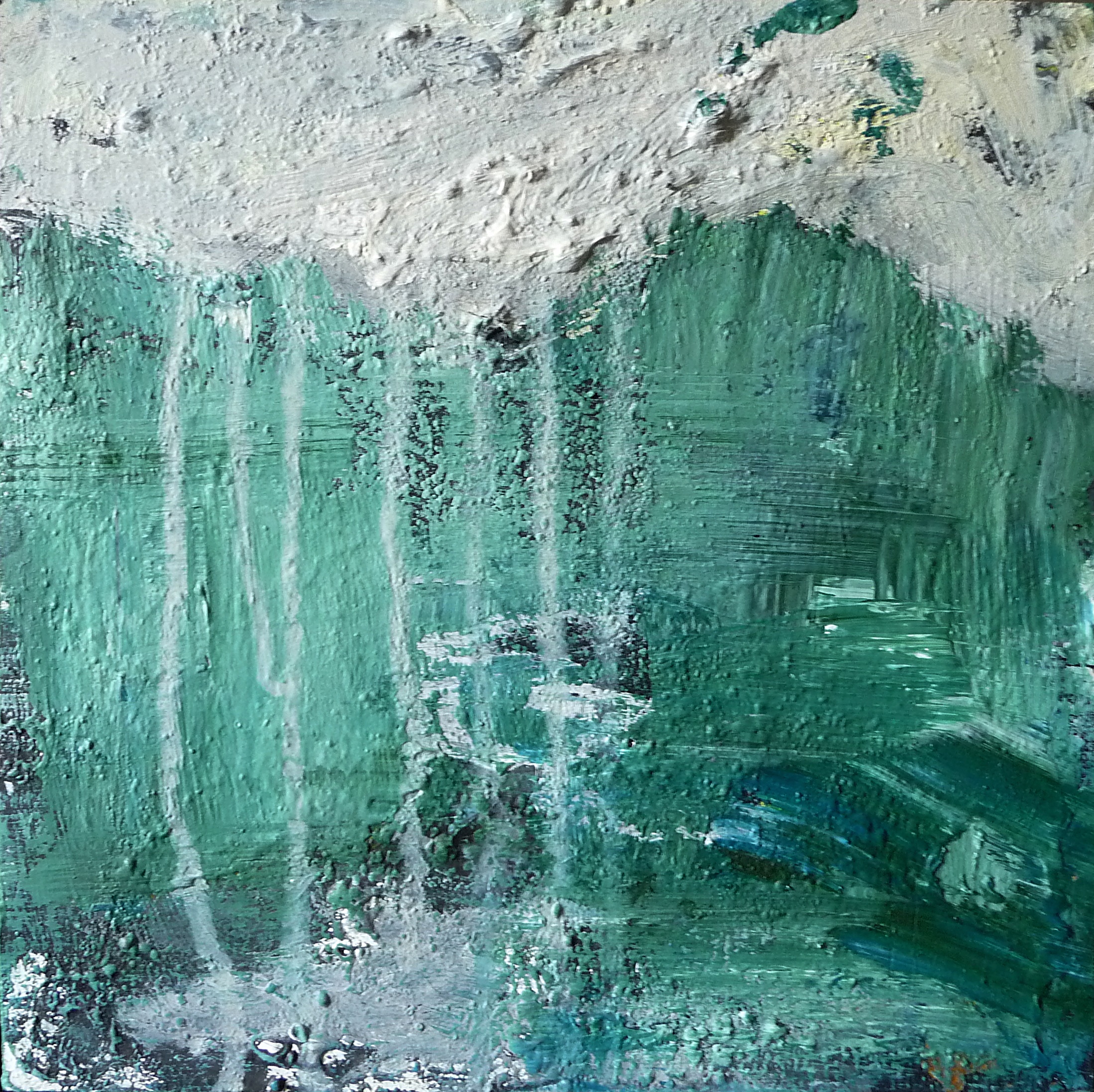
‘Moonscape, Isle of Iona’. Oil and acrylic on 10×10″ wood panel. Rose Strang 2018/2019

It was an interesting experience – at least a reminder of the moon’s effect on the tides and this felt valuable to me as an artist.

On my return to Edinburgh, I learned more about the Medieval view of the cosmos – it’s a complicated system, but here is a brief overview for now …

Medieval philosophers believed that the cosmos had three levels; the heavens – beyond the planets, where the gods resided, or ‘the divine realm’, the celestial realm where the planets resided, and the earth where everything was a reflection of the heavens.

Anything beneath the moon is termed ‘sub-lunar’ and the gods are separate from this realm, but Medieval philosophers believed we connected with them through energies of the celestial bodies – planets and stars.

The term ‘as above, so below’ refers to the idea that on earth, everything (plants, animals, stones, minerals etc) is a reflection of the heavens. They classified these physical things according to each planet, then each planet connected to the divine realm – the planets were in a sense ‘go-betweens’. So, to evoke their influence by using a talisman (i.e. objects/plants/minerals etc related to a particular planet) you could bring that planet’s influence to bear on your life or events.

That’s it very briefly for today, but since my current painting related to Saturn, below is a very brief description, or flavour at least, of its qualities and related things on earth.

In the next post I’ll explore the mytholgy surrounding Saturn, and C.S. lewis’s literary treatment of it in ‘The Panet’s Trilogy’ and ‘the Last Battle’.

Saturn:

January. Winter. Winter Solstice (21st December). Saturday. Black

Qualities and associations: Time (father time), structure, form, renewal and liberation, brooding, melancholy, death, the occult (hidden, veiled, secret), teaching, pedantry, oppression, rules and boundaries.

Earth, water, lead, all ‘dark, weighty things’, ‘those things which stupifie’, dark berries, the black fig tree, pine, cypress, trees used at burials, owls, crows, animals that live by night.

Zodiac signs of Capricorn and Aquarius.

Roman feast of Saturnalia: held at winter solstice on 21st – all people celebrated, executions were cancelled or postponed, gifts were exchanged.

Capricorn and Aquarius contsellations.

Exhibitions and available paintings Jan’ 2019

Current round-up of current exhibitions and (as yet) unsold paintings  …


Limetree Gallery, Bristol. (Contact gallery for enquiries Here)

Paintings available from the Limetree Gallery …

Winter Show. Resipole Gallery, 10th Nov’ to 22nd March. Ardnamurchan, Scotland. (Contact gallery for enquiries Here)

Paintings at the Resipole …


Small Paintings. Morningside Gallery, Edinburgh.  (contact gallery for enquiries Here)

Paintings at the Morningside Gallery …

Planets Series in progress – 2

(In progress) January. Nightscape. Oil on 40×40″ wood panel. Rose Strang 2019

I was standing today in the dark toolshed. The sun was shining outside and through the crack at the top of the door there came a sunbeam. From where I stood that beam of light, with the specks of dust floating in it, was the most striking thing in the place. Everything else was almost pitch-black. I was seeing the beam, not seeing things by it.

Then I moved, so that the beam fell on my eyes. Instantly the whole previous picture vanished. I saw no toolshed, and (above all) no beam. Instead I saw, framed in the irregular cranny at the top of the door, green leaves moving on the branches of a tree outside and beyond that, ninety-odd million miles away, the sun. Looking along the beam, and looking at the beam are very different experiences.

Quote: C.S. Lewis, ‘Meditation in a Toolshed’ (from essays collection). Planet Narnia, by Michael Ward

As mentioned in yesterday’s post, I’m painting a new series inspired by the classic Medieval view of the universe, in particular the planets. It’s a complicated picture and (though scientifically inaccurate!) quite beautiful in its imagery, mythology, associations and sense of unified harmony.

I’ve long been inspired by Medievalism, no doubt originally inspired by reading the Narniad, as it’s known today, by C.S. Lewis

The above quote by C.S. Lewis (left, enjoying a cigarette – absolutely unacceptable in these times!) is a wonderful illustration of his way of explaining philosophical concepts through lived experience and imaginative observation. It’s probably one reason for the enduring appeal of his Narnia Chronicles and writings on Theology.


Lewis had read the philosopher Samuel Alexander’s theory of Enjoyment and Contemplation, which crystallised ideas he’d been exploring. The quote above illustrates the difference beautifully; contemplation of the beam of light is a different experience to being in the beam of light – you’re no longer looking at light, you’re in it, or in other words experiencing it subjectively (enjoyment) not objectively (contemplation).

For Lewis this concept informed his writing and way of life. It’s well-known that Lewis was a committed Christian (incidentally if it’s of interest this is not how I’d describe myself – I’m not a member of any religious group, though I find Lewis’s exploration of Christianity fascinating and inspiring).

As an academic he specialised in Medieval and Renaissance literature and one of his expressed regrets was the way that Medieval myth and imagination had been sidestepped or rejected by later religious practice or theology.

It wasn’t just that he found Norse, Roman, Greek, Hindu (or any source of ancient mythology) fascinating, he also felt as a Christian that exploring these myths, or finding them spiritually inspirational was as valid an aspect of worship as following Christian religious doctrine. Similar to Blake in some ways, he profoundly appreciated the power of imagination – for Lewis this partly informed ideas about Enjoyment, as opposed to Contemplation.

At the moment, I’m reading Michael Ward’s Planet Narnia, (for which I’m grateful for providing much of the information about Lewis described above) in which Michael Ward describes and philosophically explores his discovery that each of the Narnia Chronicles was in fact inspired by the seven planets as understood from a Medieval perspective. C.S. Lewis never stated this as his partial inspiration at the time, though in retrospect, once explained, it’s startlingly obvious. It is as he states himself, surprising that he was the first person (publicly at least) to recognise it.


My painting in progress (at the top of this post) is the first in a series of seven I’ll be painting this year. I’ll write more about the inspiration as I go, but this one, titled ‘January. Nightscape’ is inspired by the planet Saturn – a somewhat dark and heavy energy by all Medieval accounts! I’ll write more about  Saturn and its influence according to Medieval mythology as the painting progresses this month.

Of interest to C.S. Lewis appreciators, the correspondingly Saturnine Narnia book is ‘The Last Battle’ (last of the series). Lewis, in keeping with the quote at the top of this post, doesn’t mention Saturn (as far as I recall) in the book, but the book is saturated with its influence throughout. I’ll explore this more as my January/Saturn painting develops.


These dark January days, I’m finding it therapeutic to light the fire, of an evening, switch off all the wifi, mobile and other distractions, and immerse myself in a book. I also really enjoy keeping an arts diary (this blog) as a way of recording my inspirations.

Also, on a pragmatic note, the resulting paintings will be for sale in the galleries that currently represent my work, namely the Limetree Gallery (Bristol), Resipole Gallery (Acharacle, Scotland) and Morningside Gallery (Edinburgh). I appreciate their support, also the supportive creative ethos of these galleries to artists they represent.

In the meantime, Happy January to readers of this blog – it is indeed a dark month here in the Northern hemisphere, I hope you’re finding ways to enjoy it!


New series in progress

(Work in progress). ‘Portrait of Donald Ferguson’. Oil on 5×7″ canvas. Rose Strang

Though I haven’t posted new works here in a while, I’ve been working on several things. They’re taking longer as I’m working in oils, which is a much slower process.

Above is an oil portrait of my friend Donald. It needs a bit more work and you can probably see I’m sort of winging it as I don’t really have a process with oils as yet. Once I’ve created a few more of these I’ll do larger portraits with a bit more life and characteristics of the subjects and I’ll also post more information about the people I’m painting.

Donald has been a great friend since the early 90’s, and this doesn’t hugely capture the aspects I’d like to (for example his mercurial, fun qualities – though he can be very contemplative as seen here) but as an exercise in observation and technique it’s worthwhile, and definitely looks like him! I’ll be adding more of these from now to Spring.

Here are a couple more showing progress ..


The other series I’m working on this year involves themes that have been on my mind since September last year. I’ve been exploring avenues of Medieval history. from a variety of angles I suppose.

This probably stems from a lifelong love of the ‘Narniad’ – the Narnia Chronicles by C.S. Lewis, whose imaginative and immersive approach to fantasy belies a rigorous education in Classics, and a dedication to theology and Christianity in later life.

Lewis was deeply interested in the Neo-Platonic view of the cosmos, which was a complicated yet harmonious view of the universe and our place in it. It’s only in recent years (fifty years after Lewis’s death in 1963) that the writer Michael Ward realised that the seven books of Narnia were each inspired by the seven planets. He published his observations in a book I’m currently reading called Planet Narnia (published I think in about 2008).

Once I understood more about the neo Platonic view of planets, it was stunningly obvious that each of the books absolutely immerses you in the ideas and qualities of the planet it explores, though the relevant planet might not even be mentioned.

I’ll save this complicated and fascinating subject for future posts, but suffice to say for now I find it a magical and quite beautiful way of perceiving nature and the subjects I paint, so this year I’ll be painting something each month that corresponds to month, time of year and related subjects.

With the month of January relating to the planet Saturn (associated with black among other things) I’m working on a very large night-scape at the moment. This smaller painting was one I began on the Isle of Iona back in October; every night I’d go out to look at the stars in a sky unpolluted by human-made light. (If you’re as mesmerised by a clear starry sky as I am, you’ll know that I ended up with a nasty crick in my neck!)

‘Night-scape, Isle of Iona’. Acrylic and oil on 10×10″ wood panel. Rose Strang 2018.


The larger painting (in progress, below) is on a 40×40″ (about 3.5 feet) wood panel, in oils. Already I’m appreciating the density of colour and texture of oil paint, as contrasted with acrylic, I’m not appreciating how long it takes to dry, but as someone who’s pretty impatient temperamentally I suppose it gives me more time to consider the subject. I find it stymies my creative flow and inspiration somewhat, but the quality of paint adds something special to the process and finish. I also like the smell of linseed oil!

(In progress). ‘January’. Oil on 40×40″ wood panel.


‘Small Paintings’ – video

Above –  fun promotional video for the upcoming ‘Small Paintings’ exhibition at Edinburgh’s Morningside Gallery this Saturday (12th Jan) which opens at 10am. I have a few paintings in the show. Hope to see you there if you’re in Edinburgh!


‘Small Works’ – exhibition this Saturday

‘North Beach, Twilight II. Isle of Iona’. Mixed media on 6×6″ wood block.(unframed) Rose Strang 2018.

The Morningside Gallery in Edinburgh launches its yearly ‘Small Works’ exhibition this Saturday from 10am onwards. It’s a very popular exhibition and I’m delighted to be showing some of my smaller works from the recent Iona series. (paintings in the show above and below)

I’ll be dropping by mid afternoon and look forward to seeing all the works on exhibition

This is the Facebook event page – Small Works

And this is the gallery website should you wish to contact the gallery about any paintings – http://www.morningsidegallery.co.uk/

‘North Beach,Twilight. Isle of Iona III’. Mixed media on 6×6″ wood block. Rose Strang 2018. (unframed).

‘West Coast, Isle of Iona’. Mixed media on 10×10″ wood panel (unframed). Rose Strang 2018.

‘North Beach,Twilight. Isle of Iona’. Mixed media on 6×6″ wood block.(unframed). Rose Strang 2018.

Exhibitions and available paintings 2018

‘Cerulean Sea, Isle of Iona’. Mixed media on 10×10″ wood panel. Rose Strang 2018 £385

Here’s a round-up of my available paintings plus info on the galleries where you can find them…

Limetree Gallery – Website

*(gallery closes from 23rd to 29th Dec. Contact gallery on website link with any queries)


The Limetree (owned by Sue Dean and Stephen Edwards) specialises in contemporary Fine Art and Glass and holds regular exhibitions throughout the year. They have two galleries: one in the heart of Bristol city and the other in Long Melford, Suffolk.

They have a particular love of contemporary Scottish artists, and always have a varied selection of their art on show. Ranging from traditional to modern, figurative to abstract, each exhibition is complemented by a selection of individual glass pieces from Britain and Sweden.

Open from 10am to 5pm, Tuesday to Saturday, or by appointment.

My artist’s pages on the Limetree website – Paintings

Works on show at the Limetree:

Resipole Gallery – Website

Resipole Studios is an award-winning fine art gallery with on-site artist studios, located on the West Coast of Scotland.


The Resipole hosts an exciting annual programme of exhibitions and workshops of Scottish contemporary art that is both emerging and established. The gallery was launched in 2004 by Andrew Sinclair after a two-year renovation of an agricultural byre.

Since its launch, Resipole Studios continues to present work by artists of many disciplines, with Scotland as their key focus. With many award-winning artists on its roster, the gallery is regarded as one of Scotland’s leading contemporary art spaces and, consequently, in 2016 was selected to show work by the late, American abstract-expressionist, Jon Schueler to mark the centenary of his birth.

My artist’s page on the Resipole website – Paintings

Works on show at the Resipole ..

Morningside Gallery – Website

The Morningside Gallery (owned by Eileadh Swan) specialises in contemporary art and works with emerging and established artists.

My paintings will be showing as part of their ‘Small Works’ show, which launches 9th January 2019. (Price information will be available then)

Works on show at the Morningside Gallery from January 9th ..

‘Road to Meikle Seggie’ – a response.

'The Road to Meikle Seggie' Richard Demarco

‘The Road to Meikle Seggie’ Richard Demarco

Last Saturday I attended a talk by Richard Demarco (Info -Richard Demarco CBE) at Summerhall in Edinburgh. This was a fairly informal pre-Christmas gathering, to explore themes of Richard Demarco’s work as a water-colourist over the decades.

Richard invited us to respond on paper to the ideas discussed, but I had to leave before the end of the talk, so thought I’d post a response here ..

Richard Demarco last year, describing Edinburgh Arts journeys during performance by Aletia Upstairs. Summerhall, summer 2017 (photo, Rose Strang)


Richard Demarco (now in his late 80’s) has dedicated his life to promoting art as a means of dialogue and healing (with focus on Europe post WW2 – more info Here) so you might expect expect his paintings to encompass themes of war – or figurative human struggle perhaps.

At first encounter though, his watercolours appear to be fairly traditional land and city-scapes; views (often iconic) mostly of landscapes across Scotland, from Edinburgh in the east, north across Fife then to the far west coast of Scotland.

There’s a focus on changing light – not just how light plays on the subject (the concern of every artist who views the world around them) but particular focus on position of the sun, stars or moonlight; the time of day and the passing of time – the message is often reiterated with telegraph poles, signposts and pathways or roads, suggesting a journey shared by others.

These paintings represent what Demarco  describes as The Road to Meikle Seggie – they represent his own sense of place in time on that road, as well as the marks of those who came before. So these are not simply watercolour views – they describe a life-long journey, with meaningful connections.

(my earlier post on The road to Meikle Seggie Here)

This could lead us down many intellectual avenues exploring art and time, but Richard Demarco’s work is about the immediacy of those themes – as they are felt and experienced in life, and this is reflected in his choice of watercolour as medium – it can’t be re-worked (in the same way as oil or acrylics for example) and this is similar to the immediacy of drawing – the viewer can see each mark as it’s been made – nothing is hidden.

The first of many questions Richard explored on Saturday was –  ‘Why do artists make their marks, and what moves them to do so? Anyone in a creative act  – dancing, writing poetry, playing music, conjuring new ways of doing anything at all.

We were asked to consider the thousands of touches it takes to create a work of visual art, or drawing, the number of movements to perfect a music piece, or a dance – untold thousands – risking failure at each touch. Richard humorously likened it to a tennis match or marathon in terms of effort involved, and of course I responded to this – how many marks do I make as a painter? Are those marks more or less neurotic doodlings?! Do they simply reflect the visual patterns of what I can see, or can I see or communicate something more profound?

I was reminded of the quote on a piece of paper that was tacked momentarily on a wall in Richard Demarco’s office, back in 1999:

He either fears his fate too much,
Or his deserts are small,
That dares not put it to the touch
To gain or lose it all. 

James Graham, 1st Marquess of Montrose


(He was probably referring to war, but a good quote nonetheless!). Richard asked us what thoughts these ideas, and his watercolours, inspired – as observers and as creative people, with the understanding that we are all creative – everyone (as Joseph Beuys famously said) is an artist. In which case , what might be the perfect creative act? Painting, music-making, dancing, singing, writing …? Richard suggested that it might actually be farming.

Which seems at first a strange suggestion, given that large-scale farming (f not small-scale or organic) too often equals exploitation or destruction.

We were asked to consider the impact of tourism on land or city-scape, and in that context –  the first known marks made by human beings – such as those in the caves of Lascaux. How did early humans experience landscape? Who were the first farmers or agriculturalists wishing to understand, live by, and perhaps revere, not simply exploit their surroundings?

Horse drawing. Caves of Lascaux, France (estimated to be 20,000 years old.)


How did early hunter-gatherers engage with their environment? How might their imagination or intellect respond to, or attempt to control the unknown that surrounded and dictated every aspect of their existence?


We were invited to think of Callanish – a pre-historic, complex arrangement of stones (Lewisian Gneiss – formed 3 billion years ago, re-arranged by humans 5 thousand years ago) on the Isle of Lewis in the Outer Hebrides …

Stones of Callanish. Photo Rose Strang 2016


They are clearly markers of the movement of stars, sun and moon – representing precise, attentive observation of all that surrounds us. The stones are also mysterious and their presence is awe-inspiring – when there you feel you’re in the presence of something profound (not just a sort of scaled-up Swiss watch!). Callanish inspires a multitude of questions and imaginative responses about every aspect of our existence. It encourages us to consider the source of knowledge – whether from our minds, or from extrinsic sources. Richard suggested we’re limited by the echo-chamber of our own thoughts – re-fed to us via social-media, or, for example, ideas fed and repeated ad-infinitum through mainstream media.

I can’t disagree with that! I was reminded of the numerous ways that landscape has profoundly affected or impacted my life. As I get older it feels ever more important to be present – to perceive what I see around me, as an artist, to the best of my ability. Maybe it’s becoming less about the marks made, since those become more instinctive – like a familiar dance that becomes, hopefully, more connected to the energy or emotion of what I see.

Now I’ve had time to mull over the ideas Richard discussed, I’m remembering the times (when I lived in Sussex for a few years) that I’d walk across the South Downs to a village called Fulking. The marks along the path left by ancient people fascinated me, because despite this being in one of the most populated regions of England, they were so few and transient – another decade or so and they’d probably be gone.

We also saw very few people on that five-mile walk, but when we arrived at the tiny village of Fulking, the pub there (called the Shepherd and Dog) thronged with tourists seeking an authentic countrified lunch experience.

Fulking sits at the foot of the downs, and has a spring that emerges from the foot of the slopes then gathers into a stream that flows past the pub. Someone has constructed a little brick shrine (arts and crafts era in style) above the water with an inscription dedicated to Ruskin (who helped build a course for the stream):

He sendeth springs

into the valleys

Which run among

the hills.

Oh that men would

praise the Lord

for his goodness


I once climbed down a steep muddy bank through tangled bushes to find the source of the water, it was pure, drinkable and icy-cold though it was mid July. It surprised me that this place, so popular with tourists, had almost no marks of modern people either at the source of the spring, or on the path that led over the downs from the coast to Fulking. It was a chalk path, worn so deep in places that the sides were above five feet.

Some months later I was visiting my grandfather, who’d grown up near Fulking in a village called Stanmer. I asked if he knew Fulking and he replied ‘I don’t know it very well personally, but I know someone who did. Your great grandfather was a sheep drover, he led sheep over the downs to Fulking’.

The precise same path I’d walked many times. It thrilled me to realise I’d been drawn to (or just chanced on maybe?) the same path hundreds of years later. Sheep-droving explained why the path was worn so deep.

That was about twenty years ago, but I believe it was integral to the way I explored landscape afterwards – one avenue of my own road to Meikle Seggie.

My grandfather’s house, Stanmer Village.


‘Iona, October Tide’ event

Video still from ‘Iona, October Tide’


I want to thank folks for coming along to my recent event Iona, October Tide .  Most particularly thanks to Donald Ferguson and Charlotte Robertson for a beautiful poem recital (Heine’s Questions – see text below) and a moving music performance (videos below)

Questions (Heinrich Heine)

By the sea, the wild, nocturnal sea,
Stands a stripling youth;
His breast full of woe, his head full of doubts,
And with bitter lips he questions the waves:
“Oh solve me the ancient riddle,
The cruel, ancient riddle
Upon which many heads have pondered,
Heads in hieroglyphic covered hats,
Heads in black birettas and turbans,
Peri-wigged heads and a thousand other
Poor, perspiring heads —
Tell me, what signifies man?
Where cometh he? What is his destiny?
Who lives up there beyond golden stars?”
The waves murmur their eternal murmer.
The wind blows, the clouds move;
The stars blink, indifferent and cold and cruel.
And a fool waits for his answer.


Christmas Exhibition – Limetree Gallery

‘Edinburgh Snow (Arthur’s Seat and Royal Mile from Regent Road). Mixed media on 24×16″ found wood panel. Rose Strang 2018.

The Limetree Gallery in Bristol will be launching their Christmas Exhibition today –  29th November  – which will include several of my paintings.

I’m really delighted to be showing as part of this exhibition, which includes a range of works by artists such as Boo Malinson, Anna King, Michael G Clark and Steven Lindsay among others. View all works in the show on this link Christmas Exhibition

(Exhibition ends December 29th)

In keeping with the winter theme, my painting Edinburgh Snow (above) will be on show, as well as paintings from the Wells of Arthur’s Seat series, and my most recent Iona, October series, all viewable on this page Artworks

(If you’re interested in any of these paintings, please contact the Limetree Gallery with any queries at their contact page – Contact )