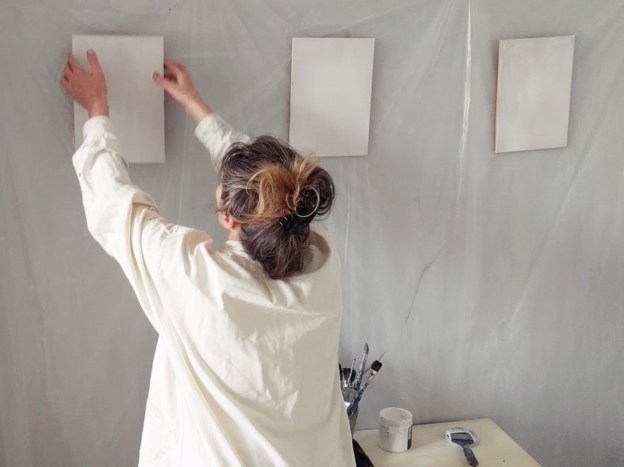
Above – Gesso-ing wood. (Adam Brewster 2021)
Pt 1: Here
Pt 2: Here
Pt 3: Here
Pt 4: Here
Pt 5: Here
Pt 6: Here
This is the fifth part of my artist’s diary series about creating paintings for The Folio Society’s publication of The Living Mountain, by author Nan Shepherd.
(The Folio Society edition of Nan Shephard’s The Living Mountain illustrated by Rose Strang and introduced by Robert Macfarlane is exclusively available at www.foliosociety.com)
Link to book …
The Living Mountain by Nan Shepherd, published by the Folio Society 2021
Pt 5: Dreaming a response

Nan Shepherd.
One of the most compelling descriptions the reader first encounters, in the first chapter of The Living Mountain, is when Nan describes wading into Loch Avon. Like many of her descriptions, it’s utterly arresting – you want to read and re-read the passage to fully imagine what she describes.
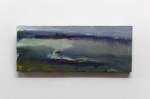
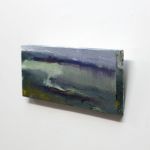
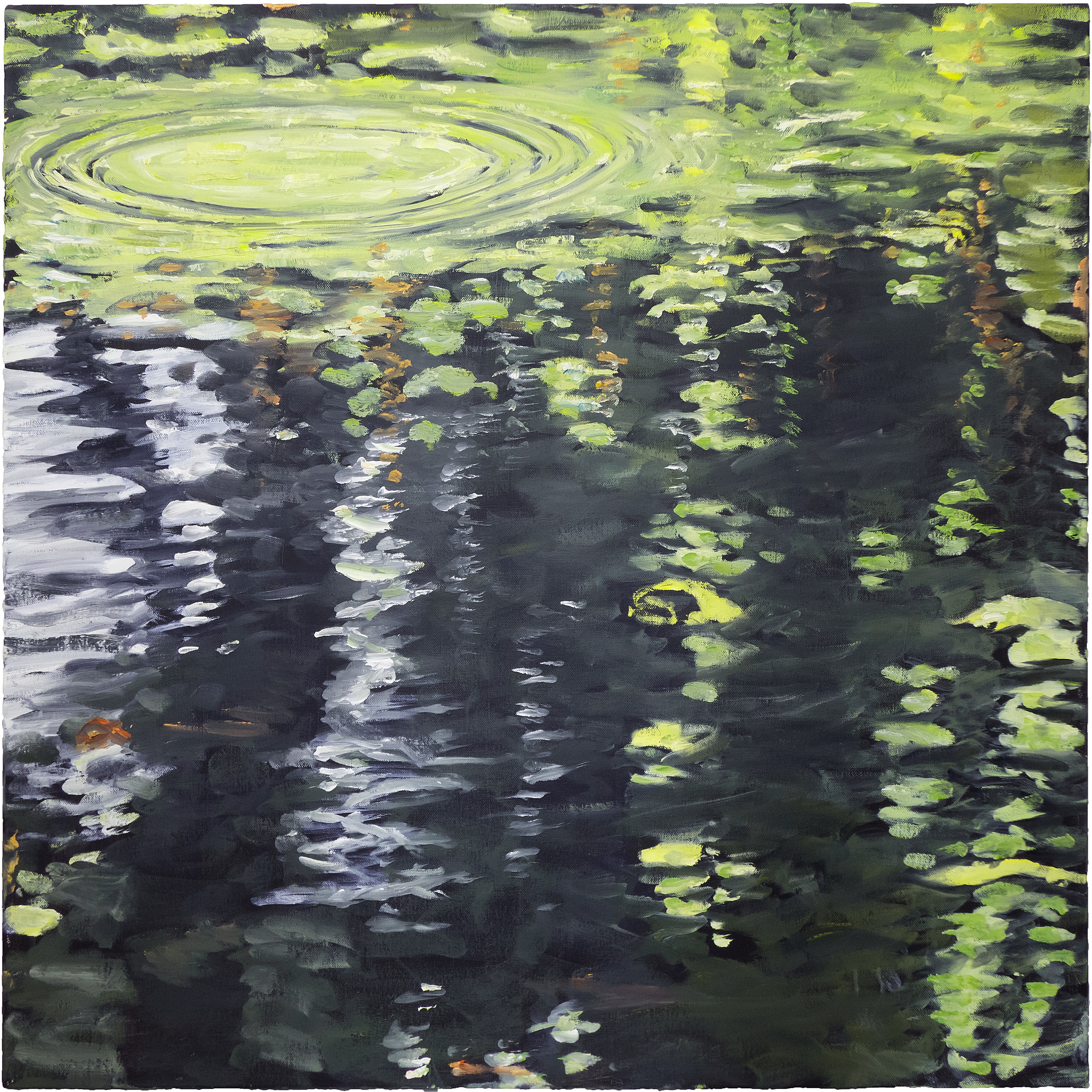
In reality, I’d have to be a mountain climber of Nan’s calibre to experience that description. I researched various images of lochs and transparent water, finally resolving to paint a certain view I’d discovered, but altered and with a lot of working and re-working of the surface to add a sense of atmosphere and energy. This became We waded on into the brightness.
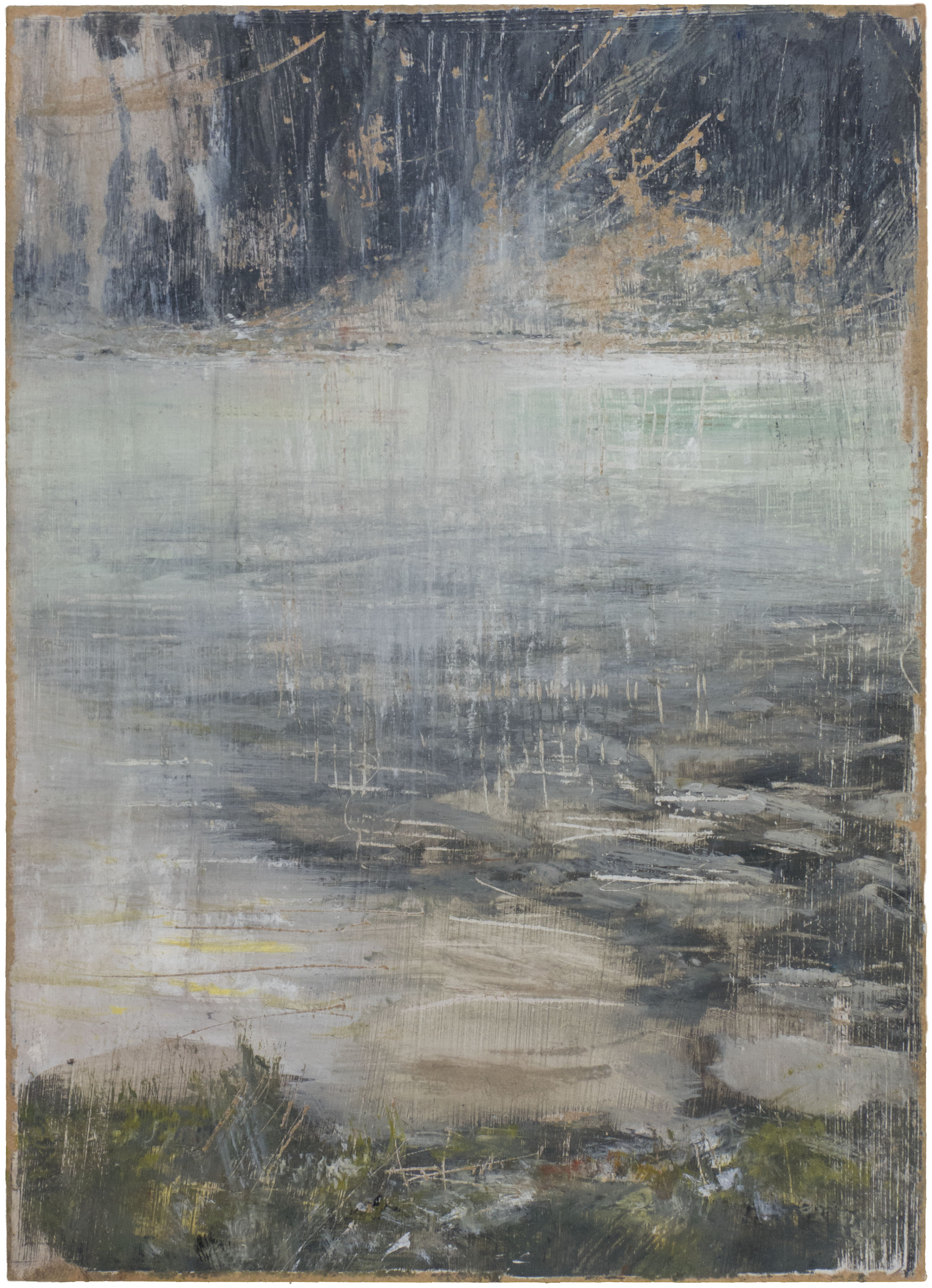
‘We waded on into the brightness. The Living Mountain Series’. Acrylic on 30x21cm wood. Rose Strang 2021
I re-read many passages from the book, seeking those which captured my imagination most. There were many descriptions I’d have loved to paint, such as Nan’s description of ‘Big Mary’ in the chapter titled ‘Man’. I’ have painted her in impasto craggy swathes with palette knife I think. Nan’s description of Big Mary’s character echoes the personalities she writes about so evocatively in her prior fiction novels. I had to consider how the paintings would work overall however, and I resolved to focus on what I paint most – an emotional and imaginative response to landscape.
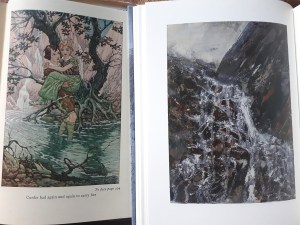
I felt my first attempt – We waded on into the brightness – was almost storybook or illustrative and I wasn’t quite sure if this was what I’d wanted, but I felt a slightly more realist painting might be a good start for readers, followed by slightly more abstracted paintings as the book progressed. My next painting attempt was Flowing from granite and, as mentioned, I wanted this to echo something of the magic in Charles Folkyard’s illustrations from The Princess and the Goblin by Aberdeenshire author George MacDonald.
That image, of Curdie carrying Irene through the flooded mountain valleys, is highly illustrative, romantic and ‘storybook’, yet magical because of MacDonald’s descriptions of the sense of overwhelming water throughout the book.
A Japanese friend of mine, Atzi, once described to me his response to Scottish landscape; ‘Its wateriness is different from anywhere else in the world’ he said, it’s unique – water is everywhere, sometimes slightly scary even’. I was also thinking of Nan’s wonderment as she observes the element of water:
I love its flash and gleam, it’s music, its pliancy and grace, its slap against my body; but I fear its strength… I have seen its birth; and the more I gaze at that sure and unremitting surge of water at the very top of the mountain, the more I am baffled. We make it all so easy, any child in school can understand it – water rises in the hills, it flows and finds its own level, and man can’t live without it. But I don’t understand it. I cannot fathom its power.
I decided to create descending ‘slabs’ in black and burnt sienna acrylic paint as a base. Acrylic dries overnight whereas impasto layers of oil paint can take weeks. Once my ‘rock’ base had dried, I made a solution of solvent and titanium white then allowed it to cascade naturally over my rock slabs. This was an unusual approach for me, I paint a lot of water, in fact it’s the subject I’ve focussed on most over decades of art-making and painting, so I can depict the visual appearance of water convincingly. For this painting though, I wanted the element of liquid itself to do the work.
When I’d finished I felt it ‘had’ something, but as usual I began to fiddle and dab and before long I’d completely spoiled the essence or energy of the original painting. Lesson learned though; it looked better when more ‘raw’. I wiped off all the oil paint back to my acrylic base and started again. I repeated this over a few days until at last it had just the right amount of … whatever it is that makes a painting feel ‘finished’!
Nan describes it as ‘that strong white stuff’, and I’d added here and there the subtlest touches of blue/green/grey while leaving the white just as it was. As usual, serendipity, and recognising when that was working for the painting, helped the final result. For example in wiping white oil off one area of the rocks, I’d inadvertently given it that wet sheen of damp which rocks take on, or stone buildings, when they’ve been thoroughly wetted. There’s also an inadvertent dragon’s eye in the rocks, which, once spotted can’t be unseen!
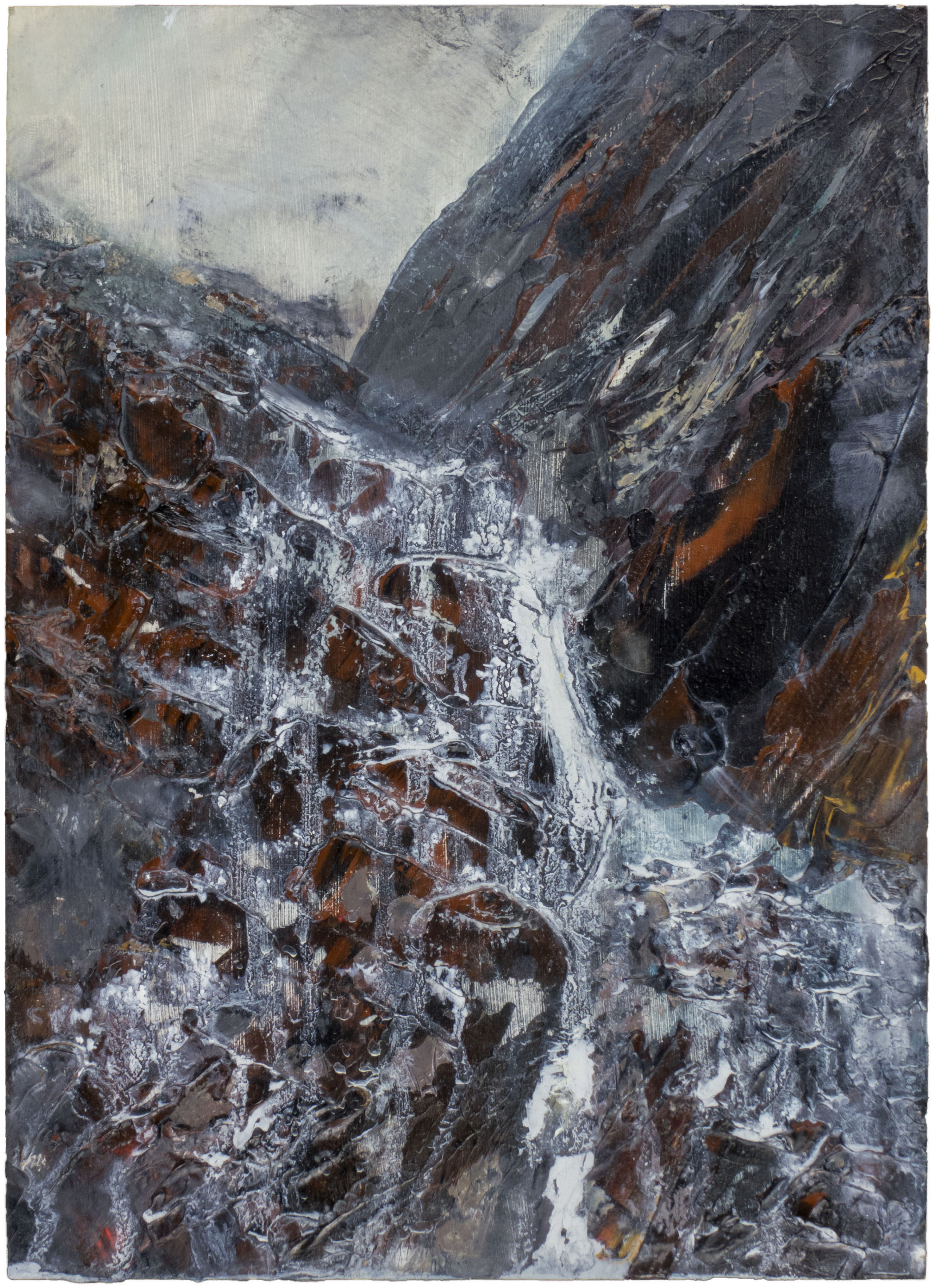
‘Flowing from granite. The Living Mountain Series’. Acrylic and oil on 30x21cm wood. Rose Strang 2021
Strange and beautiful forms are evolved was a collaborative effort in some ways. I wanted to paint the sense of ice and freezing cold. The first version was of light playing through an icicle, the next was an experimental play of textured whites and blacks. At this point Sheri Gee (artistic director of the Folio Society) required a progress report as this was written into the contract. I sent the works so far and she felt that the icicle painting didn’t have the elemental quality she’d liked about my previous paintings. I agreed and it cemented my sense of what she was looking for in these paintings. I experimented further with the black and white abstracted painting until icicles appeared, then added salt, varnish and further light effects until it seemed to work.
There’s the idea of painting what’s ‘there’ what the eye can see, then there’s the idea of painting what’s ‘felt’. I’ve always wanted to capture that visceral sense of landscape and my sense of Scottish landscape, particularly mountainous landscape, is that fear (though it might be fear and exhilaration) is quite often an element of that experience. Where my first ice painting had showed the beauty of natural ice forms, it had no feeling of ice. I thought the second version gave more a sense of the icy grip of winter.
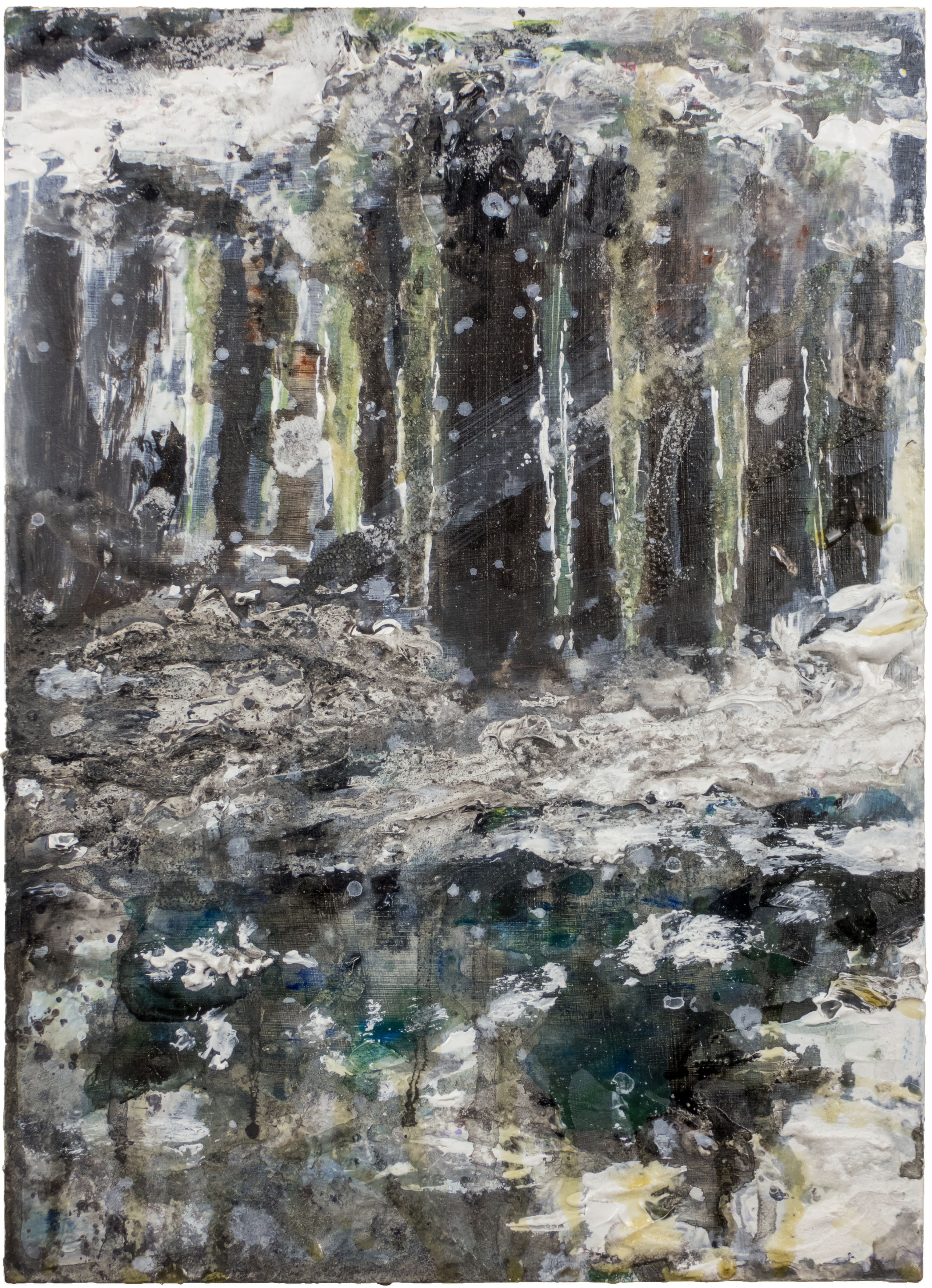
Strange and beautiful forms are evolved. The Living Mountain Series. Acrylic, salt and oil on 30x21cm wood. Rose Strang 2021
My next painting – For not getting lost is a matter of the mind – was maybe more of a conceptualised idea of the fear of getting lost in a blizzard. I used gridded paper as a base, messed up to give the sense of disorder, then painted over it to suggest snow and mist. Finally I took the image of a compass and placed in the top right corner, facing the wrong way. So far no-one has commented on this! But I wanted to reflect the fact that, especially in Nan’s day, handling a paper map in a freezing hurricane is no easy matter and is definitely ‘a matter of the mind’, or mind over matter since fear is very real in such circumstances.
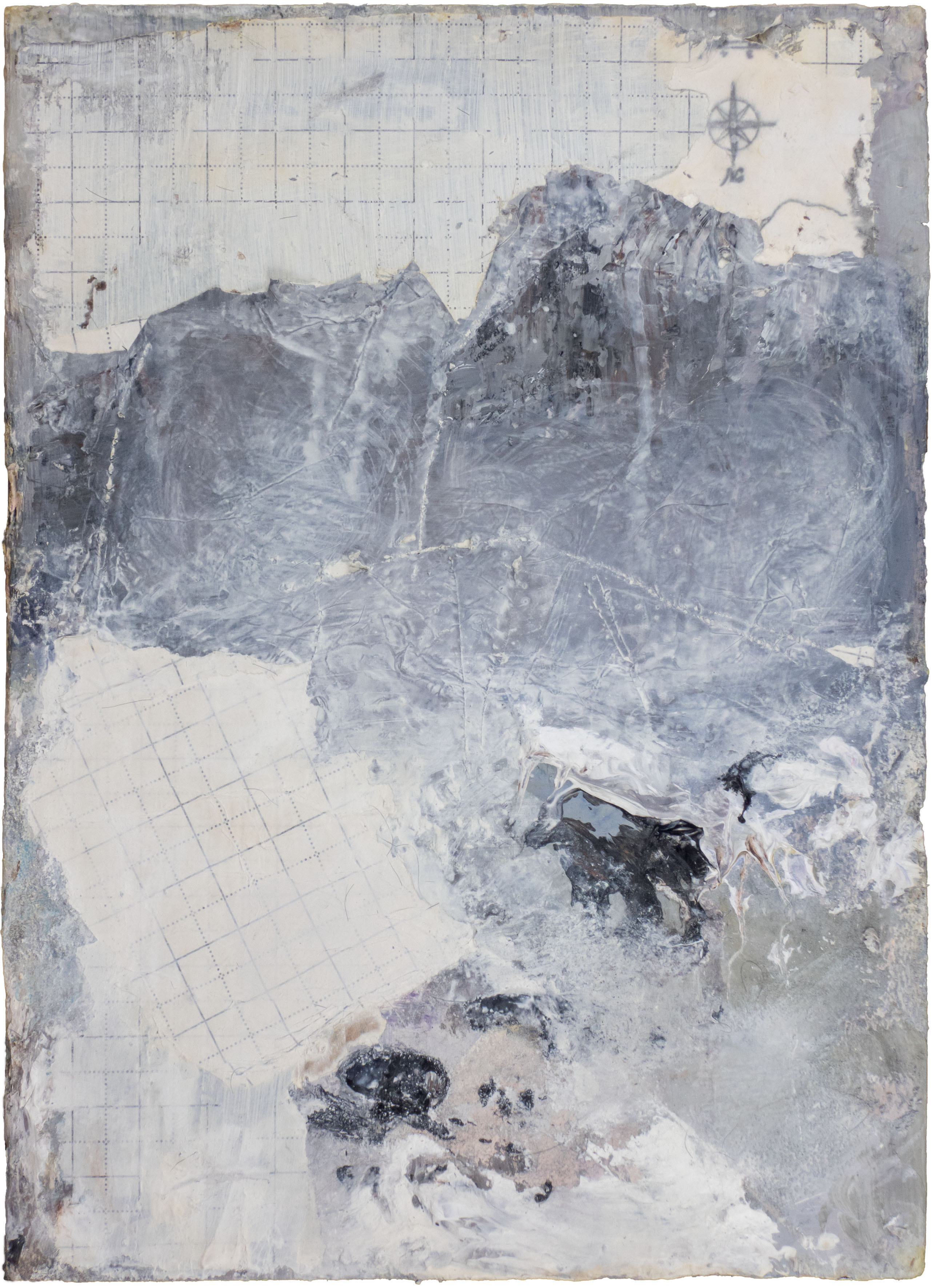
‘For not getting lost is a matter of the mind. The Living Mountain Series’. Grid paper, and acrylic on on 37x27x2 cm antique pine. Rose Strang 2021
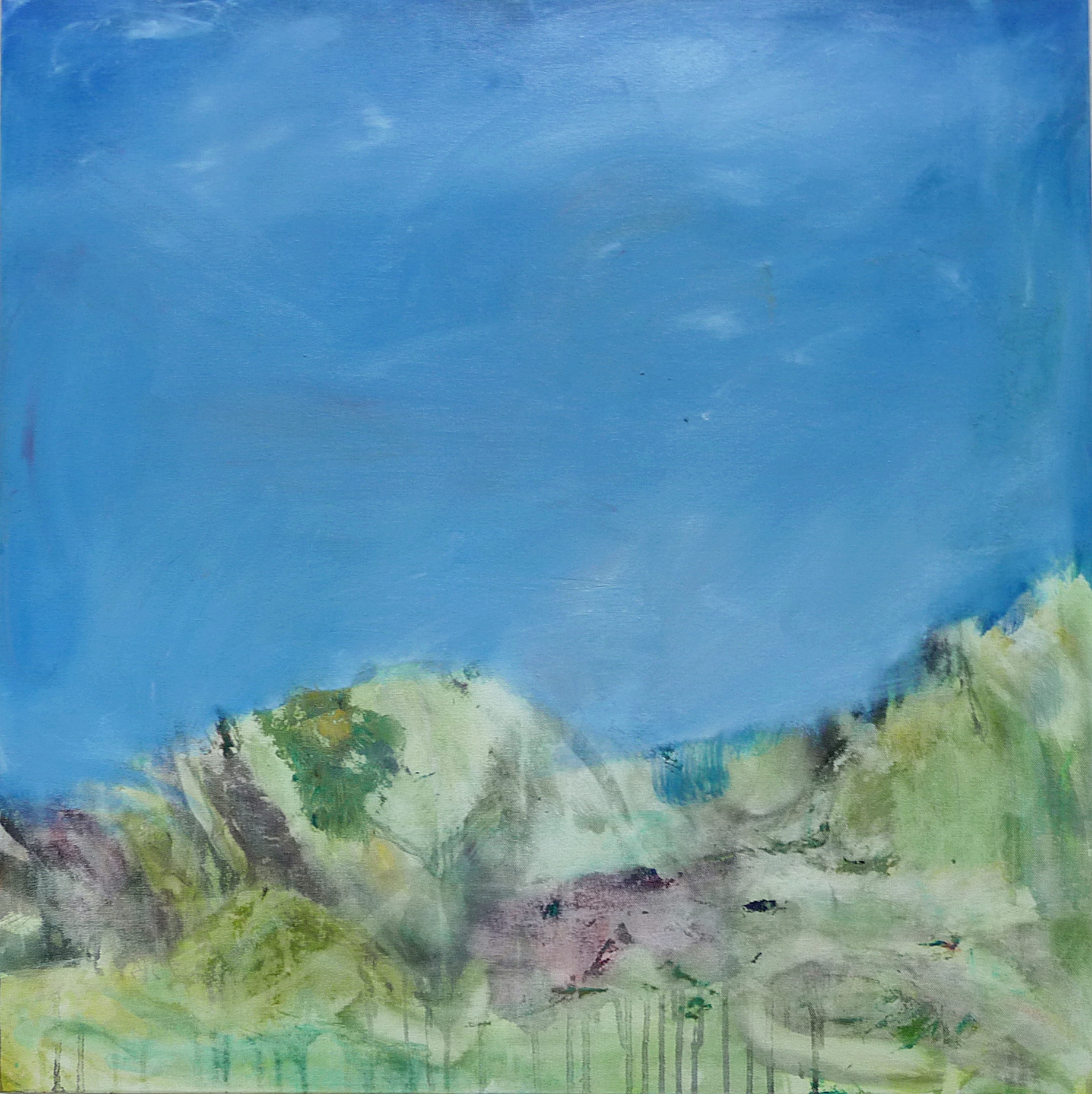
Having dealt with the ‘roaring scourge’ element of the Cairngorms, I now wanted a complete contrast, more ‘delectable as honey’ to quote Nan’s introductory words. Heather and honey go hand in hand in Scotland, plus I absolutely loved Nan’s description of the little girl’s reaction to her dad calling her to heel, responding ‘I like the unpath best’. I knew, as do Nan’s readers I’m sure, exactly what she meant! It’s always more satisfying to wander off the beaten track, where your feet can sink into squishy sphagnum moss, or on a hot day you can fling yourself onto a springy bed of heather to gaze up at the blue, blue sky filled with butterflies, or dazzling blue or green dragonflies.
If I were a realist painter I’d have painted these beautiful insects, but instead I tried to suggest their flight with scratches into the surface suggesting movement, amid watery hazes to suggest the warmth of sunshine ‘all around the blooming heather’ to quote the popular song. The mountains in summer can be delectable as honey indeed.
The wildest most remote areas of Scotland can have an almost fairy-tale atmosphere of primitive, Eden-like lushness and I wanted to capture something of those birthday-cake colours and mood in my painting, while keeping the style loose.
One of my favourite holidays as a girl was when my sister and I with our mum and her friends stayed at Craig Youth Hostel in the Torridon area. It was late June and I remember a huge metallic-green dragon fly flew on to my hand. I wanted to pick it up and it bit me then flew off! I could see the tiny serrations of skin on my hand and felt very sorry I’d upset it.
On the subject of dragonflies – many years later, I’d decided to work as an arts manager for the NHS (UK National Health Service). It was a choice made from some place in my mind that told me I had to choose a ‘sensible’ job. I’d already struggled through a year’s contract with one hospital – feeling very much a fish out of water – and now that contract was over it was time for me to find another job. I was interviewed for the position of arts manager by one of the UK’s largest hospitals and was genuinely surprised when they phoned to say I’d been successful.
I felt relieved, as you do if you worry about income, but also I knew something was missing. On the first day in the office I was shown to my desk. It was in a grim 70s building due to be demolished in the next few years. The office room was painted in peeling light blue paint, the lights were fluorescent (which had a tendency to give me a headache). I fought off a growing feeling of impending imprisonment as I sat at my desk. I remember that day I wore a grass-green wool dress to cheer me up – it’s a colour that brings the sense of nature into our lives and this building felt entirely unnatural. I looked out the windows on to a sea of cement.
At this moment an enormous metallic-green dragonfly somehow managed to fly in through the tiny slats at the top of the windows. I couldn’t believe my eyes – what would bring a green dragonfly into this enormous concrete jungle of a hospital site, never mind in to this tiny office space? I was reassured it was real though, by the ‘ooo’s’ and ‘wows!’ of my office colleagues. It flew in graceful acrobatics around the room, but clearly it was beginning to panic. I remarked on its obvious dilemma; ‘We have to let it out’. (In retrospect it’s one of the few requests I made during that job that was actually fulfilled!) Three of us managed to open the windows on their rusty hinges and at last the dragonfly flew off to freedom. Two years later I handed in my notice and within a year became a full-time painter. I think that dragonfly had a message for me.
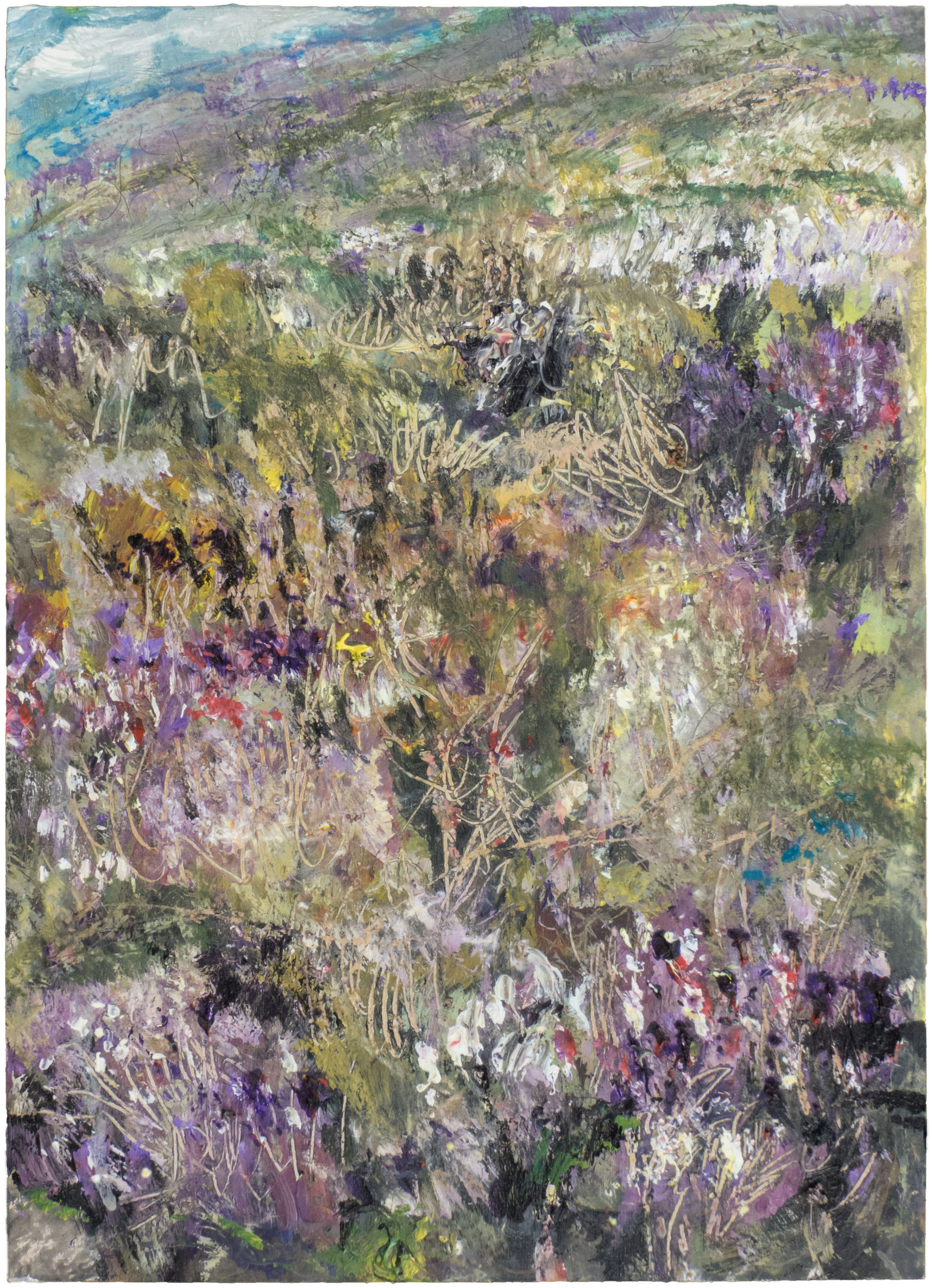
‘I like the unpath best. The Living Mountain Series’. Acrylic on 30x21cm wood. Rose Strang 2021
I now had just two more paintings to complete. With these I wanted to reflect the final chapters of The Living Mountain, to reflect Nan’s deeper philisophical, or spiritual response to the mountain. This is subtly touched on by Nan and I hoped to suggest this sense equally subtly in the final paintings.
Coming up – Pt 6: Being
















 Rose Strang Artworks