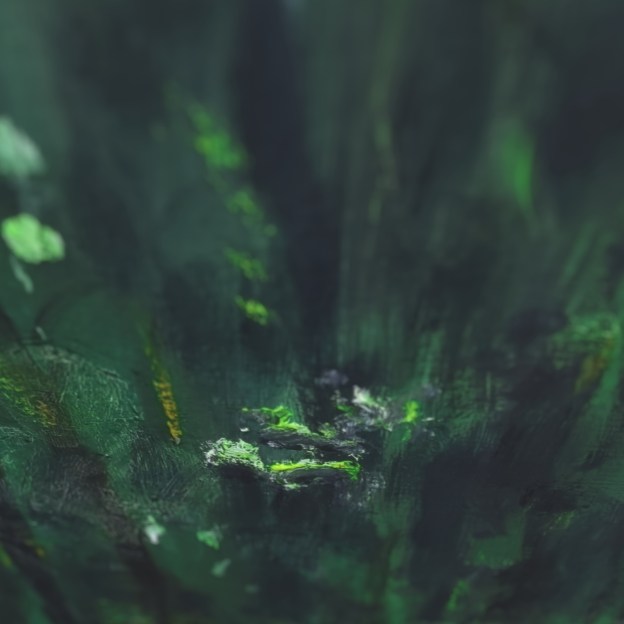
Above: detail from Forest of Luffness 1. Oil on 30×30″ canvas. Rose Strang 2025 (photograph: Adam Brewster)
The following is an essay by Rose Strang, to accompany a project called Traces. More information at the end of the essay.
The Medieval Way of Seeing (by Rose Strang, 2026)
Gold and fine silver, carmine and leaded white, indigo, lignite bright and clear, an emerald after it has just been split, placed in that dell would see their brightness fade against the colours of the grass and flowers.
Dante Alighieri, Purgatorio, Canto VIII
In some sort of crude sense, which no vulgarity, no humour, no overstatement can quite extinguish, the physicists have known sin; and this is a knowledge which they cannot lose. Robert Oppenheimer (1947 lecture “Physics in the Contemporary World”.)
Why does a ruined friary, or an 800-year-old crusader effigy matter now? What can the medieval way of understanding the cosmos offer our fragmented present?
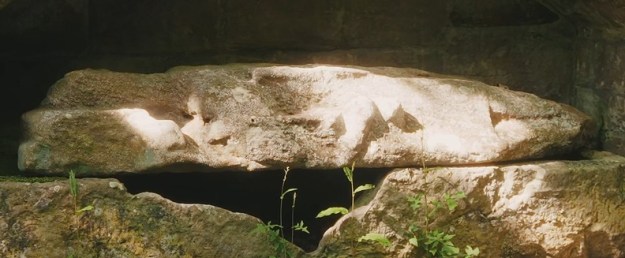
This was the challenge presented to everyone who took part in a contemplative journey to Luffness in June 2024.
The medieval mind operated with a fundamentally different framework to ours. It integrated layers of reality, perception, and imagination: a thing could be matter and meaning, physical and symbolic, particular and universal. The medieval worldview saw reality as symphonic; a synthesis where all is connected within overall harmony. This is exemplified in medieval cosmological thought and in their application of cosmological symbolism to interpret the material and spiritual worlds.
That the Medieval era also saw acts of terrible violence overshadows this harmonious view of the cosmos. Extensive evidence of brutality has perhaps come to represent the medieval past more than the visions that characterised co-existing peaceable realities, as indeed these forces co-exist today.
Dante described Purgatory’s valley, where emeralds, split open, might fade against the almost unbearably luminous grass. Six centuries later Rutherford, Cockcroft and Walton were credited with splitting the atom. Oppenheimer then developed this into the atom bomb, subsequently observing that ‘knowledge of sin’ cannot be lost. How can we, all of us, navigate threshold states between the desire to know more, to control, and to refrain?
The medieval belief was this: life is best understood not solely through intellect but through the whole spectrum of human response. Science offers facts; the medieval mind accepted facts alongside ‘the cloud of unknowing’. They embraced paradox.
Our rejection of the medieval view of the universe has diminished our capacity to understand ideas as interconnected, layered, or able to exist in parallel.
There remain, even now, ways of attending to the world that resist reduction to a single frame: observation of natural phenomena; the act of walking as a form of enquiry and contemplative practices that suspend immediate judgement in favour of sustained attention. These approaches do not reject knowledge, but deepen it, allowing different kinds of understanding to coexist.
Contemporary education trains us to see one layer at a time: the scientist sees cells, the economist resources, the tourist scenery. We fragment knowledge into competing specialisations, each claiming exclusive truth, creating a selective amnesia, and an inability to integrate complexity. When science operates on materialist grounds alone, divorced from ethical dimension, we begin to understand what the physicist’s “knowledge of sin” might mean: technologies of destruction, power without wisdom.
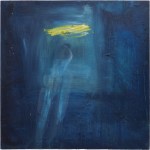
These ideas become material in the ‘threshold trilogy’ of Traces, which embodies this tension. Created following winter visits to the friary at Luffness, it explores the opposing forces of historical violence and spiritual seeking.
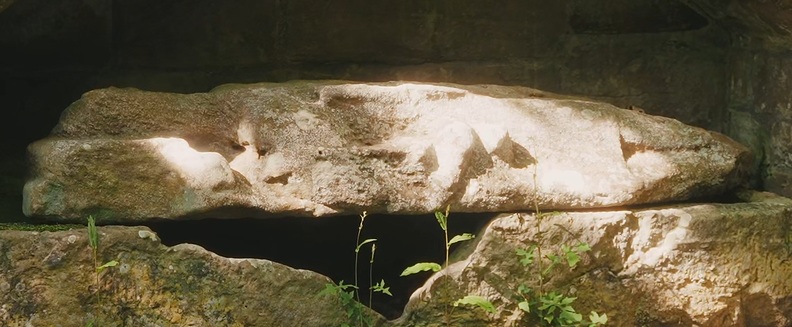
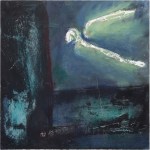
In one painting a wraithlike figure emerges from catastrophe , hovering above charred remains. The faint presence of David de Lindsay (the figure commemorated by the stone effigy at Luffness Friary) hovers in liminal blue depths, imagining home while he dies from battle wounds in the Egyptian Crusades of the thirteenth century.
-
-
‘Abyss’. Oil on 20×20″ canvas. Rose Strang 2024
-
-
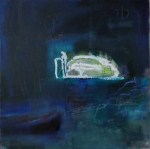
These works explore unpalatable contradictions: crusader as perpetrator and penitent, Christianity used as instrument of conquest, or
aspiration towards grace. When we perceive only one dimension of reality at a time, we no longer navigate paradox or recognise that multiple truths might coexist without contradiction. We lose the integrative thinking that prevents us reducing complexity into simplistic binaries. In an era of intensifying polarisation (political, cultural, epistemological) this loss is profound.
An 800-year-old crusader effigy matters because it embodies the very complexity we’ve lost. The medieval crusades were brutal exercises of power, yet the medieval mind also gave us the ability to synthesise different ways of understanding the world.
When contemporary extremists adopt crusader imagery, they enable fragmented thinking by taking a symbol and flattening it to single meaning, stripping away the complexity that the medieval world embraced. Recovering more complex ways of knowing is essential, if we are to understand the reductionist thinking that feeds fundamentalist beliefs and cynicism.
David de Lindsay‘s motivations towards fighting in the crusades, or founding a friary and seeking redemption, cannot be understood through contemporary either/or thinking. The Forest paintings of Traces document the pilgrimage to this effigy with Richard Demarco, whose lifelong philosophy embodies this medieval integrative approach. In these paintings, figures remain deliberately small within the cathedral-like forest, dwarfed by something larger than themselves.
Traces demonstrates this medieval capacity to perceive multiple dimensions simultaneously. The forest paintings show intergenerational pilgrimage just as Traces, the documentary film, captures Richard Demarco at 93 and the youngest member of the group – baby Atlas (the son of my niece, Emma Mases-Strang and her partner Manuel Pennuto, who created the documentary).
During the day at Luffness, Richard asked the new parents; “Will you tell Atlas about me when I’m gone?” In the documentary Richard and Atlas alone look directly at the camera. Breaking the fourth wall, they seem to ask the viewer a question; what, in the end, passes between us and those who come after?
Time becomes symphonic: the 800-year-old effigy, Demarco’s enduring memory of post-war Europe and the friary’s broken arch, which stands as the project’s central symbol of our fractured present. Yet, the act of walking there together, witnessing what is past, what exists and what we leave to posterity, enacts a medieval way of seeing and a way to seek deeper truth through shared acts of pilgrimage.
Rose Strang 2026
Quotes
Oppenheimer, J.R., 1947. Physics in the Contemporary World. Available at: https://www.oxfordreference.com/display/10.1093/acref/9780191826719.001.0001/q-oro-ed4-00007996
Dante Alighieri, Purgatorio, Canto VII, quoted in Jason M. Baxter, The Medieval Mind of C. S. Lewis: How Great Books Shaped a Great Mind. InterVarsity Press, 2022), page 50.
Bibliography
Lewis, C. S. The Discarded Image. Cambridge: Cambridge University Press, repr.2013
Ward, Michael. Planet Narnia. The Seven Heavens in the Imagination of C.S. Lewis. Oxford University Press. 2008.
Baxter, Jason M. The Medieval Mind of C. S. Lewis: How Great Books Shaped a Great Mind. InterVarsity Press, 2022.
Traces is a project in development, featuring paintings by Rose Strang and a documentary film by Manuel Pennuto.
A password-protected page contains the film trailer, a lead painting, and full information about the project, including details for curators and venue partners. Access is freely available on request: please write to rose.strang@gmail.com for the password.

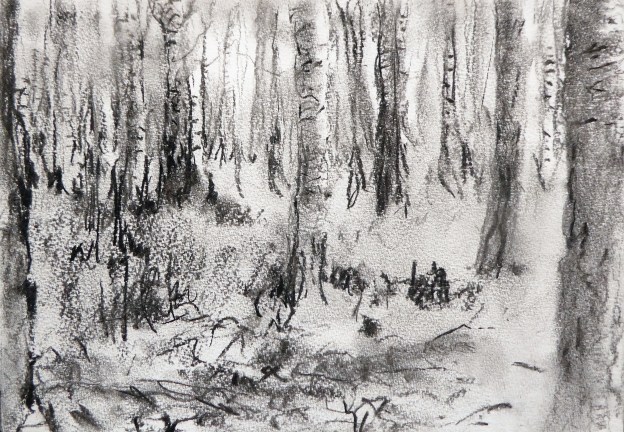
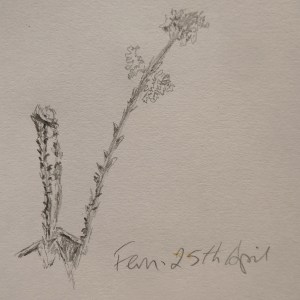
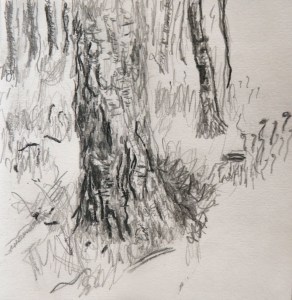
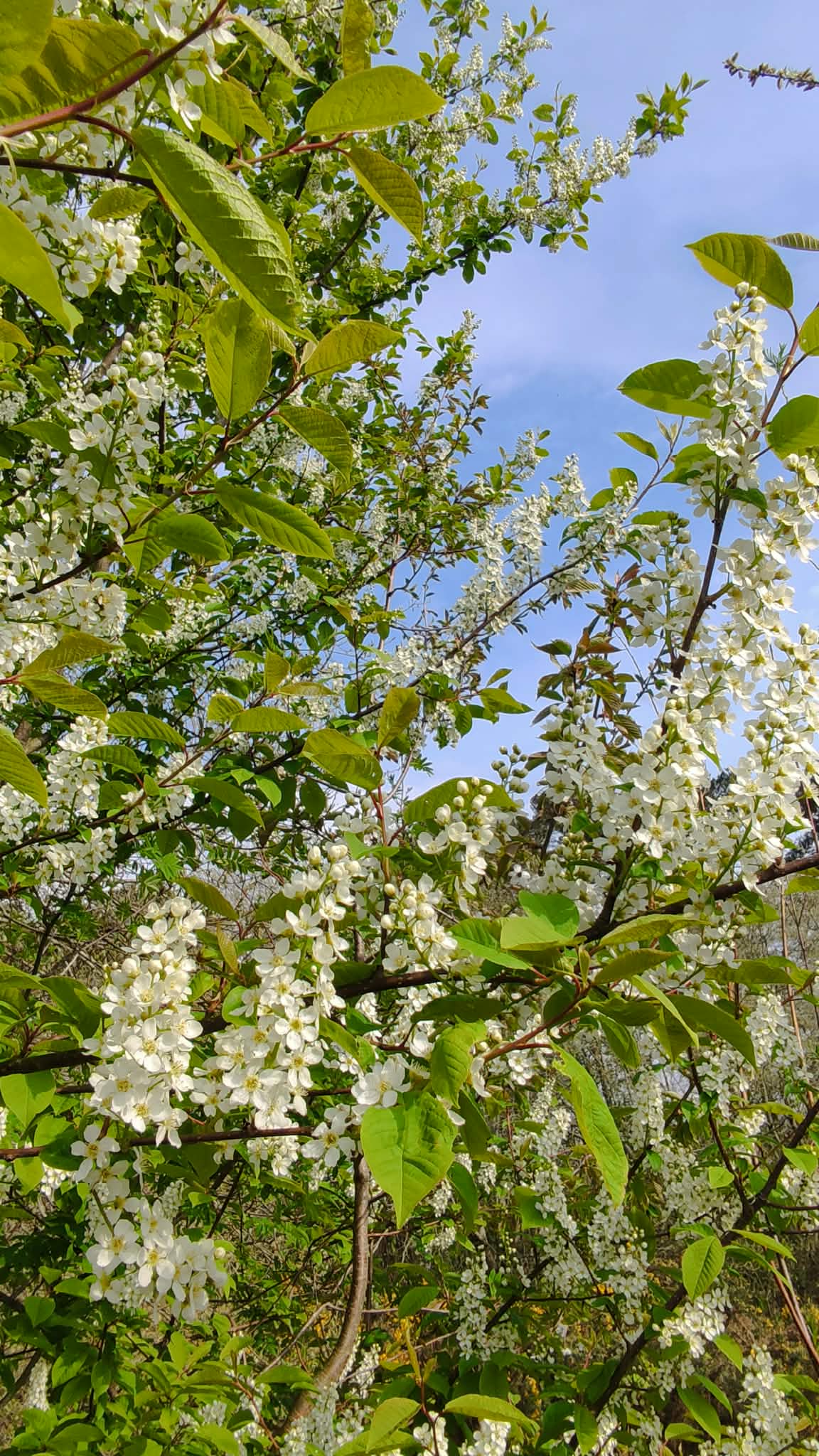 (I’m taking notes and writing a blog post each time I go to Fairhill, which is a piece of forest land owned and managed by the Life Science Centre, which is informed by Goethean science and philosophy. My trips to Fairhill are my record of a Goethean approach to observation – bringing a deeper awareness and understanding of nature. Sketching is an important part).