Tag Archives: scottish landscape artists

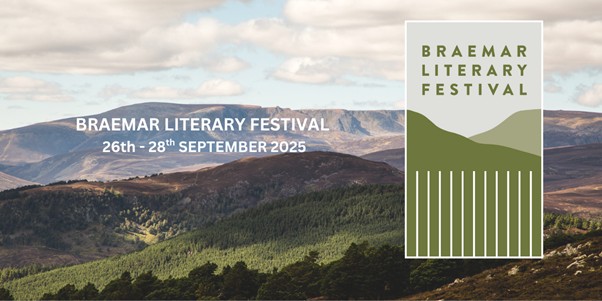
Braemar Literary Festival September

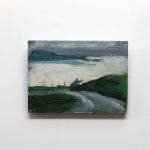
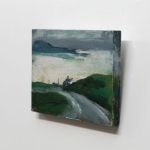
I’m excited to be part of the Braemar Literary Festival this year. Not as an author, more as an artist in thrall to an author; namely Nan Shepherd and her much acclaimed book about the Scottish Cairngorms: The Living Mountain.

My paintings from the Living Mountain Series will be showing in the Highland Pavilion, Braemar on the 27th and 28th September and I’ll be there for ‘meet the artist’ from 12 noon to 1:30pm.

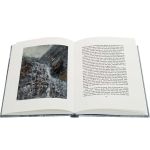
If you follow this blog you’ll maybe remember the exciting commission I was given by the Folio Society, London, in 2021. The Folio were re-publishing their own edition of The Living Mountain, and sought an artist to illustrate the book. I felt honoured and surprised – this being one of my favourite books of all time! (the Folio edition is now completely sold out – it’s possible to buy a copy online from booksellers but it’s now into the £100s. How I wish I’d held on to more of the copies they gave me. I have just one left)

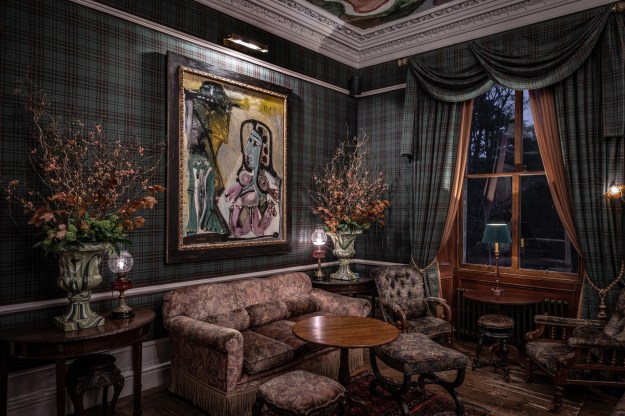
The Braemar Literary Festival was founded by world-famous art collectors Hauser and Wirth, who own the Fife Arms Hotel in Braemar. The’ve turned the hotel into a quite extraordinary experience, the place is festonned with stunning original works of art including a Picasso and an enormous Bruegel in the dining room. The atmosphere is high-end but not uppity, the style in keeping with its Victorian heritage, they even have a framed letter by Queen Victoria tucked away in an alcove somewhere.

Guest speakers to the festival will include Monica Ali, Alexander McCall Smith, David Nichol (known most recently for the televised version of his heart-rending novel; One Day), Giles Coren and many more interesting authors, journalists and presenters (link Here)

Hope to see you there! Here’s the info again …

My paintings from the Living Mountain Series will be showing in the Highland Pavilion, Braemar on the 27th and 28th September and I’ll be there for a ‘meet the artist’ hour from 12 noon to 1:30pm.

Iona Sea, new exhibitions

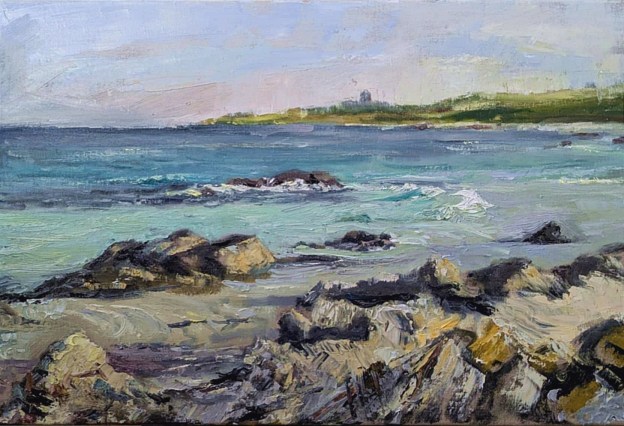
Above: Iona Abbey from North Beach. Oil on 30×20″ linen canvas. Rose Strang 2025

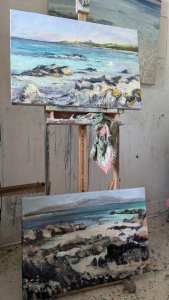
Today’s painting, above, is one of two landscapes for the upcoming Graystone Gallery exhibition in Edinburgh which launches on Saturday 19th July this year from 1 to 3pm

I’m taking these two landscapes as a starting point for two much larger abstract works for the Graystone, about which I’m very excited as I really awant to play with colour, mood and texture, not just views of Iona, lovely as those are to paint!

Just looking at my palette at the end of today is an inspiration!

More next week …

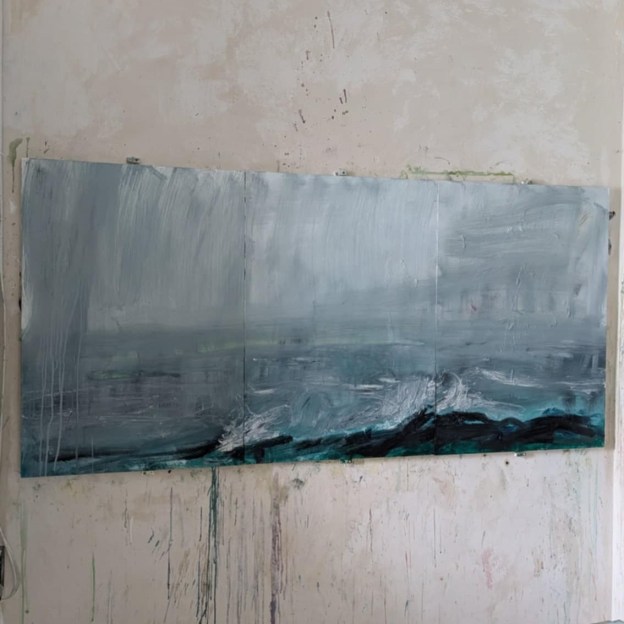
Seascapes

Above: Sea Triptych. Oil on three 33×22 inch wood panels.

Below, some smaller works in this new seascapes series –

This series is part-inspired by the Aberlady landscape – which has been a focus this year in most of my paintings.

This style of painting feels very natural and comes easily to me, but I’m still working on expression of the Luffness woods and Carmelite Friary (in Aberlady theme). Sometimes there are too many ideas and it’s better to simply paint instinctively for a while until something more unified swims into focus.

The upshot is that I’ll return to that theme after a brief hiatus into my ‘default mode’ of moody seascapes!

More details soon …

Maspie Waterfall

Above – Maspie Waterfall. Acrylic on 17 by 16 inch wood panel.

A semi-abstract painting of layered acrylic depicting Maspie waterfall in Autumn.

Maspie Burn winds its way from the Lomond Hills in Fife down to the beautiful little town of Falkland. It’s a quiet place, best known for Falkland Palace – a favourite dwelling place of Mary Queen of Scots. There have been settlements here going back into the mists of time, or pre-history to precise. If you keep walking up to the source of Maspie Burn, you’ll eventually encounter earthworks named Maiden Castle, which show the remains of an ancient fort.

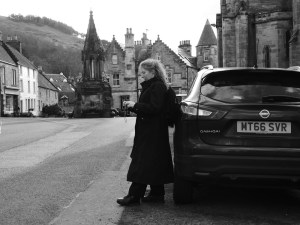
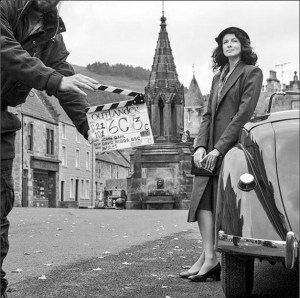
Falkland recently became better known as ‘Inverness’ in the tv series Outlander – it’s very much cuter than Inverness mind you, inverness having become a small but busy city. Photo below, me posing in Falkland, ala ‘Claire’, looking quite a bit sturdier and shorter than the model-esque Caitriona Balfe!)

I left the painting fairly abstract as it captures the energy of Autumn without going too pretty. The wood was actually part of a series of old cupboards from a flat owned by some friends of ours. Knowing I usually paint on wood, they asked if I’d like use it for painting. Yes indeed! I like re-using stuff.

Some photos of Falkland and a photo from our walk this weekend at Maspie Waterfall, you can walk behind it!

Forest of Luffness, painting progress 3

Above Forest of Luffness 4. Oil on 14×14 inch wood. Rose Strang 2024

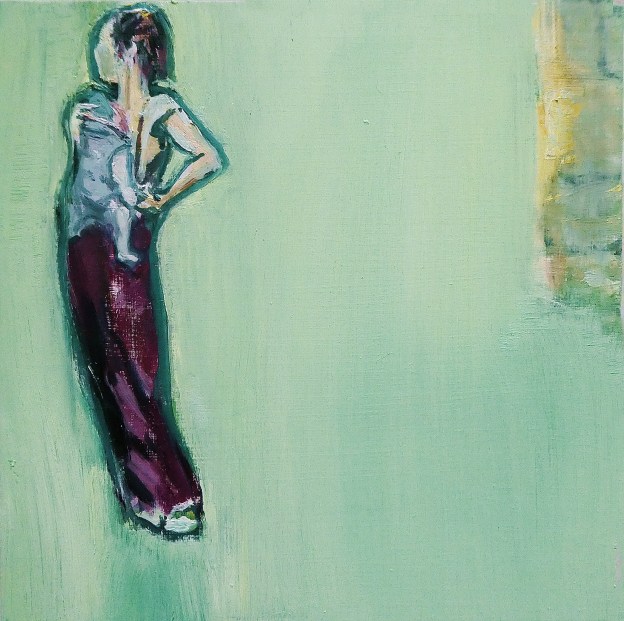
Today’s painting (from a series in progress inspired by the presence and history of a Carmelite Friary in the forest of Luffness) features my neice holding her new born baby, standing within the Friary.

I wanted to capture the sense of strength and protection that a young mother exudes, then the style of painting changed slightly and became a bit more contemporary. Probably something to do with Emma’s outfit which was quite contemporary.

I like this as a smaller study in the series. (All four paintings from this particular summer series below). I’ve been exploring the theme of the Carmelite Friary in Luffness since January, but each set of paintings is distinct to each season.

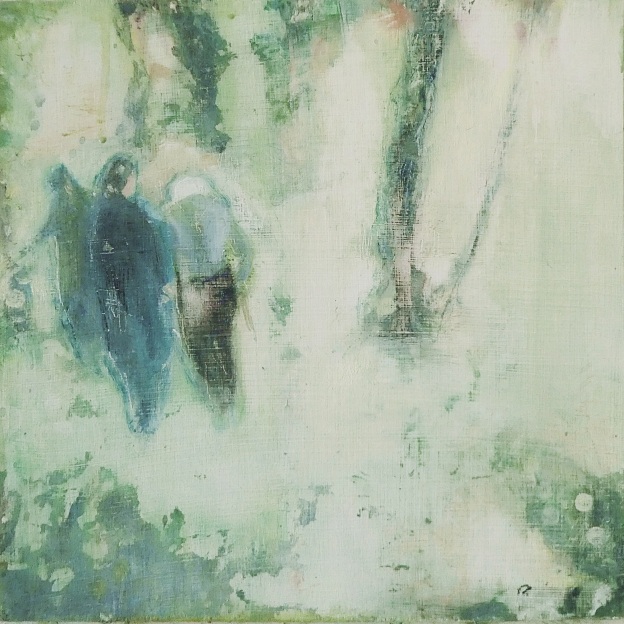
‘The Path’

The painting above The Path. Water mixable oil on 14 by 14 inch wood, depicts a meaningful walk (with Richard Demarco and Terry Ann Newman) towards the 12th century Friary ruins at Luffness recently.

More on that in this post – Dappled things

Some painting details …

.

More oil sketches …

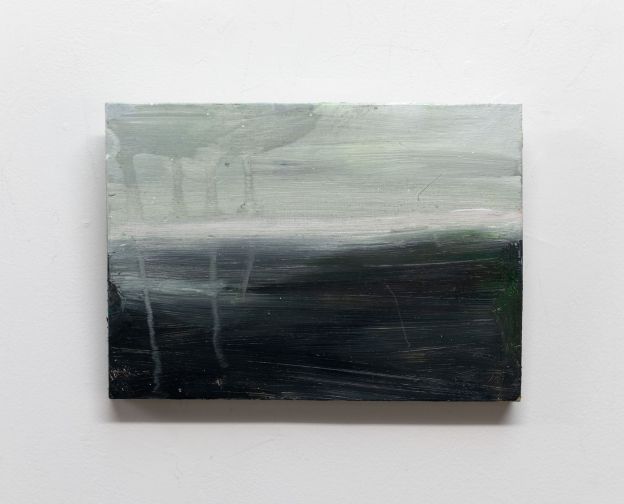
Above: Shorelines, Aberlady. I. Oil on 8×5.5″ wood. Rose Strang 2024

More oil sketches in progress today inspired by the shorelines and moods of Aberlady…

For my experimental paintings and ideas I’ve been working at this size for some time and it really works for me in terms of loose brushwork. It would be a bit of a nightmare to work at a larger size with this more experimental messy approach – that would be a lot of oil paint going to waste when it doesn’t work (which is often!) and a lot of physical energy and time expended.

It’s been a while since I posted a video of my working process. I’m very forgetful of such things but people seem to enjoy them, so one of those coming up soon.

I’m also still working on my Carmelite monastery and Crusader’s tomb series (see older posts) which are very different in feel to these smaller landscape paintings. I love the freedom of my smaller landscape paintings, but I think I have something more to say as an artist so I’ll be persevering with that series over the coming weeks. It’s important to get out of my comfort zone and dig a bit deeper …

Winter Exhibition at the Resipole

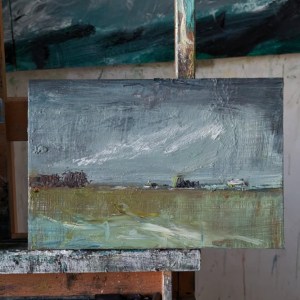
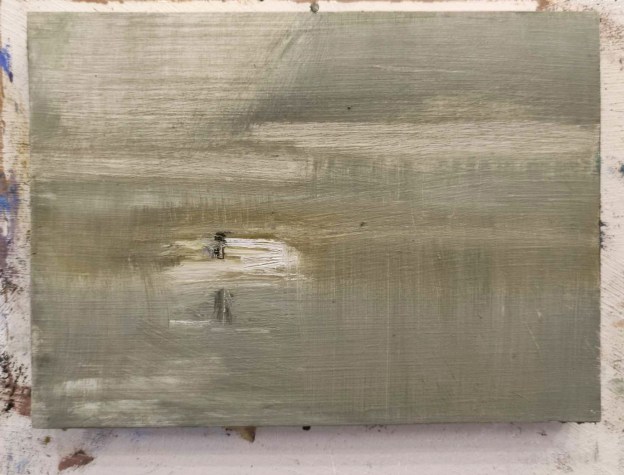
Above: Coigach 1. Oil on 5×7″ wood. Rose Strang 2023

Six little paintings on wood from my ‘Coigach series’ are showing as part of the Resipole Gallery’s Winter Show. Beautifully presented as always by the gallery curators alongside some wonderful paintings and ceramics – all reflecting the textures and atmosphere of Scotland’s west coast. Here are the six paintings in the show …

The exhibition runs from December until 29th February 2024. You can view the exhibition Here, or better still travel up there to experience Ardnamurchan – one of the few places where you can still walk among Atlantic oaks at the edge of white beaches with turquoise sea lapping the shore.

Traces of the past

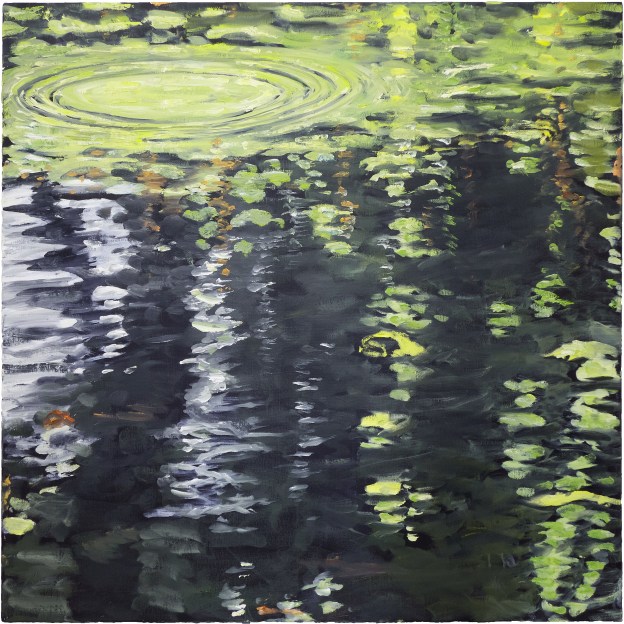
Above: Trace. Blackwater. Oil on 80x80cm canvas. Rose Strang 2023

Traces of past cultures in landscape have fascinated me for many years. Especially those traces so subtle you’d walk past, barely noticing them. Expressing this subtlety in paint is a challenge.

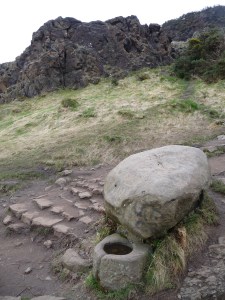
While painting a series in 2018 titled ‘Wells of Arthur’s Seat’ I started to find a way. There are literal traces, like the trace of a chain on the boulder near St Anthony’s Well which was originally attached to a metal cup above a carved stone basin. The spring has long since dried up, but as late as the early 20th century people from Edinburgh would sip the water, or soak cloth in the water then apply it to their body in the belief it cured disease or imbalance.

I don’t want to paint literal traces, however, and while exploring the history of St Anthony’s Well I became immersed in the mystery of water. Its layers, veils and reflections suggested timelessness, ‘as above so below’, or the idea of liminal or in-between places.

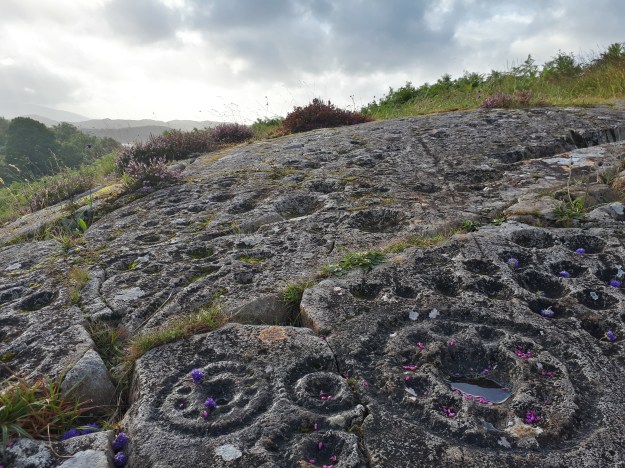
Painting ripples left by, for example, a falling twig, reminded me of pre-historic concentric rings carved into rocks around the British Isles. No one knows why those carvings were created, but to me they suggested ever multiplying rings created by cause and effect – a falling leaf that creates a pulse of water, shifting tectonic plates that create the huge pulse of a tsunami, or the mystery of gravity and the orbiting planets and moons of our solar system.

When I visited Saxon burial mounds at Sutton Hoo in Suffolk it wasn’t the mounds themselves I wanted to paint, it was the river that led to the mounds – the River Deben. I painted reflections on the river and the wake left by a passing boat – to me the flowing river brought that past culture to life more than the burial mounds. Cultures change and become strange or indecipherable but a boat’s wake remains the same. I could envisage their arrival from northern Europe to the Suffolk coast up the River Deben, imagining what made them settle here and select this particular spot as as a sacred burial ground.

Then the process of painting the layers of water was so complex in itself – there is translucency and opacity, reflections, the rhythm of flowing water and the fact of constant movement and change. I was also thinking of the fact that nature was at the heart of Saxon culture and religion. For example the tree of life – Yggdrasil – which encompasses many different worlds. Each of the tree’s three roots is fed by three different wells representing past, present and future.

These myths reflect a truth – that everything is connected. Our recent past, encompassing the industrial revolution and unprecedented consumption of resources, has taken us full circle back to this realisation of inter-connectedness, and the dilemma of how to move forward. Our culture will leave more trace than any that came before us.

At Loch Venachar in the Central Highlands of Scotland, I searched for the remains of a Crannog (iron-age man-made islands on which wooden dwelling structures were built). The island itself was visible, but sadly concrete had been poured onto the remants, probably to prevent it being washed away. Again, literal remnants didn’t move me so much as the trace of stones leading to the island – just the merest suggestion that in this area at the loch’s edge the stones were just a little raised. Gazing at the stones as dawn rose, rays of sunlight began to reveal the stones beneath the surface, while further away the surface remained opaque. These half-revealed images suggested more to the imagination.

Loch Venachar is fed by the Blackwater River and as we explored further along the river side, I found myself mesmerised by the reflected green/yellow light of foliage in the black water, still as a mirror, which brought to mind Corinthians 13:12:

For now we see through a glass, darkly; but then face to face: now I know in part; but then shall I know even as also I am known.

These ideas are complicated to express creatively in an image. Or not so complicated when simply observing what’s there; traces on water – concentric circles, ripples, what’s revealed below, or concealed from view, what is mirrored back to us. Although we can’t know all, we do know that all is connected. When contemplating nature these images become poetic and profound.

This series of three paintings – Trace. Sutton Hoo, Trace, Portnellan Island, Loch Venachar and Trace, Blackwater, will be on show as part of the exhibition Borrowed Land, which launches at The Kilmorack Gallery on the 18th November 2023.
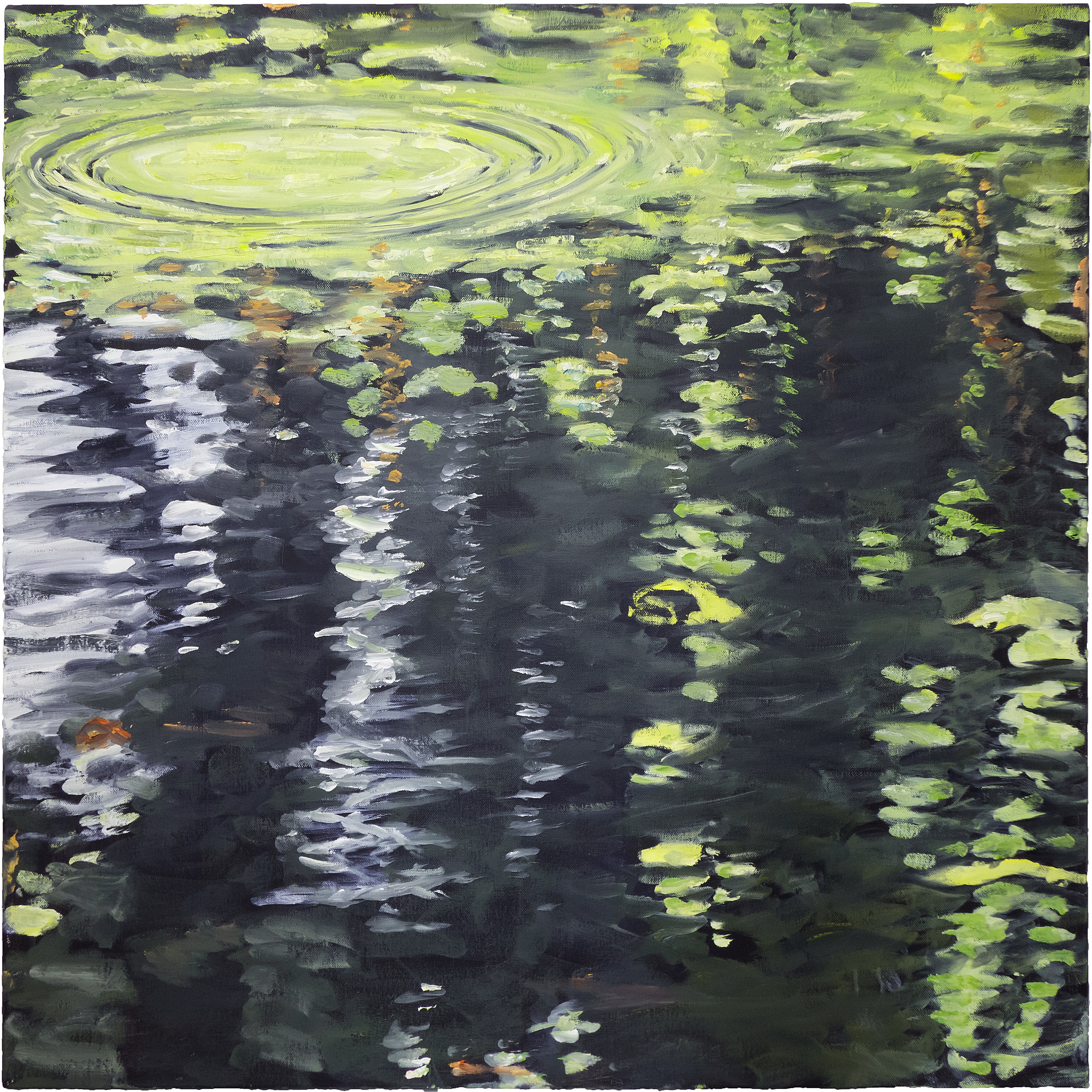
‘Trace. Blackwater’. Oil on 80x80cm canvas. Rose Strang 2023

Borrowed Land – The Kilmorack Gallery – new exhibition

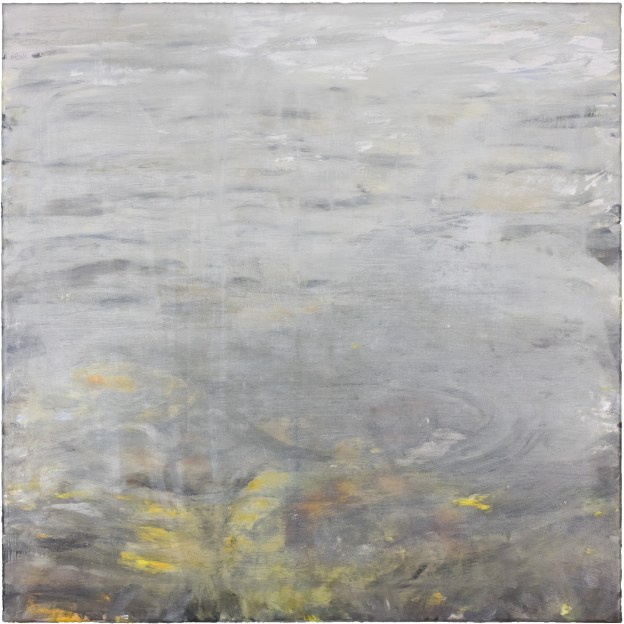
Above; Trace. Portnellan Island. Loch Venachar. Oil on 70x70cm canvas. Rose Strang 2023

These three works are on show as part of the exhibition; Borrowed Land, launching at The Kilmorack Gallery, Inverness-shire, from 18th November to 2nd March 2023/2024.

From the Kilmorack Gallery website:

“Kilmorack Gallery has timed this exhibition – Borrowed Land – to run when Scotland’s landscape is at its greatest threat since the clearances. Giant multi-national companies threaten to build electrical substations the size of university campuses, along with 60m high pylon lines hundreds of miles long, and soon after will come the transformation of hills into power stations with a new generation of mega-turbines”.

This exhibition (by the Kilmorack Gallery which is run by Tony Davidson, author of Confessions of a Highland Art Dealer: A journey in art, a glen and changing times.) represents a meaningful opportunity for me to get to the heart of my love of landscape as a painter.

The phrase borrowed land comes from the (so far unattributed) statement – We do not inherit the earth, we borrow it from our children.

In response to a request to write something about my work for this exhibition I offered the following –

Landscape is the most profound teacher. Through painting landscape over the years, my brushwork begins to reflect energy felt from the elements observed. Mark-making is instinctive to humans but we still barely understand why we make the marks we do. Those prehistoric drawings in the caves of Lascaux might express wonderment, or reverence towards nature as much as the desire to kill and eat animals.

The idea behind the phrase ‘Borrowed Land’ reframes a question; ‘What will you leave to posterity, to future generations?’ I’m fascinated by the traces left behind by past cultures, traces that are often barely discernible today. Some cultures left subtle marks.

Through landscape painting I can express my sense of reverence towards nature. I find that the element of water expresses layers of mystery – what is revealed or concealed, what is reflected? How quickly the ripples created by a falling leaf disappear and how quickly lasting destruction can occur. The paintings in this series are of bodies of water near archaeological sites of past cultures who left little trace.

Borrowed Land – launching at the Kilmorack Gallery on the 18th November.

Click on this link for more info about the exhibition – Borrowed Land

More on these paintings next week …