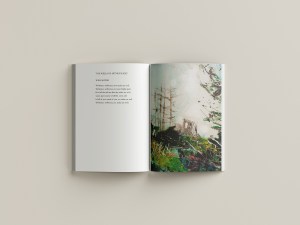
(Above: Signing copies of The Living Mountain. Photo Adam Brewster)
Pt 1: Here
Pt 2: Here
Pt 3: Here
Pt 4: Here
Pt 5: Here
This is the final part of my artist’s diary series about creating paintings for The Folio Society’s publication of The Living Mountain, by author Nan Shepherd.
(The Folio Society edition of Nan Shephard’s The Living Mountain illustrated by Rose Strang and introduced by Robert Macfarlane is exclusively available at www.foliosociety.com)
Link to book …
The Living Mountain by Nan Shepherd, published by the Folio Society 2021
Pt 6: Dreaming a response
-
-
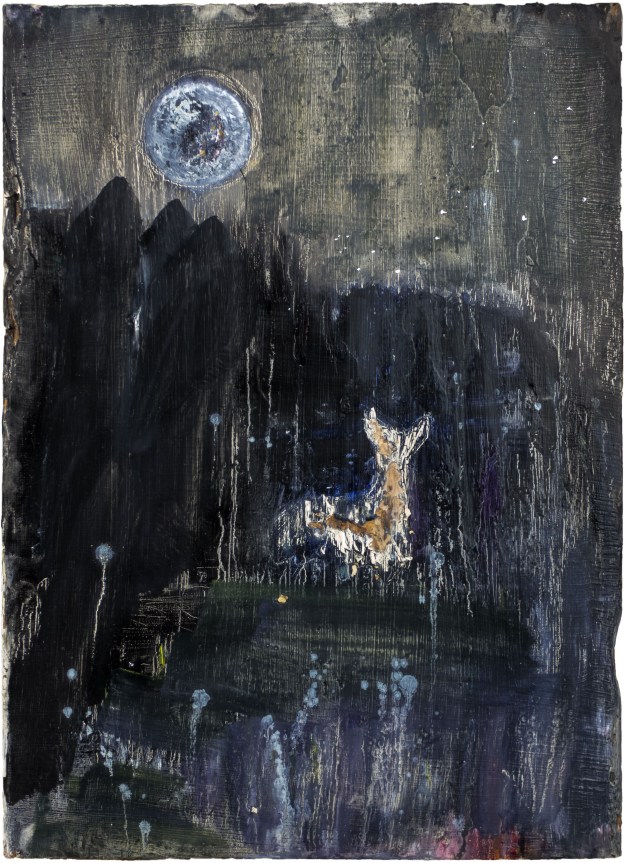
‘But did I dream that roe? The Living Mountain Series’. Oil on on on 37x27x2 cm antique pine. Rose Strang 2021
The world of mystery, or the spiritual, is subtly touched on by Nan. With But did I dream that roe? I explored a more mystic experience of Nan’s Living Mountain. This image, and title quote, came from the chapter entitled ‘Sleep’.
A few of my paintings were on rough wood which Adam had cut up after removing some shelves from a kitchen cupboard. The wood was ideal – textured and roughened with age, from the Victorian era when our tenement flat in Edinburgh’s Leith area was built. When painting it I allowed the grainy wood texture to show through. I used oils directly on to wood, with a swathe of solvent diluted Mars black. It has a density in comparison to Lamp Black oil paint and, unlike acrylic black, it dries to a lovely matt surface. Given a day or so to dry, you can scratch through to the wood or surface below which gives a good sharp calligraphic edge to the drawing, similar to line-making in the etching process.
The swathe of black oil paint with a large brush had created three peaks suggesting exaggerated mountain peaks. With the end of a plastic vitamin pill container dipped in white oil paint I created a simple moon. After dripping small droplets of purply lilac onto the black, I suggested the fire-lit smoke of a smouldering fire to the bottom right corner, then etched in the outline of a roe deer. I left it at that, knowing the image should be as simple as possible. I hoped it would say a little about the feeling of the Highlands on a moonlit night. Scotland’s culture is rich with otherworldly stories and myths. The symbology of deer, more often stags, has a central place or role in our mythical past, going far back into pre-history.
Recently I visited Kilmartin Glen, on the west coast of Scotland thirty miles south of the town of Oban. Kilmartin Glen has more pre-historic man-made marks than any other place in Scotland. There are numerous standing stones and remains of ancient burial cairns or ‘cists’ are they’re called. Even more intriguing are the mysterious ‘cup and ring’ marks that date from around five thousand years ago. No one knows what they were for, though there are literally hundreds of theories. Seen in real life, these marks are utterly strange. We sat and gazed on the cup and ring marks at Ormaig for an hour or so. I sprinkled purple flowers into them, poured water into them, photographed them and filmed them. I’d filled them with flowers and water to enhance the patterns and while this did enhance their strange beauty I was of course none the wiser as to their purpose!
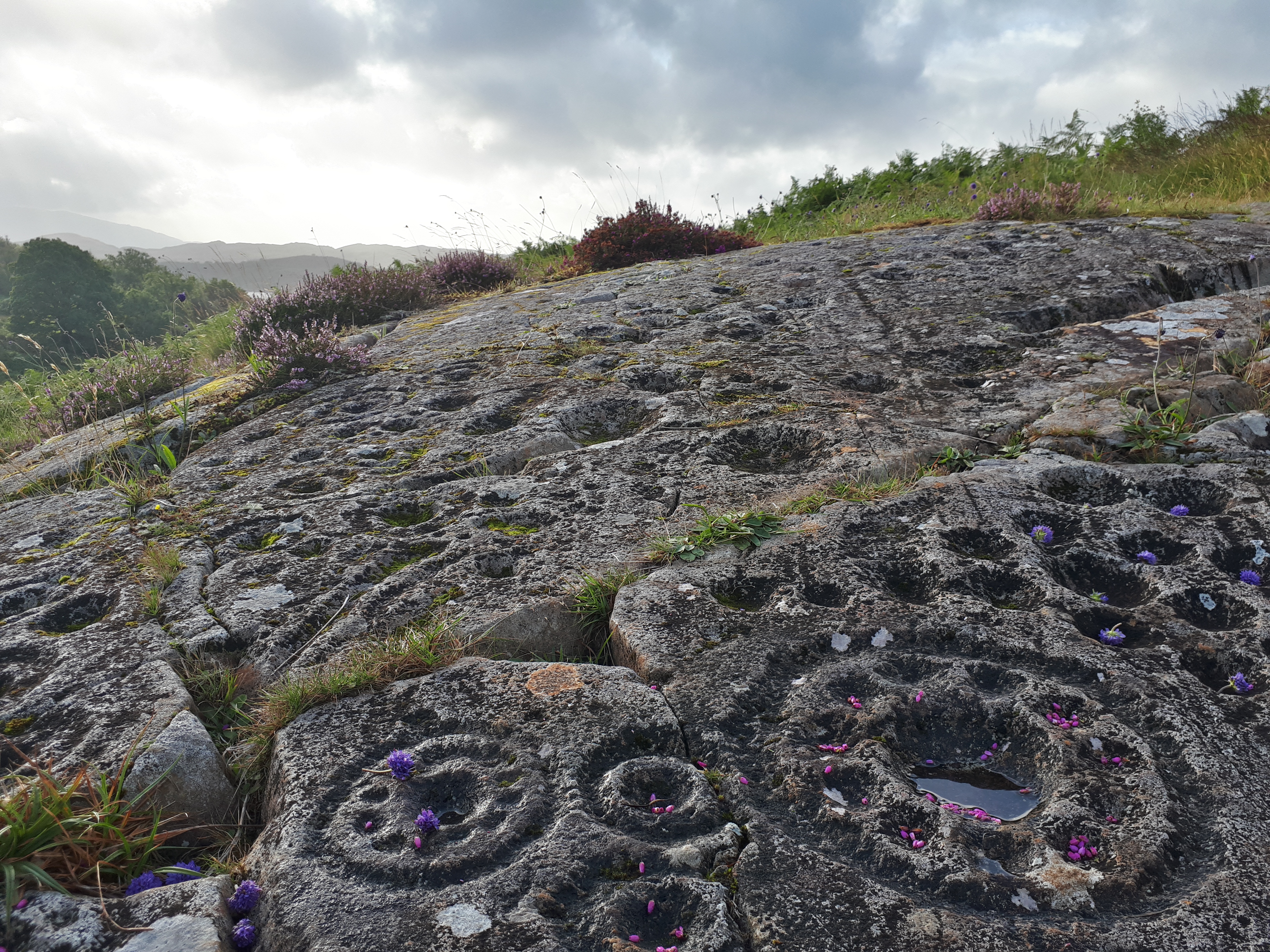
Cup and Ring marks at Ormaig, Kilmartin (photo Rose Strang 2021)
Earlier this year about spring 2021, an amateur archaeologist called Hamish Fenton climbed into one of the burial cairns at Dunchraigaig in Kilmartin and shined his torch on to the underside of the slab that covered the cist. He couldn’t believe his eyes when he saw the outline of an antlered deer. While these are still being investigated, it’s believed that these stag drawings, if as old as they’re believed to be, are in fact the earliest known pre-historic drawings in Scotland. Link
Professional archaeologists believe them to be about four to five thousand years old and, while there are other similar depictions of deer, none are as anatomically accurate and detailed as those discovered by Hamish Fenton. Celtic myths describe ordinary people falling asleep then waking in the land of Tír na nÓg – a land of the ever young, inhabited by faeries, or otherworldly folk who can turn into deer at will. The very dreamlike passage of Nan’s hazy memory of seeing a roe deer while half asleep suggests those myths:
My one October night without a roof was bland as silk, with a late moon rising in the small hours and the mountains fluid as loch water under a silken dawn: a night of the purest witchery, to make one credit all the tales of glamourie that Scotland tries so hard to refute and cannot.
It’s a subject she explores in her works of fiction with subtlety, enchanting the reader with descriptions that can only come from someone immersed in a landscape familiar to her.
The toughest painting of this commission was the final one. I was so moved by the final passages of The Living Mountain where Nan describes the way landscape has been changed by her experience; ‘… everything became good to me’.
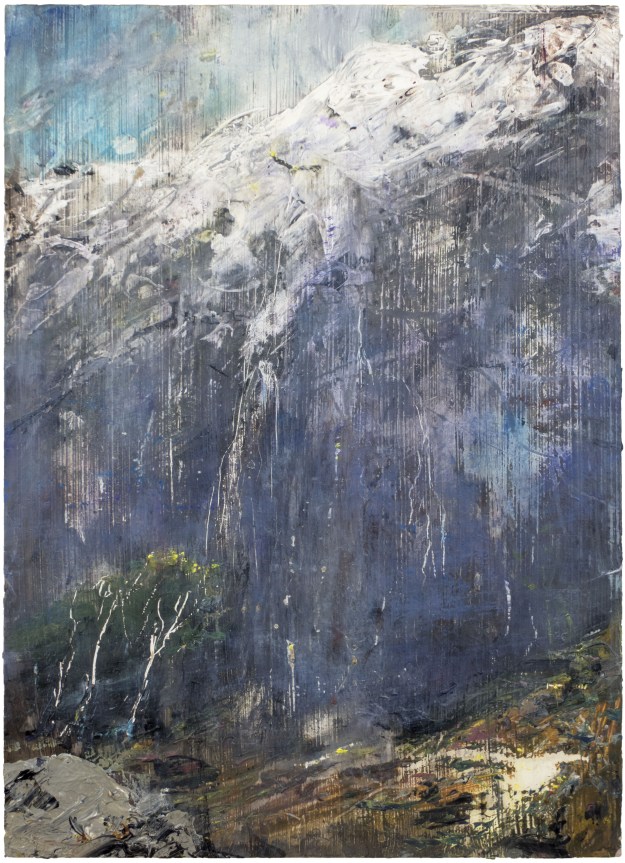
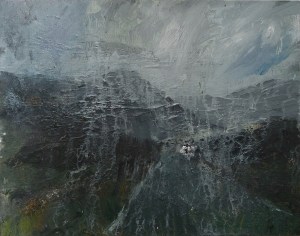
I chose that as the title of my last work for the book, though I felt I’d need another year to experiment with ways to depict it. In the end, I took a painting I’d started, which I felt ‘said’ something about the unknown or ungraspable aspects of the mountain and added small details which added to a sense of scale.
-
-
(Sold) ‘Everything became good to me. The Living Mountain Series.’ Acrylic and oil on 30x21cm wood. Rose Strang 2021
I partly had in mind Nan’s description of falling in love with the Cairngorms while on holiday as a girl, which she describes in the final chapter; ‘Being’:
So I have found what I set out to find. I set out on my journey in pure love. it began in childhood, when the stormy violet of a gully on the back of Sgoran Dubh, at which I used to gaze from a shoulder of the Monadhliaths, haunted my dreams. That gully, with its floating, it’s almost tangible ultramarine, thirled me for life to the mountain.
There are two other suggestions of a living creature in the painting that I’ll let viewers discover for themselves – they’re subtle but intentional. Having sent off the series to Sheri Gee, I was none the wiser as to how they perceived the paintings. It’s a strange fact that someone’s response can completely change my feeling about a painting I’ve created. I must be easily influenced sometimes, as there are paintings I’ve created which don’t please me at all, until someone comes along and says ‘I love this!’ On the other hand, there are paintings I’ve created that I think capture the essence of something I’ve struggled with for years – but then those paintings get almost zero reaction!
I knew that the Folio Society couldn’t wax lyrical about the paintings even if they did like them, since they had to be perused and approved of by a panel. As it happened, the panel included Robert MacFarlane, who was to write the introduction to the book (as he has for previous publications of the Living Mountain).
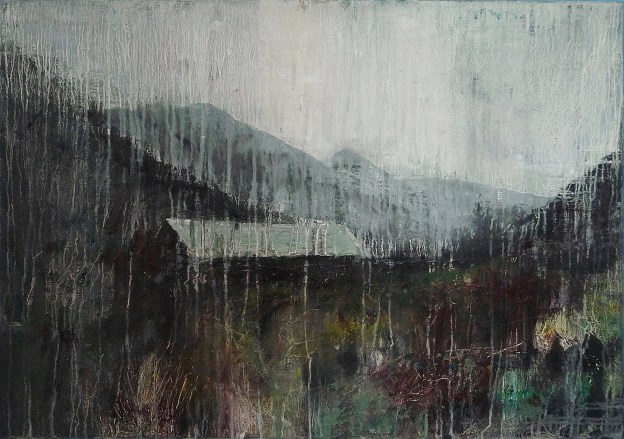
Sheri, who had been wonderfully supportive of the creative process, was kind enough to send me a preview of the part of Robert MacFarlane’s introduction that described his response to my paintings, and I was very touched by his words. In fact to be truthful I was awe-inspired by his capacity to read exactly into the intentions I’d had for several of the paintings; namely and in particular Flowing from granite and I like the unpath best.
Needless to say it was a boost to my artistic confidence about the series, which I’d found a challenge – The Living Mountain being a book for which I had profound respect.
It inspired me to immediately order a copy of Robert’s latest book; Underland. I had some years earlier read The Wild Places, and thoroughly enjoyed it. I also had a beautiful hardback copy of The Lost Spells, written by MacFarlane and illustrated by Jackie Morris’s magical watercolours, which I’d received as a gift from my cousin Christine who knew I’d enjoy Robert’s work as much as she had. Apart from these though, I felt remiss in knowledge of his more recent work.
By this time, the Living Mountain commission had been completed for at least a month. It was now a case of simply waiting for the October publication. I was tackling a new painting commission about the landscape surrounding Sutton Hoo in Suffolk and MacFarlane’s Underland played into my imagination as I attempted to capture the atmosphere of that landscape. The book’s observations on what we choose to bury, and why, played into my understanding of the treasure buried at Sutton Hoo. Or more accurately the beliefs and emotions that may have led them to bury their dead and their belongings in the way they did. Reading Underland, it was also very clear that Robert MacFarlane’s entire approach to life is intensely observed – he’d merely turned his X-ray mind towards my paintings!
It’s a grand thing to get leave to live.
The quote above is from Nan Shepherd’s The Quarry Wood. Geordie, a farmer, and father of the novel’s heroine Martha, remarks after killing a hen; ‘It’s a grand thing to get leave to live’, refering also to the times in which the novel was set – during WW2.
Painting this series was a blessing for me during lockdown, I felt privileged to have a meaningful project to throw myself into when so many others had their lives turned upside down – an experience that left many people demotivated, isolated or depressed, not to mention worried about income. I wondered at times how Nan Shepherd might have dealt with a pandemic. I’m pretty sure she’d have been out in the mountains, checking on folks like ‘Big Mary’, offering help.
The Folio Society kindly sent me several copies of the complete book. Seeing my own paintings in this beautiful publication of The Living Mountain is a moment to savour indeed. From my fascination as a child with the illustrations of Charles Folkyard in The Princes and The Goblin by George MacDonald, to illustrating Shepherd’s The Living Mountain. Both authors grew up up in the countryside of Aberdeenshire, for both authors landscape plays a profoundly meaningful role in their world view.
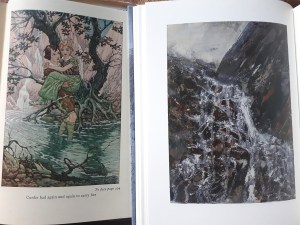
When I place Flowing from granite side by side next to Folkyard’s illustration of Irene and Curdie in the mountains, I do get the feel of something similar, albeit in very different styles!
Working on these paintings has been wonderful, and I’m grateful to Sheri Gee and all at the Folio Society for choosing my work and presenting it perfectly, to Erlend Clouston for his friendly support and everything I learned about Nan, and to Robert MacFarlane for his insightful words about the paintings; all sincere in their dedication to the legacy and inspiration of Nan Shepherd. It’s an honour to be part of that.
Rose Strang December 2021
-
-
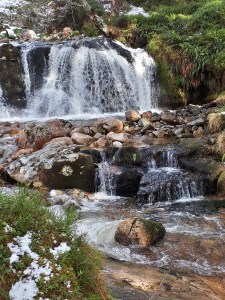
Waterfall, Glen Feshie. (Photo Rose Strang 2021)
-
-
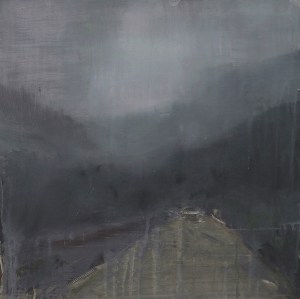
Left; illustration by Charles Folkyard from George MacDonald’s ‘The Princess and the Goblin’. Right: painting by Rose Strang for ‘The Living Mountain’. (photo Rose Strang 2021)








 Rose Strang Artworks