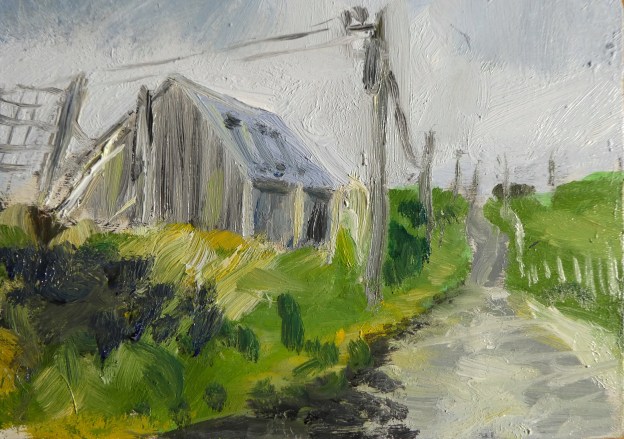
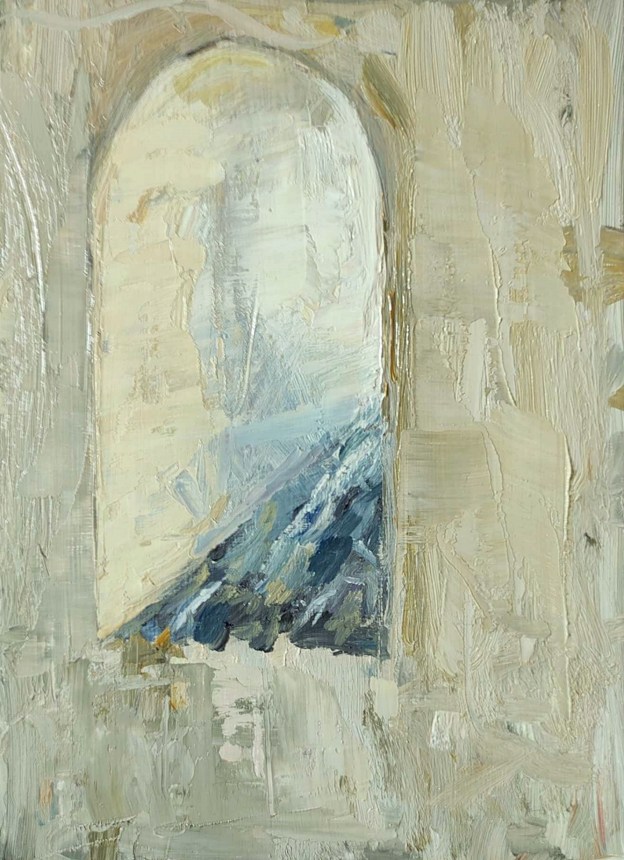
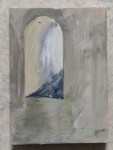
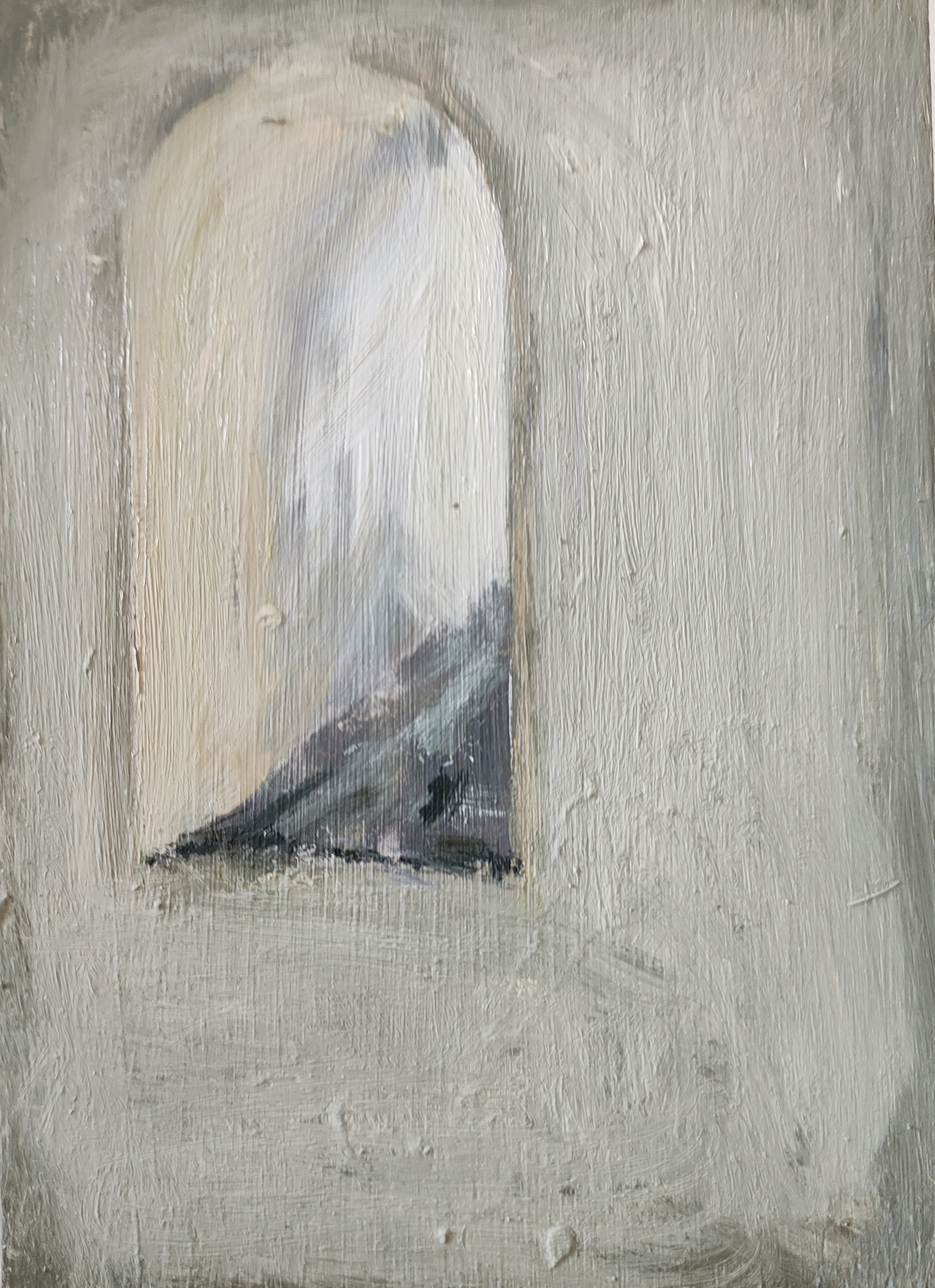
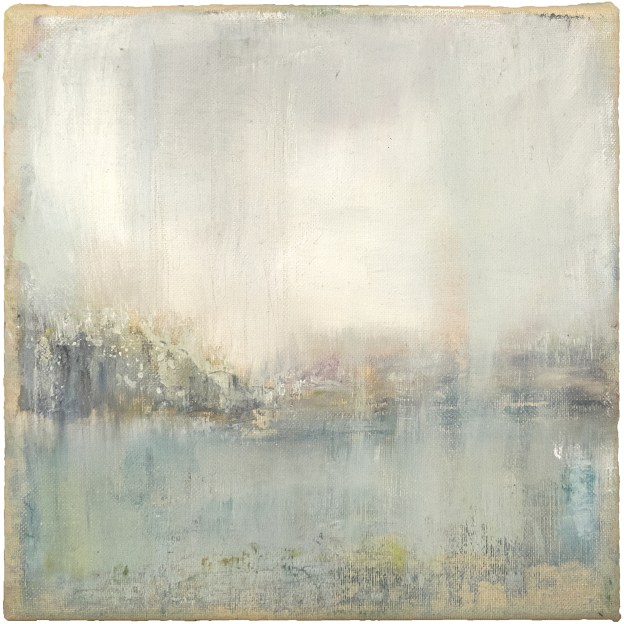
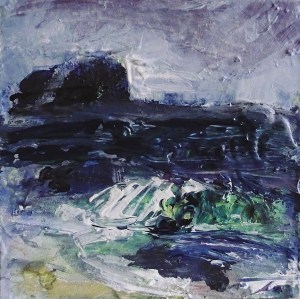
Above – Coigach 2. Oil on 5×7″ wood. Rose Strang 2023.
I’ve realised that strictly speaking this series should be called ‘Coigach Series’ since the paintings are not just my impressions of Achiltibuie. I tend to call the Coigach area of Scotland’s west coast ‘Achiltibuie’ since that’s where I go to visit friends when I’m up there. The whole area is Coigach though – named for one of the mountains in the area. Coigach is an incredible landscape featuring unbelievably pointy mountains with beautiful names such as Stac Polaidh and Suillven. I’m gradually getting to the more dramatic scenes as I progress.
I’ve been getting into the feel of this series on 5×7 inch wood, but today I moved on to 10×10 inch wood as I’ll be creating a series for the Limetree Gallery’s winter show this year. I feel this Coigach series will suit the gallery well. The gallery owners have asked their artists for paintings in the 10×10″ format, which suits me well as I often work at that size.
Here are the latest 7×5 paintings, and the first at 10×10 …
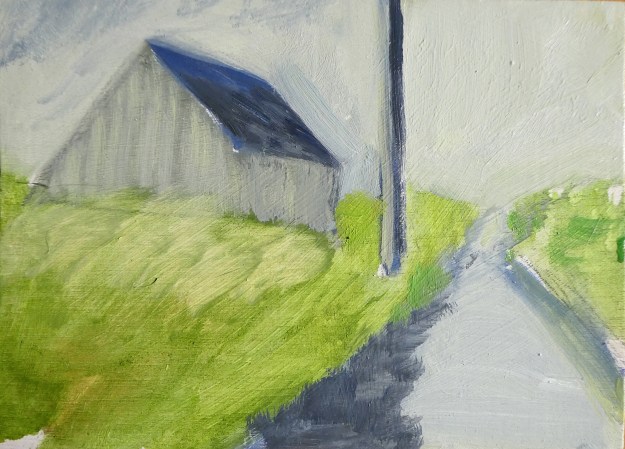
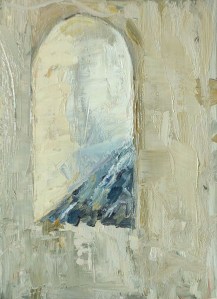
Above – ‘Achiltibuie 3’. Oil on 5×7″ wood. Rose Strang 2023
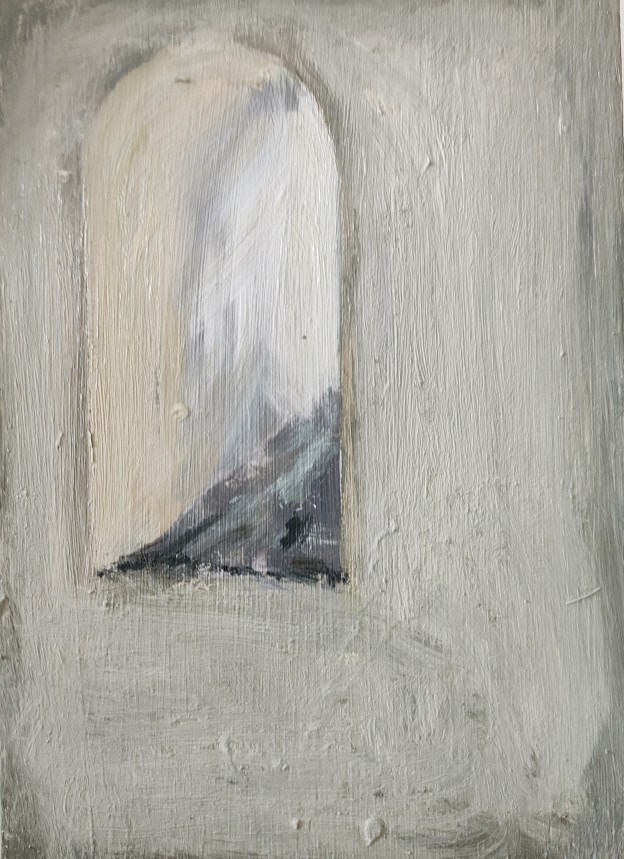
It’s always interesting when you feel you’re going in the right direction paint-wise, but it’s not quite there yet. I prefer the painting below (Achiltibuie 4’. Oil on 5×7″ wood. Rose Strang 2023) to the one above. The one above looks predictable to me whereas the one below has more mystery. Hmmm!
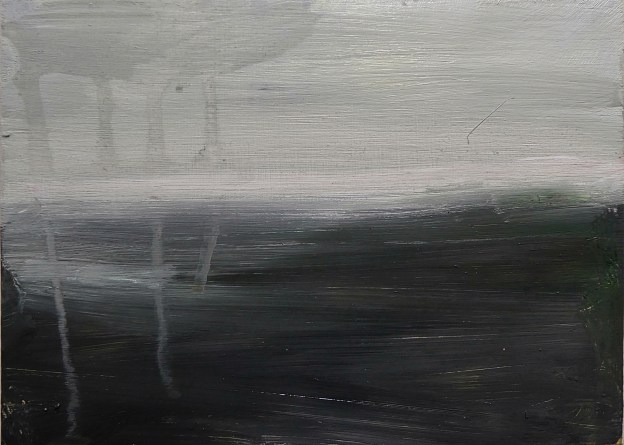
Above ‘Achiltibuie 1’. Oil on 5×7″ wood. Rose Strang 2023
It’s been a very experimental time these last few weeks, not least since it’s impossible to find time to paint on a regular basis, or to focus on one subject with all the projects going on. My studio is temporary till next year and consists of a tiny kitchen alcove, until we find a new home somewhere rural where we can stretch out a little. Needless to say I can’t wait, but it’s a laborious process.
The painting above is from a series I’m painting of my impressions of Coigach and Achiltibuie where we stayed for a few days back in May. I’ve always loved the impressions of landscape that remain in imagination after driving through it. One of my favourite artists, Ilse d’Hollander, had a similar approach – she’d cycle through the countryside of Holland, then return to the studio to create semi abstract impressions. A ‘painter’s painter’ as she was described, she wanted to say a lot with little, more about distilled memories of her short journeys. A sense of space, or light, or distance for example.
I particularly enjoyed this short video about her work, beautifully filmed and edited by Gauitier Deblonde …
Despite all the distractions, I must find time to paint a series for the upcoming winter exibition at Limetree for November. I’m also getting together a little project with my friend and collaborator Atzi Muramatsu. I’ll be creating small portraits in oil on wood of Atzi and members of a small string quartet. The quartet will then play for one night at The Scottish Arts club in November. It’ll be a nice little project, meaningful but manageable!
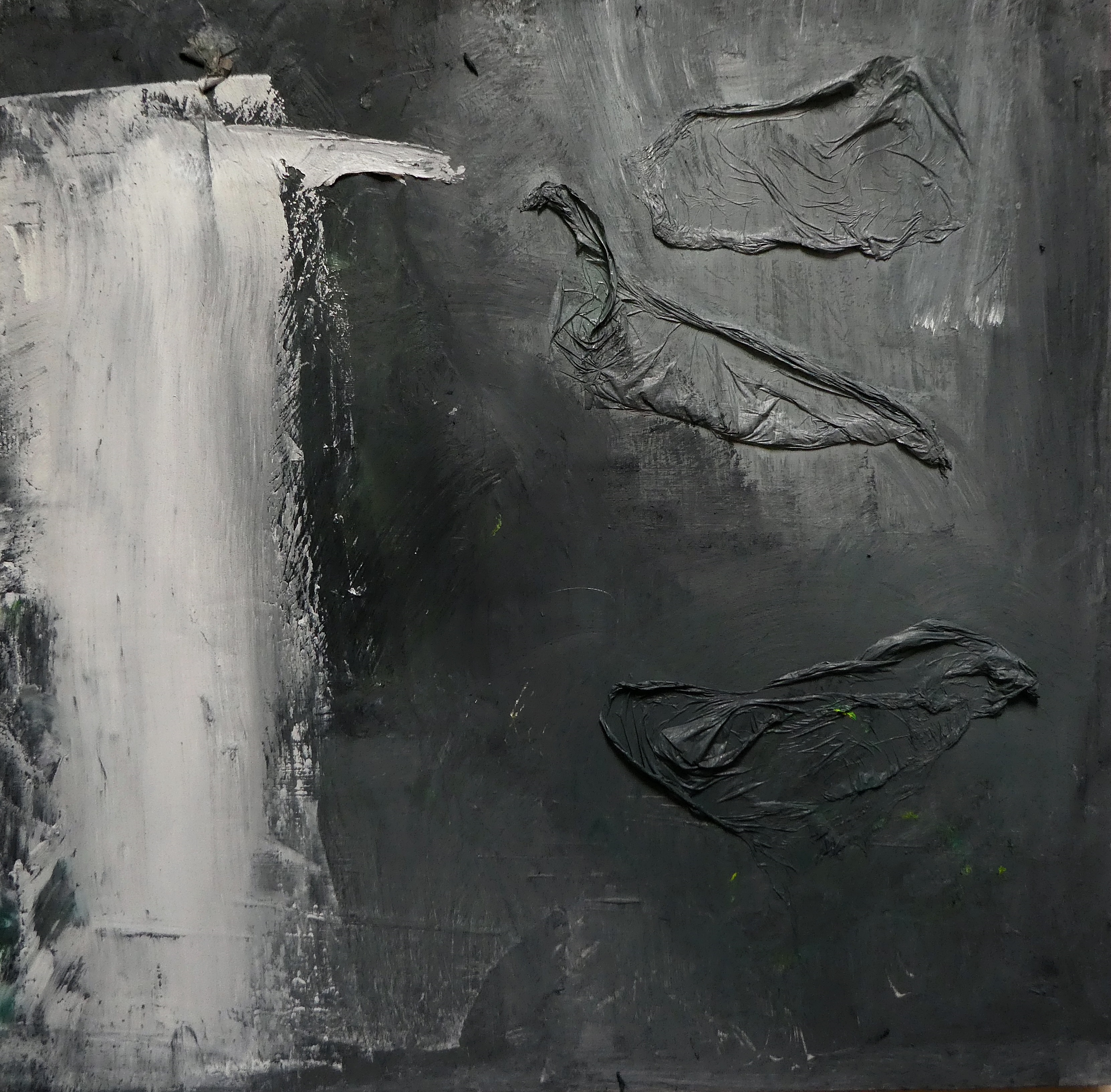
I’m exploring some more abstract approaches at the moment, or mixed media anyway. This piece was created with plastic, cold wax and oils. Quite good fun, it’s good to loosen up – not to always feel you have to stick to the same approach.
‘Waterfall’. Mixed media on 15×15″ wood. Rose Strang 2023
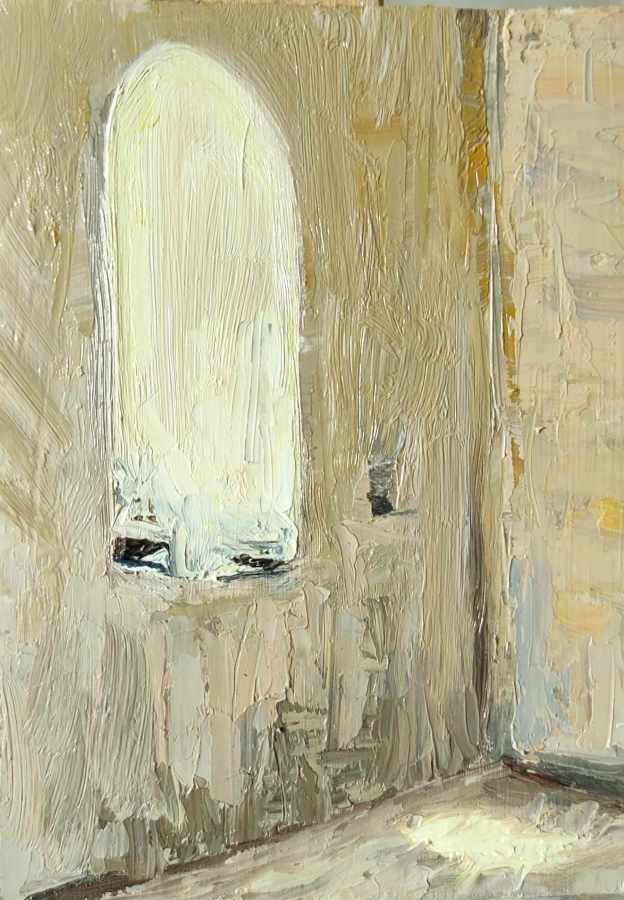
Above – St Oran’s Chapel 2, Iona. Oil on 5×7″ wood. Rose Strang 2023
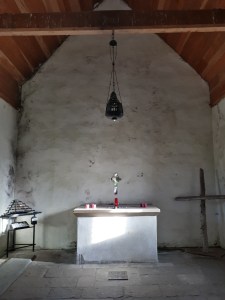
I’m hugely enjoying this self-motivated exploration of light and texture. As yet I’ve no idea where I’m likely to exhibit it. Today’s painting does remind me of the soft buttery light that flowed through the windows of St Oran’s Chapel on the 15th May this year.
I’d love to treat my walls to a coat of lime render (the plaster used to cover the walls of St Oran’s) but it’s a bit caustic I’m told, not ideal for domestic settings.
Above St Oran’s Chapel 1, Iona. Oil on 5×7″ wood. Rose Strang 2023
Working with a palette knife brought better results today. So this will officially be the first finished painting of this series!
Once I move on to canvas I’ll explore some dry brush work but the palette knife seems to suit the scale and texture of wood just now. I’m using a palette of white, lemon yellow, medium yellow, ochre, cadmium red, crimson and black. I’ve been looking at the beautifully subtle work of Jan Mankes, but his technique was very painstaking – slow build up of layers in oils – which doesn’t suit my style so much.
Above – painting in progress St Oran’s Chapel, Iona. July 2023. Rose Strang
A change of palette after a very busy few months. No doubt I’m drawn to these cool beiges and subtleties of light because life has been quite hectic.
There hasn’t been much time to paint, what with getting married in May and all! Then Adam and I spent a month editing our wedding video and creating music for it so we could share a video of our special day with family and friends (we decided we’d have a very low-key wedding, so it was just the two of us).
I kept thinking of the light during our wedding in St Oran’s Chapel – it couldn’t have been any more beautiful. Hence these first attempts at capturing the subtlety of light and the way it plays on textured plaster. It’s quite a minimalist, and spiritual theme. St Oran’s Chapel is believed to be the oldest building on the Isle of Iona that’s still standing. It sits modestly in the grounds of Iona Abbey and it’s quite small. The acoustic is amazing.
This series will develop onto larger pieces of wood and canvas, and might involve figurative painting too – a bit of a rarity in my work.
Being the visually oriented people we are, we wanted to find an excellent photographer for our wedding day so we were lucky to find Martin Venherm Martin Venherm Photography whose photos we’d admired when he’d been hired to shoot our friends’ wedding. He created images we absolutely love, and will enjoy looking at in the years to come! Here are a few of my favourites …
Above: Through Kintail 3. Oil on 14×11″ wood. Rose Strang 2020.
I’m delighted that Through Kintail 3 will be on show at the Caledonian Club in London as part of an exhibition organised by the Society of Scottish Artists (SSA) from Tuesday 20th June this year.
The exhibition will take place from 21 June – 13 July in the Club’s Drawing Room and will showcase leading contemporary art by SSA Professional Members.
The exhibition includes works from invited artist Alasdair Wallace, alongside selected works from SSA Professional Members.
Selected Artists:
Christopher Brook | Rowena Comrie SSA PPAI | Soosan Danesh | Jean Duncan | Rhona Fleming | Shona Grant | Cate Inglis | Philip J Lavery | Aileen Keith | Rosalind Lawless | Lindsey Lavender | David Lemm | Kenris MacLeod | Mary Morrison | Gemma Petrie | Jenny Pope | Derek Robertson | Charlotte Roseberry | Carol Sinclair | Christine Sloman | Joan Smith | Rose Strang | Frank To SSA ASGFA | Vasile Toch PSSA | Fenneke Wolters-Sinke | Luke Vinnicombe
The Caledonian Club, founded in 1891, is a private members’ club situated in the heart of Belgravia, London and is “the representative national club and headquarters for Scots in London.”
This exhibition is the first in a revolving exhibition programme exploring the possibility of multiple rolling exhibitions throughout the year.
Place-names can tell you so much about the history of a place. If you find an old enough map of the Isle of Iona you can see that, tiny though the island is (three by one and a half miles) it has been inhabited by people for thousands of years.
Cnoc an Oran, for example – ‘hill of song’ in Scottish Gaelic, or Sìthean Mòr – ‘hill of the angels’ as it’s translated, though Sìthean also translates as ‘fairies’. Back in about 500AD when an exiled Irish prince, St. Columba (or Collum Cille as he was known) arrived here to set up a religious community, he would have encountered the ancient remains of previous dwellers going back to the iron and bronze ages. Iona has always been a an important spiritual place.
Map of Hy (Iona) 1874
Known as ‘The Dove’ Collum Cille seems to have been anything but! (Maybe this was an early example of sarcasm). He banned women from the island, saying; wherever there are cows there are women and wherever there are women there’s trouble, or words to that effect. He was known as a powerful political negotiator across Scotland. ‘You wouldnae mess wi him’ as Scots might say!
He did set up a Benedictine Monastery though, and an Abbot of the abbey, named Adomnán, wrote of the miracles conducted by Collum Cille, which included facing down a sea monster (it’s since been speculated that it was in fact Nessie).
I first visited Iona in my early twenties seeking, I suppose, spiritual understanding. I did find it a deeply affecting place, which is why I’ve returned so many times since then. On that first trip, I visited the craggy south end of the island, where the rusting machinery remains of an 18th century marble quarry still exist.
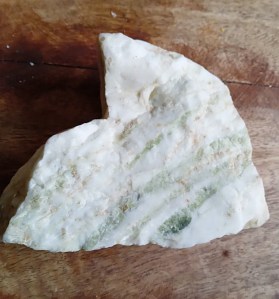
The beautiful lucent white marble is streaked with deep grass-green serpentine and it made the perfect material for the alter that was created for the abbey in the early 1900’s when the abbey was restored. For hundreds of years, children of the island have sold little pebbles of the sea-washed marble to visitors for luck, they still do today.
On my first visit though, I decided to take a slightly larger piece, about 4×5 inches – a large chip from the marble quarry cuttings. It has travelled everywhere with me, you could say it’s been ‘my rock’! Though I think it’s time for me to return it to its home on Iona by way of a ‘thank you’ for everything the island has given me.
It sounds trite or contrived in the usual way of island sayings, when you read that ‘Iona always gives you what you need’, but I’ve found that to be true. There was the sense of spiritual discovery and wonderment in landscape in the first place- an inspiration for me to paint landscape – as well as the more difficult times when I’ve been struggling with life and visited the island to contemplate.
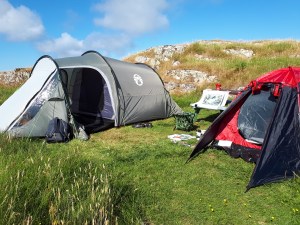
Contemplation sounds peaceful but those visits were turbulent in a variety of ways. For example the time I spent 21 days in a tent by myself, feeling that I needed a break from noise and people. In fact it made me deeply appreciate people since my main companions for those 21 days were spiders, a drove of slugs crawling over my tent, midges, a corncrake whose harsh mating call kept me awake half the night, and a team of baa-ing sheep who decided that my airing sleeping bag was a good place to urinate. (That’s a stench that never washes out, the sleeping bag was indeed a wash-out after that!)
Luckily the campsite owner had a stash of beautiful wool-lined sleeping bags and didn’t bat an eye when I told him of my predicament, lending me one of these for the rest of my stay.
Two tents, one to live in and one for paintings
There was also the time I stayed there in the wintry months, as part of an artist’s residency project. During that fortnight I shared a dwelling space with some very troubled people. Iona attracts pilgrims from across the world who desperately seek healing for emotional or physical wounds. It’s not easy to deal with that sometimes and I found that the atmosphere, combined with a few of the demons of my past, haunted me for months to come.
‘North Beach,Twilight. Isle of Iona’. Mixed media on 6×6″ wood block. Rose Strang 2018. Sold.
‘North Beach, Twilight II. Isle of Iona’. Mixed media on 6×6″ wood block. Rose Strang 2018. Sold.
‘Pisces Moon, Isle of Iona’. Mixed media on 10×10″ wood panel. Rose Strang 2018. Sold.
On the other hand, each day brought blessings: the endless beauty and colours of the landscape, the turbulent energy and colours of the tide changing at twilight, which inspired a series of paintings titled October Tide, then there were fellow creatives who arrived with songs, music and ideas, and new friendships …
Mary McCormick, a grounded and unassuming women in her 70’s from the American mid west, was someone who observed without judgement or drama. She loved to collect small pebbles from her daily walks, pour them into a little dish and invite us to admire them, sharing her photos of the day with residents around the kitchen table. If the conversation veered into turbulent waters, she’d succinctly say her piece with calming compassion and just leave it there, resonating with understated wisdom.
One day we walked to SìtheanMor, ‘The Hill of Angels/Fairies’ and she said that she’d heard in a book that you had to listen here for nature, or God, or for whatever beliefs you had, to give you an important message. I stood for a while, watching a wash of slate grey cloud blowing across a dazzling blue sky – it looked like a painting in progress – and the phrase ‘You are meant to enjoy it’ came to mind.
Mary at the north beach
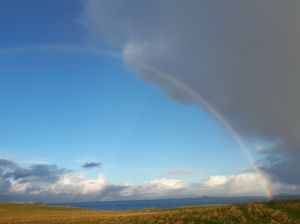
Rainbows and clouds over the north beach
Afterwards we dropped in to the Columba Hotel and I told Mary about the troubled thoughts that had been stirred up by time spent on the island this time and the company, or demands as I felt, of emotionally troubled people. I’d felt so upset I’d taken to hiding in my room in the evenings, worried that I’d affect others with my mood, that I was ‘losing it’. Mary immediately exclaimed ‘Oh, no Rose! ..’ jumping up from her place next to the log fire and coming over to hug me, ‘You’re the most grounded person here, you’ve been a friend during my time here’. My worries felt washed away. We’ve stayed friends since then of course, though Mary is now back in the US, writing, exploring grasslands of the Midwest and finding opportunities to be involved in her main occupation of landscape gardening.
During the residency I’d been reading the poems of Virgil, and on my return I began to explore Medieval philosophy, which led to a new series of paintings about the planets as understood in Medieval cosmology. It was an incredibly enriching time when I read Planet Narniaby the author Michael Ward, which explores the planetary influence in the works of C.S. Lewis.
Sketch. Iona 2018
Virgil
Sketch. Iona 2018
I found that contemplating the influence of each planet changed me. Working through the ideas connected with Saturn for example – winter, introspection, hard lessons, death … (my dad had died just two years before) during the months of December and January 2018, led to a new understanding of how to live life – you’re meant to enjoy it.
Spring arrived at the same time that I was painting Jupiter, which alligns with the change from winter to spring – winter passed, guilt forgiven as C.S. Lewis writes in his Planets poem on the subject of Jupiter – and with it a new relationship.
Last year my partner Adam presented me with an engagement ring that he’d designed himself, made with a small piece of the Ionian marble (my rock, that I’d found on my first trip to Iona in the early 90s!) After celebrating, we discussed where we’d like to get married, but each idea was fraught with planning troubles – we wanted to get married in the countryside, but how would we bring all our relatives from different parts of Britain to the celebration?
In the end, it made most sense for just the two of us to go away to get married, what’s known these days as ‘an elopement wedding’. It was Adam who suggested the obvious – ‘how about Iona?’ I was struck by the fact that I was surprised (and delighted) by the idea. Back in my twenties I’d thought to myself ‘I’d like to get married here, if I ever get married’. Somehow that dream had been buried in the back of my mind until Adam took the idea out, gave it a dust and – there it was!
And so we’ll be in Iona this May (the green, fertile month of love, art and expression, as understood in Medieval cosmology). Inspiration for my next series of paintings. I’m going to take my Iona rock back to the south end of the island and leave it there as a thank you to Iona.
I hope someone else discovers it, and that it brings them enjoyment … C.S Lewis says it better than I can:
“Meditation in a Toolshed” By C. S. Lewis.
I was standing today in the dark toolshed. The sun was shining outside and through the crack at the top of the door there came a sunbeam. From where I stood that beam of light, with the specks of dust floating in it, was the most striking thing in the place. Everything else was almost pitch-black. I was seeing the beam, not seeing things by it. Then I moved, so that the beam fell on my eyes. Instantly the whole previous picture vanished. I saw no toolshed, and (above all) no beam. Instead I saw, framed in the irregular cranny at the top of the door, green leaves moving on the branches of a tree outside and beyond that, 90 odd million miles away, the sun. Looking along the beam, and looking at the beam are very different experiences.
And from ‘Surprised by Joy’, C.S.Lewis:
In other words, the enjoyment and the contemplation of our inner activities are incompatible. You cannot hope and also think about hoping at the same moment; for in hope we look to hope’s object and we interrupt this by (so to speak) turning round to look at the hope itself. (…) The surest way of spoiling a pleasure was to start examining your satisfaction. But if so, it followed that all introspection is in one respect misleading. In introspection, we try to look ‘inside ourselves’ and see what is going on. But nearly everything that was going on a moment before is stopped by the very act of our turning to look at it. Unfortunately, this does not mean that introspection finds nothing. On the contrary, it finds precisely what is left behind by the suspension of all our normal activities; and what is left behind is mainly mental images and physical sensations. The great error is to mistake this mere sediment for the activities themselves.
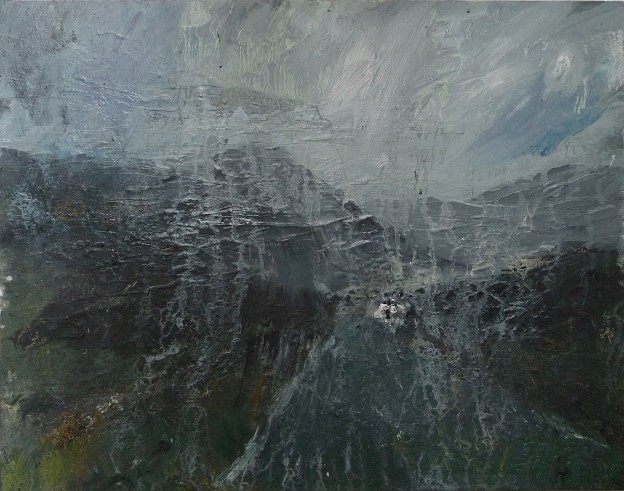
(Above: It is luminous without being fierce. Living Mountain Series. Rose Strang 2021).
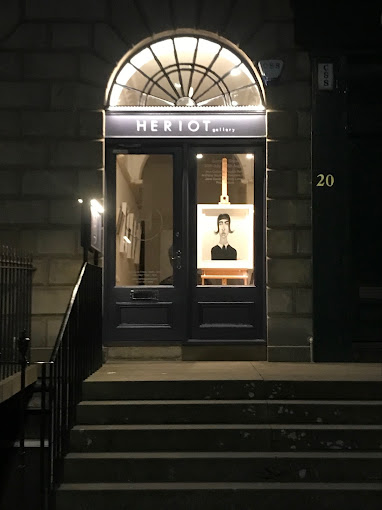
Exhibition launching on Monday the 17th of April at the Heriot Gallery, Dundas Street, Edinburgh – The Living Mountain: Dreaming a Response
The paintings will be on exhibition and sale from the 17th to 23rd April at The Heriot Gallery and are now available to view and reserve from this link – The Living Mountain Series
The Heriot Gallery, 20A Dundas Street, Edinburgh, EH3 6HZ
“A stunning series of images – a symphony of subtle essences, distilled experiences, fleeting memory fragments and deep, heart-felt lingering impressions.” ***** Giles Sutherland, the Times, 21st February 2023
This series was very special for me; commissioned by the Folio Society London for their 2021 publication of Scottish literary classic The Living Mountain by Nan Shepherd, the paintings were created between December 2020 and April 2021.
I had already read The Living Mountain several years before and I was honoured to be chosen to paint a response to Nan Shepherd’s beautiful book, which expresses her response to the Cairngorm plateau in the north of Scotland.
When I first read the book, I felt a thrill of recognition; Shepherd observes as a mountain walker, but also as an artist – vividly describing the colours, moods, flora and fauna of her beloved Cairngorms.
Her approach was to explore the mountain’s effect on all of the senses, and this is a sensual work in the true sense of the word – also visionary and spiritual. Shepherd’s words have inspired many writers and artists, myself included, because through her experience of the mountain she explored what it is to be human. She questions the loss of innocence that can take place in our effort to conquer life through will and intellect; she was partly influenced by Buddhism, but the Cairngorms were her teacher.
As an artist, I related to this quest to communicate how landscape affects us. Nan condenses a lifetime of understanding and wisdom into this book, her shortest and, at first, her most overlooked work.
To paint this series in response was a daunting challenge, but one that I welcomed wholeheartedly. I’m very grateful to The Limetree Gallery and the Heriot Gallery for presenting this series – they have been wonderful to work with and I’m looking forward to seeing the exhibition in April.
Along with the Living Mountain series, there will also be additonal paintings created in response to the project and a short film inspired by the project as a whole, with specially commissioned music by Atzi Muramatsu.
If you are interested in the paintings or would like to reserve one before the exhibition launches on 17th April (two have already been reserved), please contact The Limetree Gallery (who are working in collaboration with the Heriot) with any queries on their website Limetree Gallery


















 Rose Strang Artworks