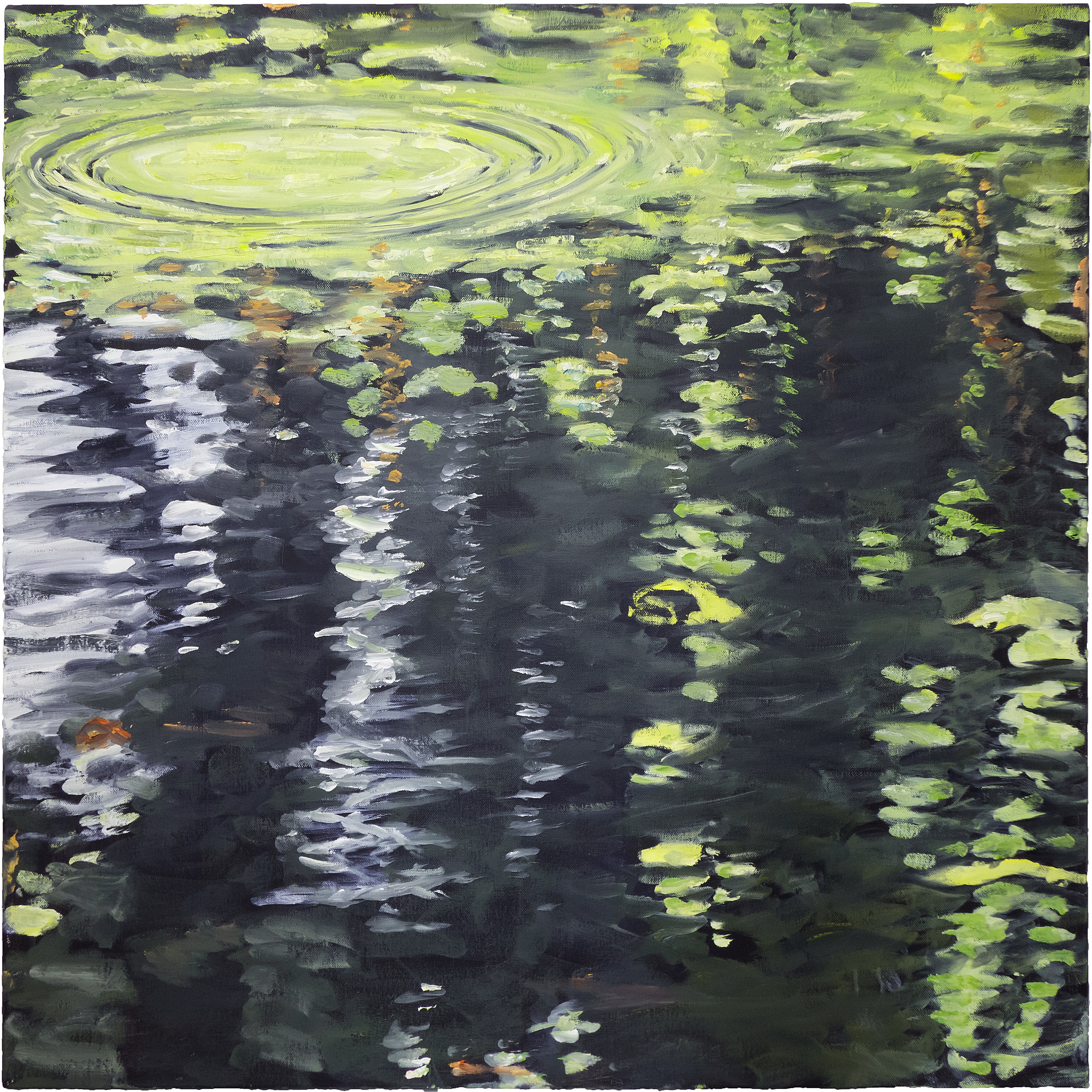
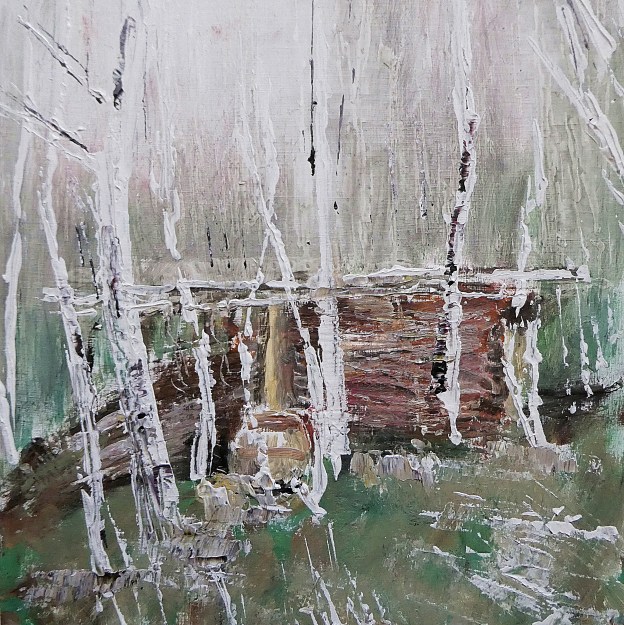
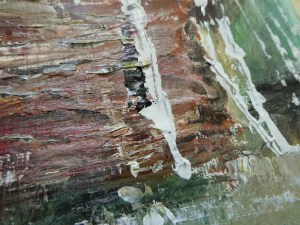
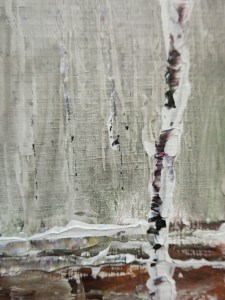
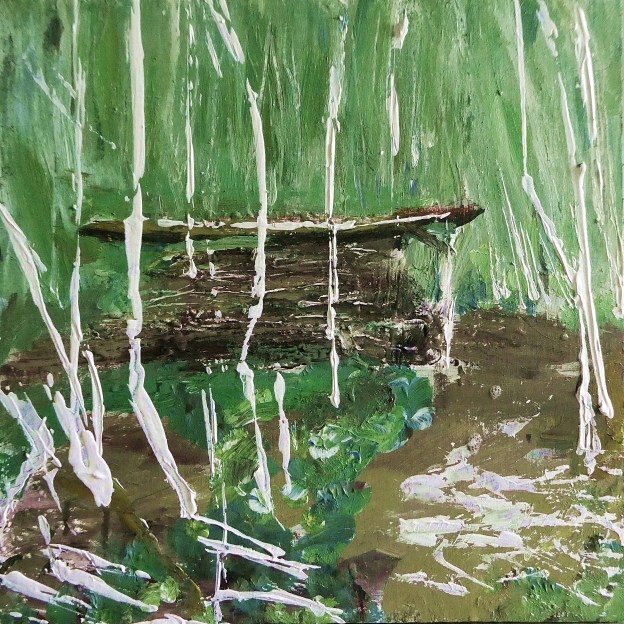
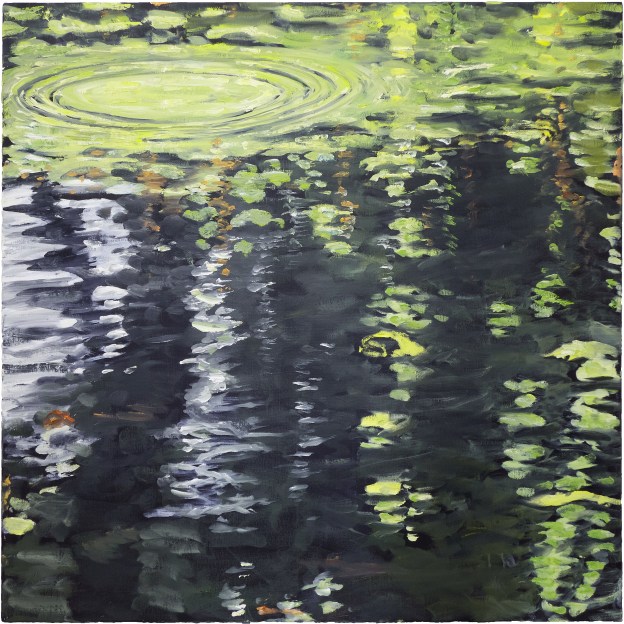
Above: Trace. Blackwater. Oil on 80x80cm canvas. Rose Strang 2023
Traces of past cultures in landscape have fascinated me for many years. Especially those traces so subtle you’d walk past, barely noticing them. Expressing this subtlety in paint is a challenge.
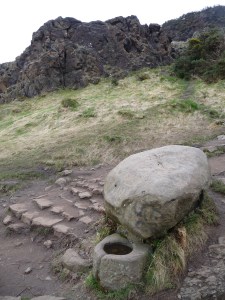
While painting a series in 2018 titled ‘Wells of Arthur’s Seat’ I started to find a way. There are literal traces, like the trace of a chain on the boulder near St Anthony’s Well which was originally attached to a metal cup above a carved stone basin. The spring has long since dried up, but as late as the early 20th century people from Edinburgh would sip the water, or soak cloth in the water then apply it to their body in the belief it cured disease or imbalance.
I don’t want to paint literal traces, however, and while exploring the history of St Anthony’s Well I became immersed in the mystery of water. Its layers, veils and reflections suggested timelessness, ‘as above so below’, or the idea of liminal or in-between places.
-

-
‘Wells of Arthur’s Seat, Stream and Hill I’ Mixed media on 35 x 18.5 inch wood panel. Rose Strang 2018
-
-
St Anthony’s Well, Arthur’s Seat 2018 (photo Rose Strang)
-

-
Sold. ‘Wells of Arthur’s Seat, Stream’ Mixed media on 10 x 10 inch wood panel. Rose Strang 2018.
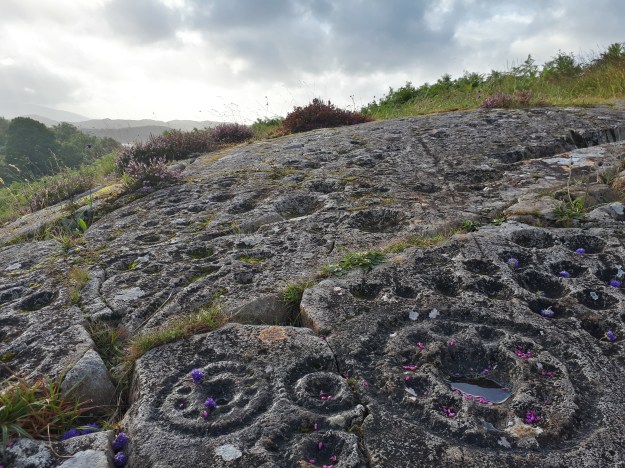
Painting ripples left by, for example, a falling twig, reminded me of pre-historic concentric rings carved into rocks around the British Isles. No one knows why those carvings were created, but to me they suggested ever multiplying rings created by cause and effect – a falling leaf that creates a pulse of water, shifting tectonic plates that create the huge pulse of a tsunami, or the mystery of gravity and the orbiting planets and moons of our solar system.
-
-
Cup and Ring marks at Ormaig, Kilmartin (photo Rose Strang 2021)
When I visited Saxon burial mounds at Sutton Hoo in Suffolk it wasn’t the mounds themselves I wanted to paint, it was the river that led to the mounds – the River Deben. I painted reflections on the river and the wake left by a passing boat – to me the flowing river brought that past culture to life more than the burial mounds. Cultures change and become strange or indecipherable but a boat’s wake remains the same. I could envisage their arrival from northern Europe to the Suffolk coast up the River Deben, imagining what made them settle here and select this particular spot as as a sacred burial ground.

Sold. ‘Trace. Sutton Hoo’. Water mixable oil on 70x70cm canvas. Rose Strang 2021
Then the process of painting the layers of water was so complex in itself – there is translucency and opacity, reflections, the rhythm of flowing water and the fact of constant movement and change. I was also thinking of the fact that nature was at the heart of Saxon culture and religion. For example the tree of life – Yggdrasil – which encompasses many different worlds. Each of the tree’s three roots is fed by three different wells representing past, present and future.
These myths reflect a truth – that everything is connected. Our recent past, encompassing the industrial revolution and unprecedented consumption of resources, has taken us full circle back to this realisation of inter-connectedness, and the dilemma of how to move forward. Our culture will leave more trace than any that came before us.
At Loch Venachar in the Central Highlands of Scotland, I searched for the remains of a Crannog (iron-age man-made islands on which wooden dwelling structures were built). The island itself was visible, but sadly concrete had been poured onto the remants, probably to prevent it being washed away. Again, literal remnants didn’t move me so much as the trace of stones leading to the island – just the merest suggestion that in this area at the loch’s edge the stones were just a little raised. Gazing at the stones as dawn rose, rays of sunlight began to reveal the stones beneath the surface, while further away the surface remained opaque. These half-revealed images suggested more to the imagination.

Sold. ‘Trace. Portnellan Island, Loch Venachar’. Water mixable oil on 70x70cm canvas. Rose Strang 2023
Loch Venachar is fed by the Blackwater River and as we explored further along the river side, I found myself mesmerised by the reflected green/yellow light of foliage in the black water, still as a mirror, which brought to mind Corinthians 13:12:
For now we see through a glass, darkly; but then face to face: now I know in part; but then shall I know even as also I am known.
These ideas are complicated to express creatively in an image. Or not so complicated when simply observing what’s there; traces on water – concentric circles, ripples, what’s revealed below, or concealed from view, what is mirrored back to us. Although we can’t know all, we do know that all is connected. When contemplating nature these images become poetic and profound.
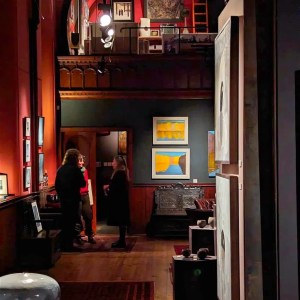
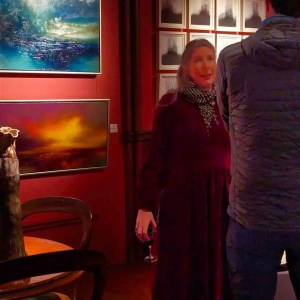
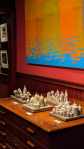
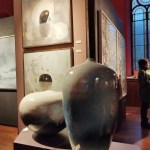
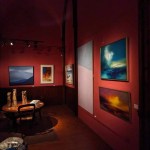
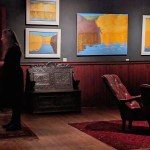
This series of three paintings – Trace. Sutton Hoo, Trace, Portnellan Island, Loch Venachar and Trace, Blackwater, will be on show as part of the exhibition Borrowed Land, which launches at The Kilmorack Gallery on the 18th November 2023.





 Rose Strang Artworks