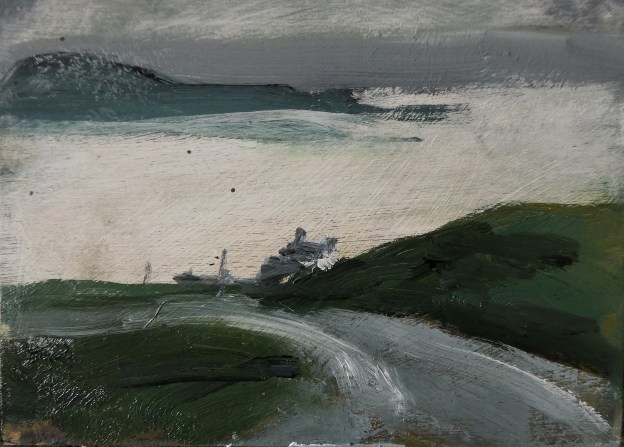
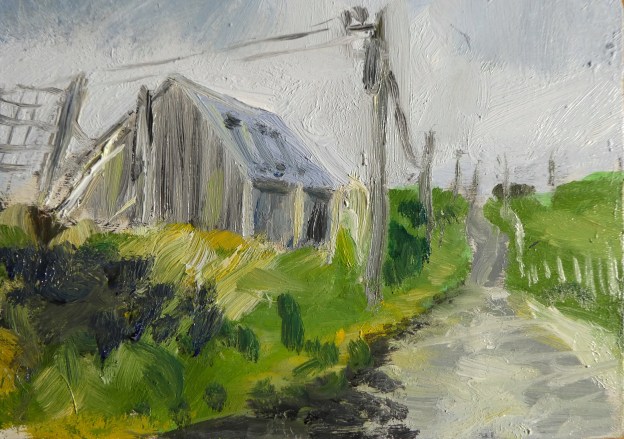
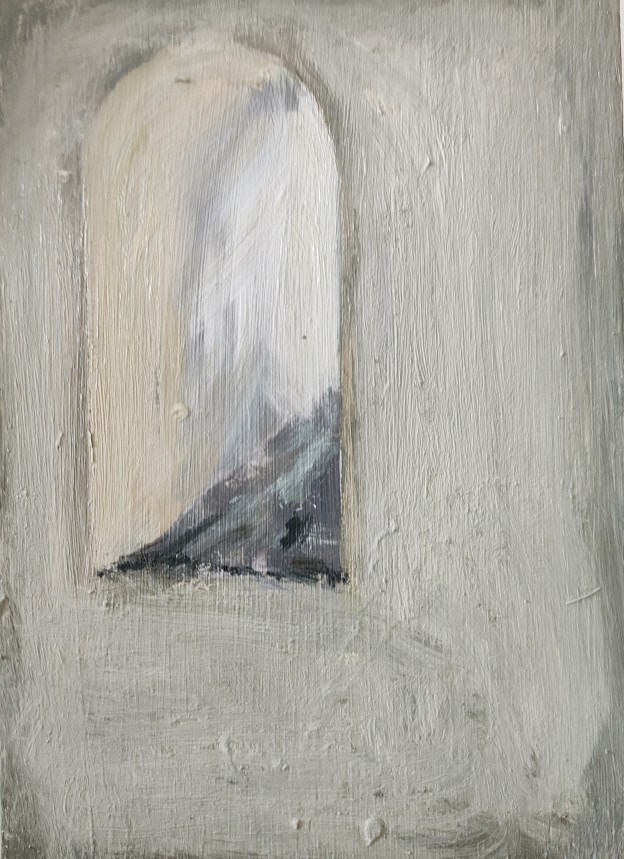
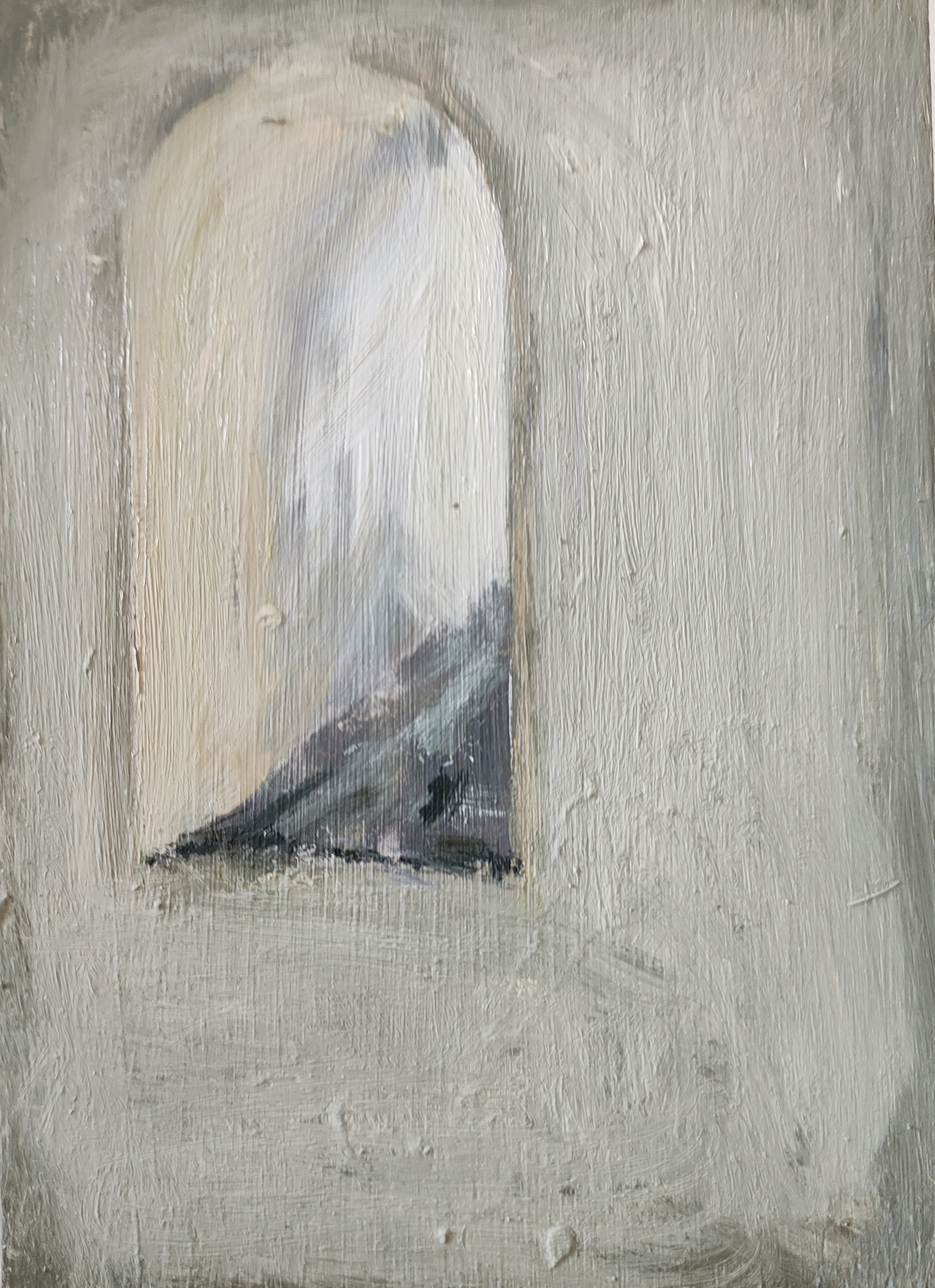
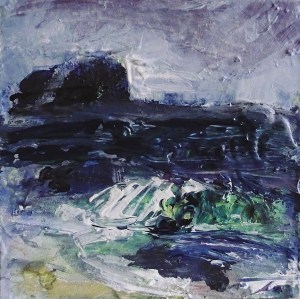
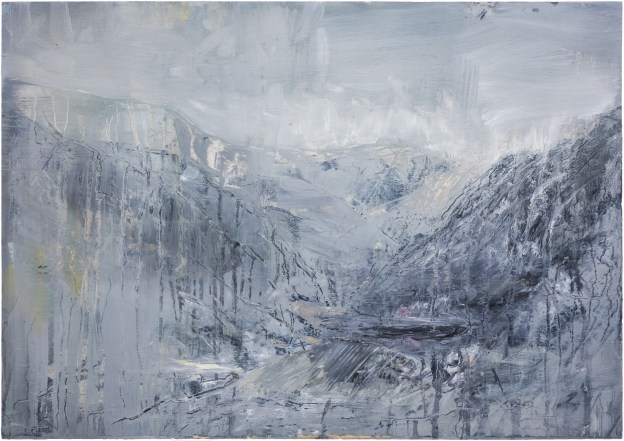
Above – Coigach 2. Oil on 5×7″ wood. Rose Strang 2023.
I’ve realised that strictly speaking this series should be called ‘Coigach Series’ since the paintings are not just my impressions of Achiltibuie. I tend to call the Coigach area of Scotland’s west coast ‘Achiltibuie’ since that’s where I go to visit friends when I’m up there. The whole area is Coigach though – named for one of the mountains in the area. Coigach is an incredible landscape featuring unbelievably pointy mountains with beautiful names such as Stac Polaidh and Suillven. I’m gradually getting to the more dramatic scenes as I progress.
I’ve been getting into the feel of this series on 5×7 inch wood, but today I moved on to 10×10 inch wood as I’ll be creating a series for the Limetree Gallery’s winter show this year. I feel this Coigach series will suit the gallery well. The gallery owners have asked their artists for paintings in the 10×10″ format, which suits me well as I often work at that size.
Here are the latest 7×5 paintings, and the first at 10×10 …
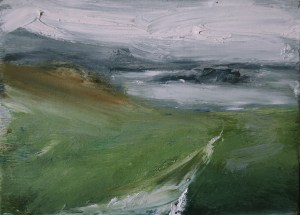
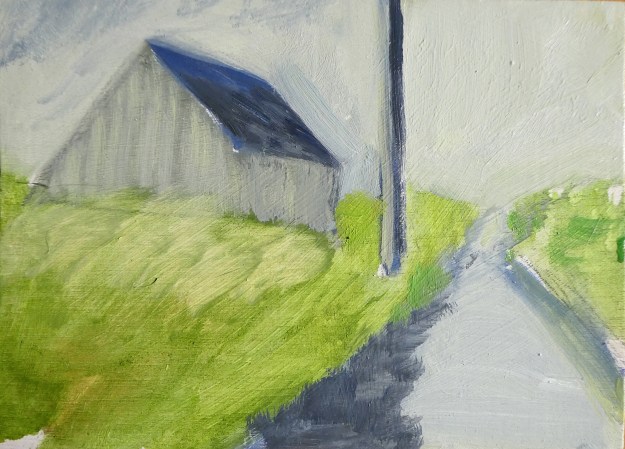
Above – ‘Achiltibuie 3’. Oil on 5×7″ wood. Rose Strang 2023
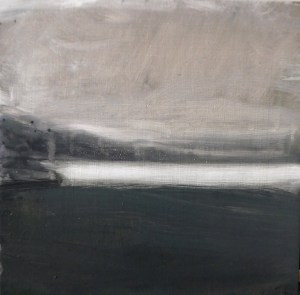
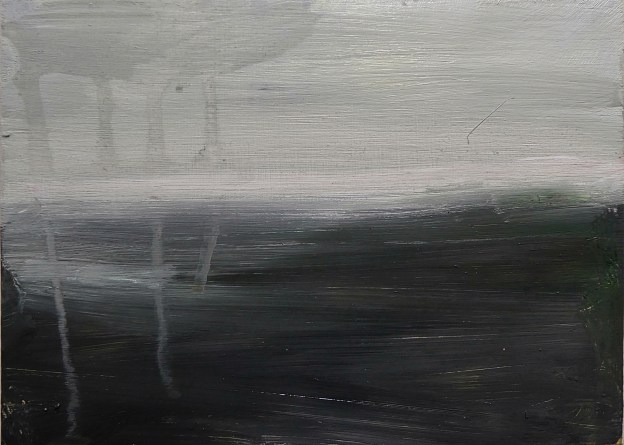
It’s always interesting when you feel you’re going in the right direction paint-wise, but it’s not quite there yet. I prefer the painting below (Achiltibuie 4’. Oil on 5×7″ wood. Rose Strang 2023) to the one above. The one above looks predictable to me whereas the one below has more mystery. Hmmm!
Above ‘Achiltibuie 1’. Oil on 5×7″ wood. Rose Strang 2023
It’s been a very experimental time these last few weeks, not least since it’s impossible to find time to paint on a regular basis, or to focus on one subject with all the projects going on. My studio is temporary till next year and consists of a tiny kitchen alcove, until we find a new home somewhere rural where we can stretch out a little. Needless to say I can’t wait, but it’s a laborious process.
The painting above is from a series I’m painting of my impressions of Coigach and Achiltibuie where we stayed for a few days back in May. I’ve always loved the impressions of landscape that remain in imagination after driving through it. One of my favourite artists, Ilse d’Hollander, had a similar approach – she’d cycle through the countryside of Holland, then return to the studio to create semi abstract impressions. A ‘painter’s painter’ as she was described, she wanted to say a lot with little, more about distilled memories of her short journeys. A sense of space, or light, or distance for example.
I particularly enjoyed this short video about her work, beautifully filmed and edited by Gauitier Deblonde …
Despite all the distractions, I must find time to paint a series for the upcoming winter exibition at Limetree for November. I’m also getting together a little project with my friend and collaborator Atzi Muramatsu. I’ll be creating small portraits in oil on wood of Atzi and members of a small string quartet. The quartet will then play for one night at The Scottish Arts club in November. It’ll be a nice little project, meaningful but manageable!
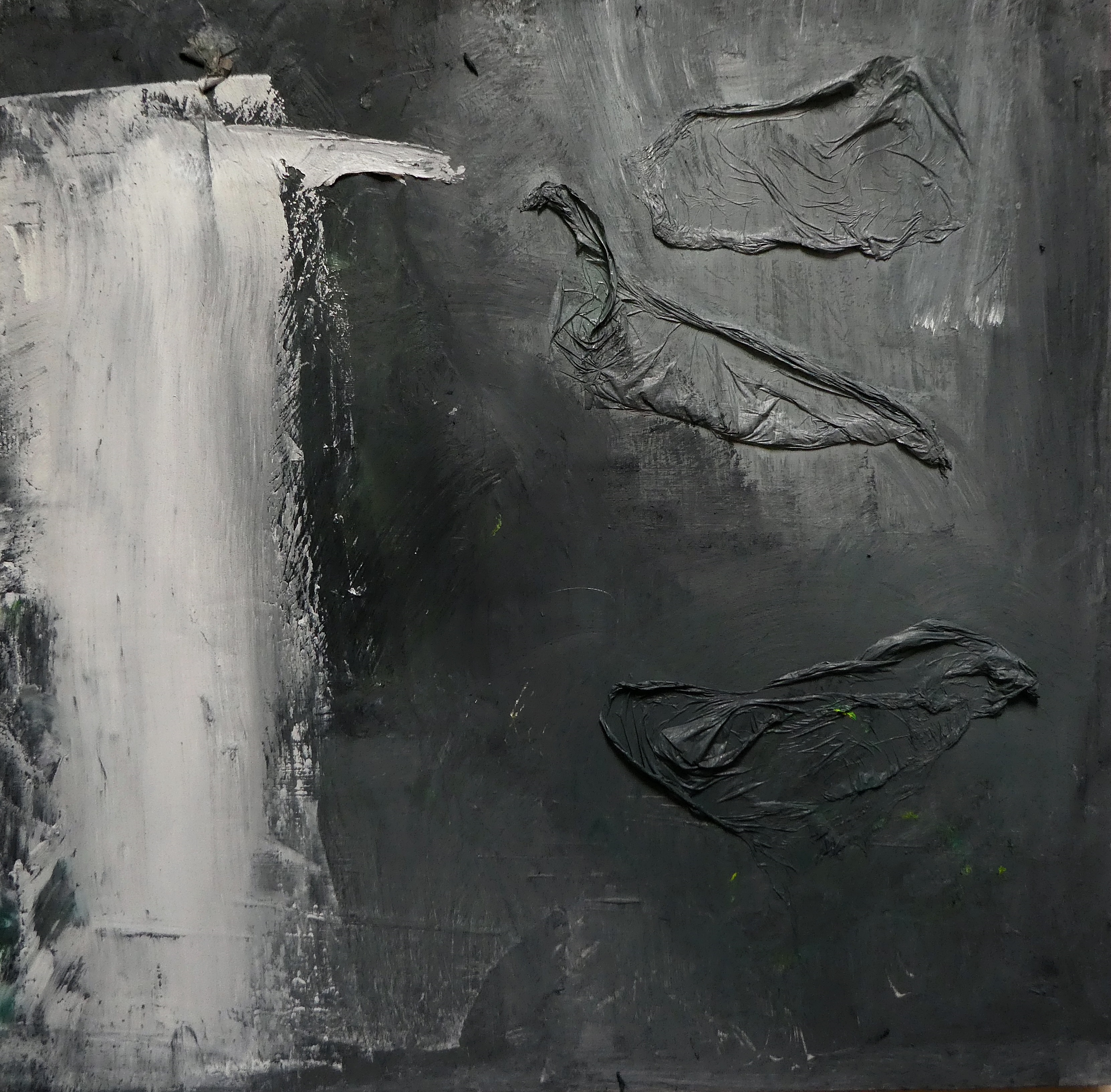
I’m exploring some more abstract approaches at the moment, or mixed media anyway. This piece was created with plastic, cold wax and oils. Quite good fun, it’s good to loosen up – not to always feel you have to stick to the same approach.
‘Waterfall’. Mixed media on 15×15″ wood. Rose Strang 2023
Above – painting in progress St Oran’s Chapel, Iona. July 2023. Rose Strang
A change of palette after a very busy few months. No doubt I’m drawn to these cool beiges and subtleties of light because life has been quite hectic.
There hasn’t been much time to paint, what with getting married in May and all! Then Adam and I spent a month editing our wedding video and creating music for it so we could share a video of our special day with family and friends (we decided we’d have a very low-key wedding, so it was just the two of us).
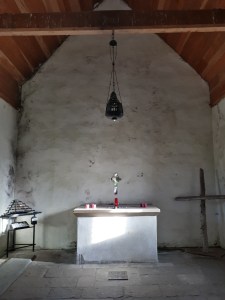
I kept thinking of the light during our wedding in St Oran’s Chapel – it couldn’t have been any more beautiful. Hence these first attempts at capturing the subtlety of light and the way it plays on textured plaster. It’s quite a minimalist, and spiritual theme. St Oran’s Chapel is believed to be the oldest building on the Isle of Iona that’s still standing. It sits modestly in the grounds of Iona Abbey and it’s quite small. The acoustic is amazing.
This series will develop onto larger pieces of wood and canvas, and might involve figurative painting too – a bit of a rarity in my work.
Being the visually oriented people we are, we wanted to find an excellent photographer for our wedding day so we were lucky to find Martin Venherm Martin Venherm Photography whose photos we’d admired when he’d been hired to shoot our friends’ wedding. He created images we absolutely love, and will enjoy looking at in the years to come! Here are a few of my favourites …
Above: Through Kintail 3. Oil on 14×11″ wood. Rose Strang 2020.
I’m delighted that Through Kintail 3 will be on show at the Caledonian Club in London as part of an exhibition organised by the Society of Scottish Artists (SSA) from Tuesday 20th June this year.
The exhibition will take place from 21 June – 13 July in the Club’s Drawing Room and will showcase leading contemporary art by SSA Professional Members.
The exhibition includes works from invited artist Alasdair Wallace, alongside selected works from SSA Professional Members.
Selected Artists:
Christopher Brook | Rowena Comrie SSA PPAI | Soosan Danesh | Jean Duncan | Rhona Fleming | Shona Grant | Cate Inglis | Philip J Lavery | Aileen Keith | Rosalind Lawless | Lindsey Lavender | David Lemm | Kenris MacLeod | Mary Morrison | Gemma Petrie | Jenny Pope | Derek Robertson | Charlotte Roseberry | Carol Sinclair | Christine Sloman | Joan Smith | Rose Strang | Frank To SSA ASGFA | Vasile Toch PSSA | Fenneke Wolters-Sinke | Luke Vinnicombe
The Caledonian Club, founded in 1891, is a private members’ club situated in the heart of Belgravia, London and is “the representative national club and headquarters for Scots in London.”
This exhibition is the first in a revolving exhibition programme exploring the possibility of multiple rolling exhibitions throughout the year.
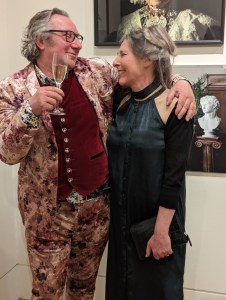
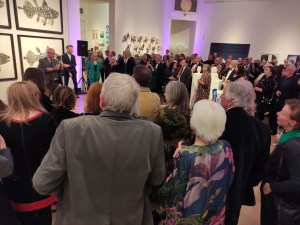
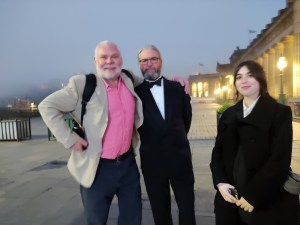
Above, with Richard Demaro and Terry Newman at the RSA Annual exhibition, Edinburgh. (Photo Adam Brewster).
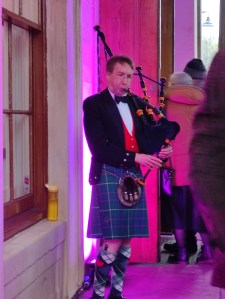
Also a few more photos below of a very enjoyable evening!
My painting below Chancelot Mill, the submission that earned me a spot on the Landscape Artist of the Year last year, is in the show. You can view it, or buy it, on the RSA website on this link – RSA Annual Exhibition
Chancelot Mill, oil on 33×23 inch wood panel. Rose Strang 2022
My favourite pieces of the evening were a beautiful landscape by Kate Downie, and a self portrait by Duncan Robertson – viewable on these links –
Duncan’s piece amused me as I used to share a flat with him and afew other friends (the flat featured in the photograph below) and it’s very characteristic! It was also really lovely to see Richard Demarco, now in his 90’s and looking as energetic as ever.
Obviously my favourite dapper gentleman of the evening was my partner Adam Brewster, looking as though he’d stepped out of a James Bond film in his black tie!
Adam
For contrast to the poshness of the event we dropped into a Pizza hut afterwards with our good friend Giles Sutherland. It was an unusually misty evening in Edinburgh, the Haar from the sea making the night lights of Edinburgh look very mysterious!
Place-names can tell you so much about the history of a place. If you find an old enough map of the Isle of Iona you can see that, tiny though the island is (three by one and a half miles) it has been inhabited by people for thousands of years.
Cnoc an Oran, for example – ‘hill of song’ in Scottish Gaelic, or Sìthean Mòr – ‘hill of the angels’ as it’s translated, though Sìthean also translates as ‘fairies’. Back in about 500AD when an exiled Irish prince, St. Columba (or Collum Cille as he was known) arrived here to set up a religious community, he would have encountered the ancient remains of previous dwellers going back to the iron and bronze ages. Iona has always been a an important spiritual place.
Map of Hy (Iona) 1874
Known as ‘The Dove’ Collum Cille seems to have been anything but! (Maybe this was an early example of sarcasm). He banned women from the island, saying; wherever there are cows there are women and wherever there are women there’s trouble, or words to that effect. He was known as a powerful political negotiator across Scotland. ‘You wouldnae mess wi him’ as Scots might say!
He did set up a Benedictine Monastery though, and an Abbot of the abbey, named Adomnán, wrote of the miracles conducted by Collum Cille, which included facing down a sea monster (it’s since been speculated that it was in fact Nessie).
I first visited Iona in my early twenties seeking, I suppose, spiritual understanding. I did find it a deeply affecting place, which is why I’ve returned so many times since then. On that first trip, I visited the craggy south end of the island, where the rusting machinery remains of an 18th century marble quarry still exist.
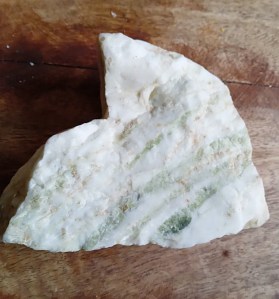
The beautiful lucent white marble is streaked with deep grass-green serpentine and it made the perfect material for the alter that was created for the abbey in the early 1900’s when the abbey was restored. For hundreds of years, children of the island have sold little pebbles of the sea-washed marble to visitors for luck, they still do today.
On my first visit though, I decided to take a slightly larger piece, about 4×5 inches – a large chip from the marble quarry cuttings. It has travelled everywhere with me, you could say it’s been ‘my rock’! Though I think it’s time for me to return it to its home on Iona by way of a ‘thank you’ for everything the island has given me.
It sounds trite or contrived in the usual way of island sayings, when you read that ‘Iona always gives you what you need’, but I’ve found that to be true. There was the sense of spiritual discovery and wonderment in landscape in the first place- an inspiration for me to paint landscape – as well as the more difficult times when I’ve been struggling with life and visited the island to contemplate.
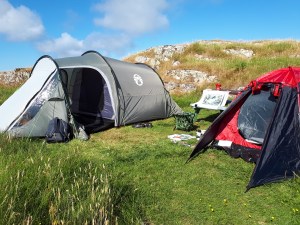
Contemplation sounds peaceful but those visits were turbulent in a variety of ways. For example the time I spent 21 days in a tent by myself, feeling that I needed a break from noise and people. In fact it made me deeply appreciate people since my main companions for those 21 days were spiders, a drove of slugs crawling over my tent, midges, a corncrake whose harsh mating call kept me awake half the night, and a team of baa-ing sheep who decided that my airing sleeping bag was a good place to urinate. (That’s a stench that never washes out, the sleeping bag was indeed a wash-out after that!)
Luckily the campsite owner had a stash of beautiful wool-lined sleeping bags and didn’t bat an eye when I told him of my predicament, lending me one of these for the rest of my stay.
Two tents, one to live in and one for paintings
There was also the time I stayed there in the wintry months, as part of an artist’s residency project. During that fortnight I shared a dwelling space with some very troubled people. Iona attracts pilgrims from across the world who desperately seek healing for emotional or physical wounds. It’s not easy to deal with that sometimes and I found that the atmosphere, combined with a few of the demons of my past, haunted me for months to come.
‘North Beach,Twilight. Isle of Iona’. Mixed media on 6×6″ wood block. Rose Strang 2018. Sold.
‘North Beach, Twilight II. Isle of Iona’. Mixed media on 6×6″ wood block. Rose Strang 2018. Sold.
‘Pisces Moon, Isle of Iona’. Mixed media on 10×10″ wood panel. Rose Strang 2018. Sold.
On the other hand, each day brought blessings: the endless beauty and colours of the landscape, the turbulent energy and colours of the tide changing at twilight, which inspired a series of paintings titled October Tide, then there were fellow creatives who arrived with songs, music and ideas, and new friendships …
Mary McCormick, a grounded and unassuming women in her 70’s from the American mid west, was someone who observed without judgement or drama. She loved to collect small pebbles from her daily walks, pour them into a little dish and invite us to admire them, sharing her photos of the day with residents around the kitchen table. If the conversation veered into turbulent waters, she’d succinctly say her piece with calming compassion and just leave it there, resonating with understated wisdom.
One day we walked to SìtheanMor, ‘The Hill of Angels/Fairies’ and she said that she’d heard in a book that you had to listen here for nature, or God, or for whatever beliefs you had, to give you an important message. I stood for a while, watching a wash of slate grey cloud blowing across a dazzling blue sky – it looked like a painting in progress – and the phrase ‘You are meant to enjoy it’ came to mind.
Mary at the north beach
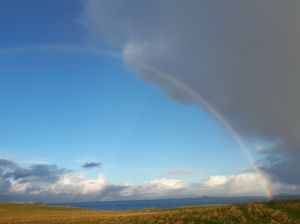
Rainbows and clouds over the north beach
Afterwards we dropped in to the Columba Hotel and I told Mary about the troubled thoughts that had been stirred up by time spent on the island this time and the company, or demands as I felt, of emotionally troubled people. I’d felt so upset I’d taken to hiding in my room in the evenings, worried that I’d affect others with my mood, that I was ‘losing it’. Mary immediately exclaimed ‘Oh, no Rose! ..’ jumping up from her place next to the log fire and coming over to hug me, ‘You’re the most grounded person here, you’ve been a friend during my time here’. My worries felt washed away. We’ve stayed friends since then of course, though Mary is now back in the US, writing, exploring grasslands of the Midwest and finding opportunities to be involved in her main occupation of landscape gardening.
During the residency I’d been reading the poems of Virgil, and on my return I began to explore Medieval philosophy, which led to a new series of paintings about the planets as understood in Medieval cosmology. It was an incredibly enriching time when I read Planet Narniaby the author Michael Ward, which explores the planetary influence in the works of C.S. Lewis.
Sketch. Iona 2018
Virgil
Sketch. Iona 2018
I found that contemplating the influence of each planet changed me. Working through the ideas connected with Saturn for example – winter, introspection, hard lessons, death … (my dad had died just two years before) during the months of December and January 2018, led to a new understanding of how to live life – you’re meant to enjoy it.
Spring arrived at the same time that I was painting Jupiter, which alligns with the change from winter to spring – winter passed, guilt forgiven as C.S. Lewis writes in his Planets poem on the subject of Jupiter – and with it a new relationship.
Last year my partner Adam presented me with an engagement ring that he’d designed himself, made with a small piece of the Ionian marble (my rock, that I’d found on my first trip to Iona in the early 90s!) After celebrating, we discussed where we’d like to get married, but each idea was fraught with planning troubles – we wanted to get married in the countryside, but how would we bring all our relatives from different parts of Britain to the celebration?
In the end, it made most sense for just the two of us to go away to get married, what’s known these days as ‘an elopement wedding’. It was Adam who suggested the obvious – ‘how about Iona?’ I was struck by the fact that I was surprised (and delighted) by the idea. Back in my twenties I’d thought to myself ‘I’d like to get married here, if I ever get married’. Somehow that dream had been buried in the back of my mind until Adam took the idea out, gave it a dust and – there it was!
And so we’ll be in Iona this May (the green, fertile month of love, art and expression, as understood in Medieval cosmology). Inspiration for my next series of paintings. I’m going to take my Iona rock back to the south end of the island and leave it there as a thank you to Iona.
I hope someone else discovers it, and that it brings them enjoyment … C.S Lewis says it better than I can:
“Meditation in a Toolshed” By C. S. Lewis.
I was standing today in the dark toolshed. The sun was shining outside and through the crack at the top of the door there came a sunbeam. From where I stood that beam of light, with the specks of dust floating in it, was the most striking thing in the place. Everything else was almost pitch-black. I was seeing the beam, not seeing things by it. Then I moved, so that the beam fell on my eyes. Instantly the whole previous picture vanished. I saw no toolshed, and (above all) no beam. Instead I saw, framed in the irregular cranny at the top of the door, green leaves moving on the branches of a tree outside and beyond that, 90 odd million miles away, the sun. Looking along the beam, and looking at the beam are very different experiences.
And from ‘Surprised by Joy’, C.S.Lewis:
In other words, the enjoyment and the contemplation of our inner activities are incompatible. You cannot hope and also think about hoping at the same moment; for in hope we look to hope’s object and we interrupt this by (so to speak) turning round to look at the hope itself. (…) The surest way of spoiling a pleasure was to start examining your satisfaction. But if so, it followed that all introspection is in one respect misleading. In introspection, we try to look ‘inside ourselves’ and see what is going on. But nearly everything that was going on a moment before is stopped by the very act of our turning to look at it. Unfortunately, this does not mean that introspection finds nothing. On the contrary, it finds precisely what is left behind by the suspension of all our normal activities; and what is left behind is mainly mental images and physical sensations. The great error is to mistake this mere sediment for the activities themselves.
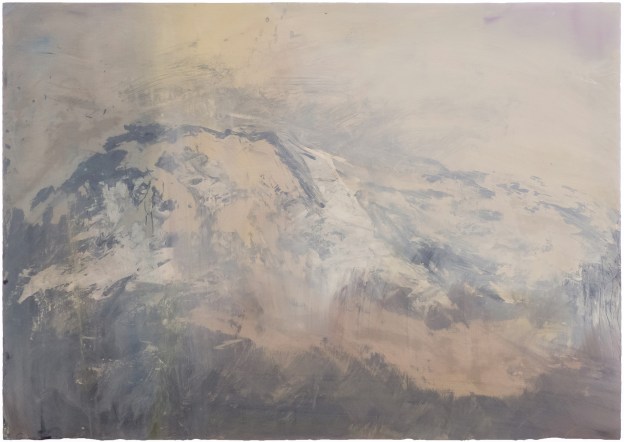
Above Beinn Odhar Bheag, Glenfinnan. Oil on 32×23″ wood. Rose Strang 2020
Back in my twenties (when money was even scarcer than it is today) one of my favourite things was to drive up to the west coast of Scotland with a friend or two and camp wild among the ancient oaks and white sands of Arisaig, Morar or Ardnamurchan.
Cooking over a tiny gas stove under heavy rain required ingenuity – an anorak served as a tarpaulin over the bushes above my head as I cooked spag bol from scratch, in the dark, with a torch strapped to my head. Numerous swigs from a bottle of red wine helped with the ever present midges, in as much as I was beyond caring after a while, though I’d awake the next day with a face so covered in midge bites it resembled a shiny pink football!
Something about camping wild can lead to the most immersive experiences though, I remember sitting at the foot of a freezing waterfall, dipping my head in the water to cool down the midge bites, until my face felt numb – a strangely pleasant sensation, relatively!
I’ve never much enjoyed constant city-life, and have from time to time lived in more rural locations (in Orkney, and on the Isle of Paros in Greece). So it’s a surprise even to me that it’s taken so long to move out of the city – next year I hope to move permanently to the countryside.
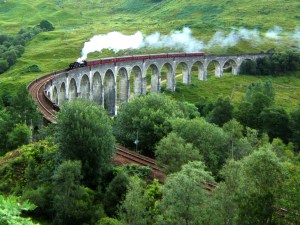
One of my favourite stops on the road to the isles was at Glenfinnan. Leaving the constant noise of Edinburgh we’d drive for a few hours to Fort William for supplies, then it’s just a half hour drive west to Glenfinnan. Beinn Odhar Bheag sits just south of the village of Glenfinnan, a place redolent with history and atmosphere. It was here that Charles Edward Stuart first gathered Highland clans from across Scotland for the fateful last war of independence which culminated at Culloden. And it’s the famous Glenfinnan Viaduct bridge here that featured in the Hogwart Express journeys in Harry Potter films.
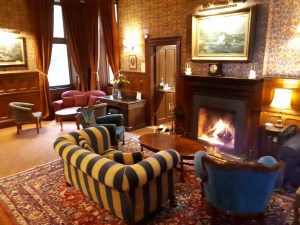
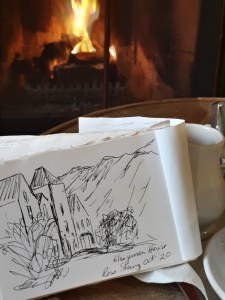
Harry Potter hadnt been written back then, and I only vaguely knew about the Jacobite connection back then. What I loved was to drop in to the Glenfinnan House Hotel for a cup of tea. No matter how scruffy and muddy our car, or boots, we always felt welcome there. As soon as you enter the hall you’re greeted with a Scottish Highland miasma of huge log fire, vast dark oil paintings depicting various moody mountains, wildlife or battle scenes, a mish-mash of antique furniture and dark wood panelling.
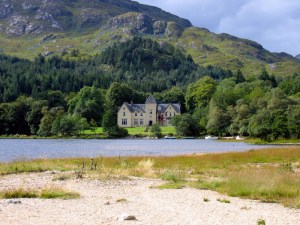
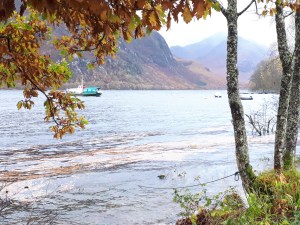
On a sunny day, you might carry your pot of tea into one of the sitting room areas, clad in fading green tartan comfy chairs, where floor to ceiling windows look out on one of the most stunning views in Scotland – across the silvery Loch Shiel to wild mountains beyond. More likely though, you’d sit warming your damp feet in a huge sofa next to the fireplace and find that your head would be almost reeling with … the silence. The sheer redolent and resounding silence after all the city noise!
I painted Beinn Odhar Bheag (pronounced ‘Ben ower beg’ meaning ‘the little dun coloured hill’ in Scottish Gaelic) a few years ago and didn’t think much of it at the time. Dusted off and looked at again, it’s better than I remembered! So I’ll be submitting it for a landscape painting award, and we’ll see what happens.
I’ve left the wood showing through and there’s very little paint used. I added a swathe of darker colour to the left to suggest the ever changing light on the mountains as the clouds pass over.
Adam and I were lucky enough to stay at the hotel for my birthday in November 2020. Though it was lockdown it still felt warm and friendly and we absolutely loved it.
I’m sorry to hear that the couple who managed and cooked for the hotel have moved on to new projects after twenty years. So it’s temporarily closed at the moment, presumably due to open again soon once they’ve appointed new managers, I hope. I wish them luck!
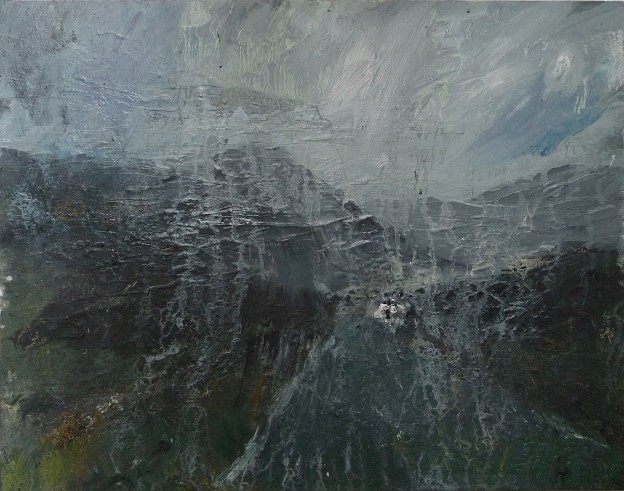
(Above: Among Elementals. The Living Mountain Series. Oil on 60x42cm wood. Rose Strang 2020.)
“A stunning series of images – a symphony of subtle essences, distilled experiences, fleeting memory fragments and deep, heart-felt lingering impressions.” *****
Giles Sutherland, the Times, 21st February 2023
It was an absolute delight to read Giles Sutherland’s sensitive, insightful review (link below) in The Times today. Not simply the understanding of intention and inspiration behind the paintings, but because it so succinctly gets to the core of why Nan Shepherd’s beautiful book The Living Mountain inspires artists and creative thinkers everywhere, especially in our contemporary times.
Here’s a link to the article (if you can’t access the article the text is copied in full below):
Not that long ago, in the mid 80s, in response to a question from a brave, young, female north American student, my Scottish literature lecturer opined that the reason there were no women writers on the syllabus was there that there were ‘no Scottish women writers of substance’.
How shocking that such nonsense was then so deeply imbedded in academe. The hapless lecturer had clearly not heard of Nan Shepherd, born in 1893, a native of Deeside and contemporary of literary luminaries such as Neil Gunn, Lewis Grassic Gibbon, Marion Angus, Helen B. Cruickshank, and Agnes Mure Mackenzie.
Shepherd – whose literary ability was at least equal to that of her male peers – is currently undergoing a reappraisal and revival, supported by such talents as the writer Robert Macfarlane, and the artist Rose Strang. Strang’s paintings, which form the basis of this show, were commissioned to illustrate a new edition of Shepherd’s classic of nature writing, The Living Mountain, first published in 1977.
Following in Shepherd’s footsteps, Strang travelled to the Cairngorms, to places such as Càrn Bàn Mòr. Her journey provided inspiration for a series of nine oil paintings, inspired by the mountains’ genus loci and the fluid poeticism of Shepherd’s prose.
The result is a stunning series of images – a symphony of subtle essences, distilled experiences, fleeting memory fragments and deep, heart-felt lingering impressions.
Strang’s painting makes us ask deep questions about what painting is, how it functions and gives us answers to its ultimate purpose. Like Shepherd’s words, and indeed the Cairngorms themselves, these paintings work slowly, generatively taking hold of our senses and our imagination, striking deeply at our core or, if you like, our souls.
‘One cannot know the rivers till one has seen them in their sources but this journey…is not to be undertaken lightly. One walks among elementals and elementals are not governable…’ wrote Shepherd in the first chapter.
Strang’s ‘Among elementals’ deals with the idea of seeking the source of things, for like Gunn, Shepherd’s thinking was infused with the power of symbolism, so important in Eastern and Celtic culture. Here, as in the other paintings, there is a sense of wonder and the fragility of the human presence among the mountains’ deep geological time.
A wonderful film by Strang, with atmospheric music by Atzi Muramatsu, provides yet another accompaniment to Strang’s imagery and Shepherd’s words.
See this small but perfectly formed show if you can.
*The exhibition runs at the Heriot Gallery, Edinburgh, 17-23 April.
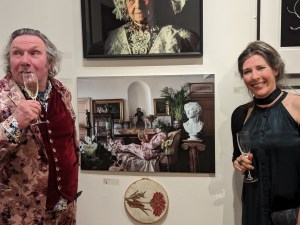
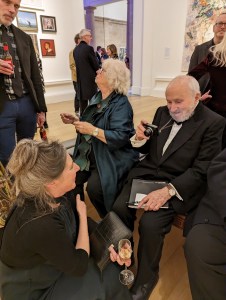
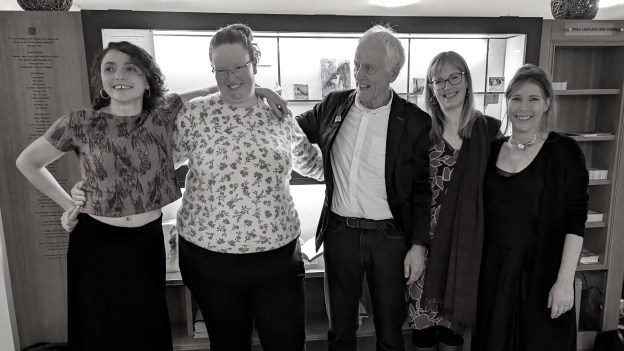
(Above, from left to right: Anna Fleming, Kerri Andrews, Erlend Clouston, Merryn Glover, Rose Strang, at The Scottish Poetry Library).
I’m very excited to share a new video (link below), created in response to my recent exhibition The Living Mountain. Dreaming a Response, which is currently showing at The Scottish Poetry Library in Edinburgh until the 31st March. If you don’t get a chance to see the paintings at the Scottish Poetry Library, the exhibition continues at The Heriot Gallery, Dundas Street, Edinburgh from 17th to 23rd April 2023.
The video showed at the Scottish Poetry Library as part of a launch event of the exhibition and as part of an evening celebrating what would have been Nan Shepherd‘s 130th birthday (author of The Living Mountain)
It features really beautiful music by my friend (and collaborator on many projects since 2013) Atzi Muramatsu. I knew Atzi would respond to the themes with talent and sensitivity but I was deeply moved by his interpretation. Listening to it for the first time was a ‘hairs-standing-on-end’ thrill for me! I won’t go on too much, but do have a watch and listen. A heartfelt thank you to Atzi.
There was a wonderful buzz at the event, which completely sold out (Nan Shepherd being a popular subject these days). Much of the talk included speculation on why such a gifted author only published her non-fiction work The Living Mountain in her later years. I’m very grateful to Aly Barr and all at the Scottish Poetry Library for including me in the event. They were fantastic people to work with – humorous and calm throughout!
Three authors, Merryn Glover, Kerri Andrews and Anna Fleming, shared moving excerpts from their new books. Then, literary executor of Nan Shepherd’s estate (and lifelong friend of Nan) Erlend Clouston, gave a characteristically fascinating and humorous talk about Nan, followed by a general discussion and Q+A from the audience. There wasn’t enough time for all the many ideas and experiences to be shared.
Thankfully amongst all the excitement I remembered to buy all three books, all of which, from their unique perspectives, delve into the fascinating life and inspiration of Nan Shepherd:
And here’s a link to Erlend Clouston talking about Nan as part of Simone Kenyon’s project called Into the Mountain – Erlend on Nan
The exhibition at the Scottish Poetry Library also includes a display of some of Nan’s letters and first drafts of poems. (My personal favourite was ‘Achiltibuie’ because it’s a jewel-like poem, capturing the incredible landscape of Achiltibuie – a place quite dear to my heart).
Thank you to everyone who attended the events at the Scottish Poetry Library. Thank you of course to my partner Adam Brewster who was there being supportive and creative throughout this project (which was two years in the making!) and for the stunning photos of the Cairngorms which feature in the video above. And again thanks to the Scottish Poetry Library for making the event so special and exciting. I think it’s wonderful how inspiration leads to many new inspirations, ever blossoming. It was just great to meet everyone there and share our love of The Living Mountain. Here’s to many more such events in future!
The Living Mountain. Dreaming a Response continues at the Scottish Poetry Library until 31st March, then goes on exhibition for one week at the Heriot Gallery, Dundas Street, Edinburgh from 17th to 23rd April.























![PXL_20230217_190459910[16779]](https://rosestrangartworks.com/wp-content/uploads/2023/02/pxl_20230217_19045991016779.jpg)
 Rose Strang Artworks