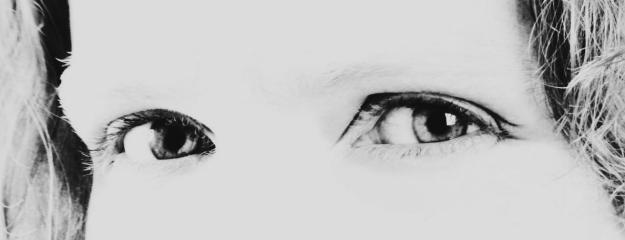
Louise Palfreyman
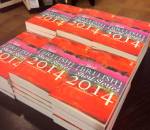
It’s just a week away from my upcoming Hebridean adventure and collaboration with author and poet Louise Palfreyman (featured in Best British Short Stories 2014,) and cellist/composer Atzi Muramatsu.
I’ve known Louise since around 2010, when we met at the creative writing group Powwow (based in Birmingham).
As mentioned a few weeks ago I’m featuring an interview with both of these lovely, talented people in my blog, starting with Louise today…
 Rose: Thanks for taking time for this interview Louise. Firstly, for me Powwow Writer’s Group was a foray, or sideline into creative writing which I enjoyed, though visual art is my focus, but you’d already had a career as a journalist and in more recent years as an author, with work published in Best British Short Stories, The Pigeonhole, Litro, The View from Here, and Hypertext Magazine. How did you get involved in journalism? It always seems to me a somewhat stressful, if interesting world to be involved in, can you tell me a bit more about that experience?
Louise: I had five options on gaining my degree (actually, you have limitless options, but I narrowed my career choices down to five). I plumped for journalism because I wanted to write. I found the exposure to all walks of life fascinating. It has to have influenced my fiction in some way. In the end it was stressful. The toll it took on family life was enormous, and so I pulled away. I’ll never regret my choice though. It has led to so many other things.
R: There’s a huge difference between journalism and creative writing of course, but it’s a fairly common crossover – many writers have gone from one to the other. Would you say journalism has impacted in any sense on your approach as a creative writer? And why did you decide to pursue creative writing?
L: Journalism taught me economy and precision. I have no trouble editing myself. It also taught me to avoid clutter. I recently put a story of mine into a word counter because I don’t have Word on my phone and it’s a great tool, because it also gives you all sorts of stats on sentence length, word frequency and even reading age. The story read as US fifth grade, which is a reading age of 10-11 years. That’s about right for a former tabloid reporter.
I came to creative writing thinking I could master it pretty quickly, as I’d churned out so many  thousands of words over the years. It was arrogant of me to assume that, and I promptly fell flat on my face before slowly learning the new craft of fiction, at PowWow and at an Arvon creative writing retreat, where my story for the Best British anthology was produced.
I’ve been fortunate to rub shoulders more recently with some very fine writers through the encouragement of Nicholas Royle, editor at Salt Publishing, and by corresponding with writers I admire like David Rose, who is one of the best writers of short fiction today. It’s important to up your game, to stretch yourself, and there’s nothing like being around brilliant writers for that.
R: Which authors or writers have been an inspiration, or influence, and what aspects of their work interest you?
 L: I’m always careful answering this one, because there’s a huge difference between inspiration and influence. I can walk around in a cosmic daze after reading Don DeLillo, for example, but I have no aspirations to replicate his voice or style. I am not an ageing American male. I’m a carefully preserved English female.
My biggest influence, truly, is poetry. Again, I’ll keep names vague because what poetry has taught me has far more to do with rhythm and symbolism than it ever could about the specificity of a single voice.
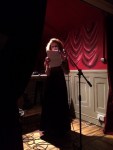
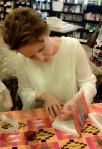
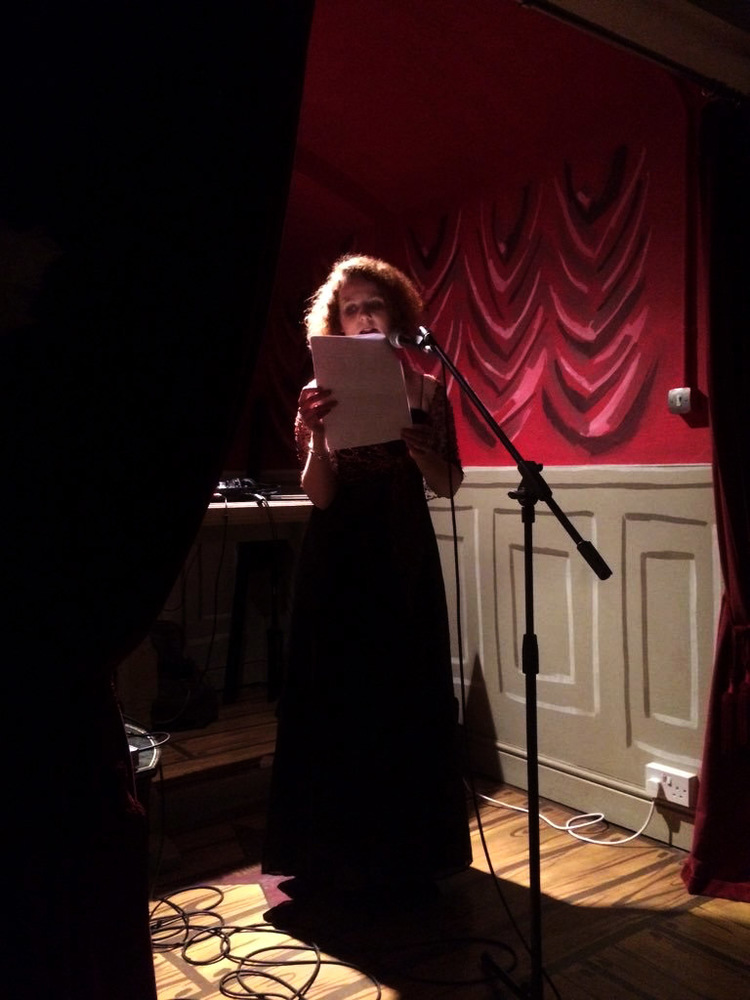
Live reading, Birmingham 2015
R: Your preferred forms at the moment are the short story or ‘flash fiction’. Reading through The Jewel of the Orient (link below) I was struck by the depth of ideas and atmosphere captured in such a short work – it takes us on quite a journey in a short piece of text. What led you to choose the shorter form as opposed to the novel? Can you describe the process of packing so much in to a short work- for example is it edited from a much longer work or structured carefully from the beginning?
L: The Jewel was one of those pieces that came into me and inhabited me, rather than a story I laboured over for weeks, though there are plenty of those.
Again, poetry has everything to do with how I approach the short story form. I feel excited by what you can achieve in fewer than 3,000 words – which is what my stories tend to be. And I love the rigour of flash. I’m very pleased with a recent story of 346 words. I try to tell a complete tale in as few words as possible. A great exercise is to look at a first draft and halve it. Halve it exactly. Then halve it again. What have you lost? What have you gained?
Of course, this process involves more than just slash and burn. You also have to step back and consider what you wanted to achieve in the first place. What is your story about? What is its main thrust? These are the things that can get lost, I feel.
Never forget the purpose, the singularity, of a short story.
Link: Jewel of the Orient
 R: One of the qualities I most enjoy in your writing is I suppose what you’d call magic realism; the way you draw your reader gradually into unreality. In Buddleia for example (audio link below), it’s pleasing to discover she has wings, we want her to have wings. Or in Jewel of the Orient the completely unexpected transformation at the point where the sexual voyeur expects a ‘happy ending’! It’s surprising, often very amusing (also in Calypso where she struggles to convince mental health workers she’s immortal) but these aspects tie in to the heart or idea of the story.
Are there reasons why a central theme of the fantastical or dream-like is a recurring theme in your work? How do you take the reader convincingly on that journey?
L: I never set out to consciously address the reader, for starters. These considerations have to come later, in the editing stage. What is needed first of all is complete immersion. Some people grab a few minutes of writing time as soon as they wake up. They tell me that they are still tapped into their subconscious at that critical point before showering, dressing and surfacing into the day.
Unfortunately, I am not a morning person (as you well know) and so I am unable to access my subconscious at this crucial point. I have to get there at other times, and I definitely have to bring myself into ‘the zone’ in order to be able to achieve the right flow of thought.
It’s not about automatic writing, or the ‘stream of consciousness’ style so despised by some. There is structure in there too, which can come from turning over an image or an idea, sometimes for days, weeks, months. Ideas formulate in interesting ways, and I’m not sure I can entirely answer your question about why the fantastical recurs in my writing. Of course, to say ‘It just does’ would be infuriating, so I’ve tried to unpack it a little. My love of Debussy and poetry may give you more explanation, perhaps. Symbolism. Impressionism. Other worlds. I like to escape.
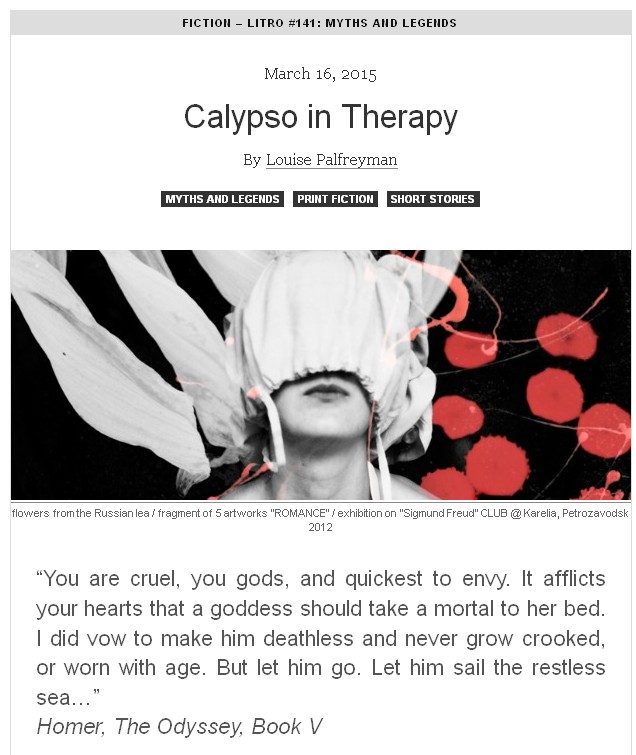
Link: Buddleia Link: Calypso in Therapy
R: You have a talent for capturing atmosphere, and the sense of place. Are you an author who collects observations in a little book each day, or is it largely sense recall or a trip through imagination?
L: I try to jot key things down, usually into Notes on my phone. I recently resurrected an old digital voice recorder. I’ve kitted it out with a lapel mic. I am going to discretely mutter to myself in the park. I like the idea of muttering away whilst walking the dog. You have to grab thoughts when they come to you, and mine come when I walk. They also flood in on train journeys, so travel can be very good for inspiration.
R: Lastly, what are you looking forward to, creatively as a writer, on our upcoming Hebridean odyssey? Is this a new approach for you and how do you feel about the collaborative process? Is that a new experience for you?
L: Collaboration is a complete joy. I’m an extrovert writer, and so I find the isolation inherent in the process absolutely crucifying. It is always so refreshing to attend workshops and classes, events and performances, and collaboration also affords artists the very particular joy of synergy. Knowing that your creative fusion has produced something you can present to the world, something unique and of that time and those particular people, is, I think, very special. So I’m looking forward to our adventure enormously. When you are working with people you admire, forces build before you have even started. There’s an immense anticipation, an energy. Things are starting to form, and we haven’t even got there yet!
R: I echo your thoughts wholeheartedly! This is going to be a fascinating journey, I’m honoured and inspired to have you and Atzi working on this project. Thanks Louise for sharing thoughts about your work with me, and I’ll see you on the 16th when we start our journey!
(More about our collaboration and Hebridean trip Here)
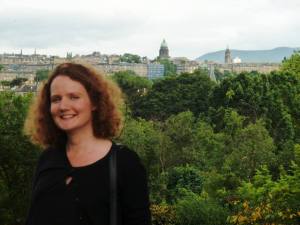
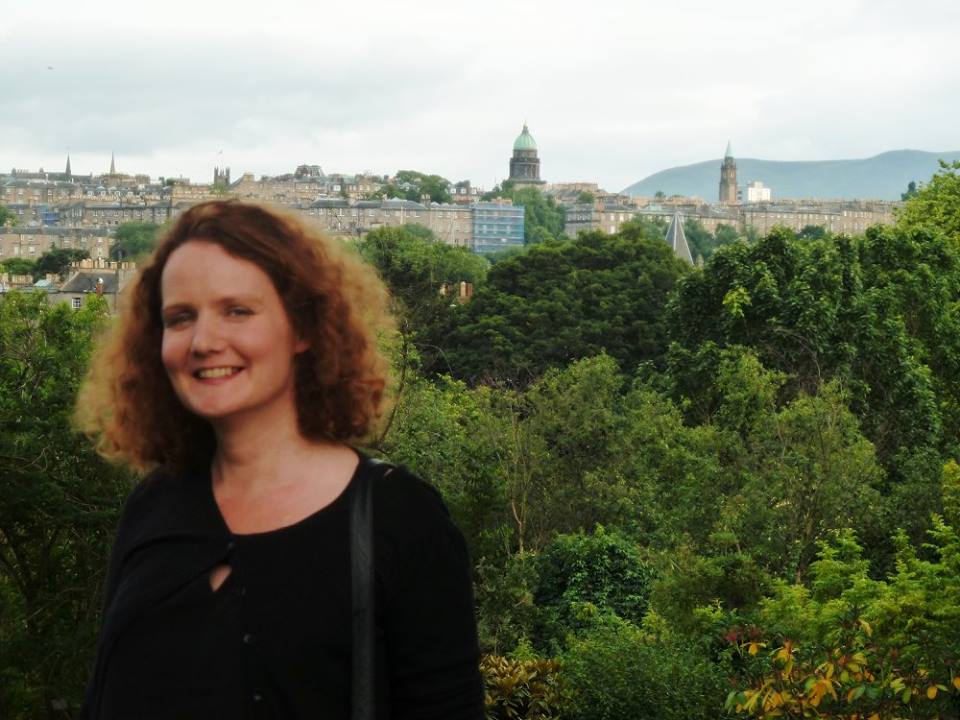
Louise Palfreyman in Edinburgh July, 2016
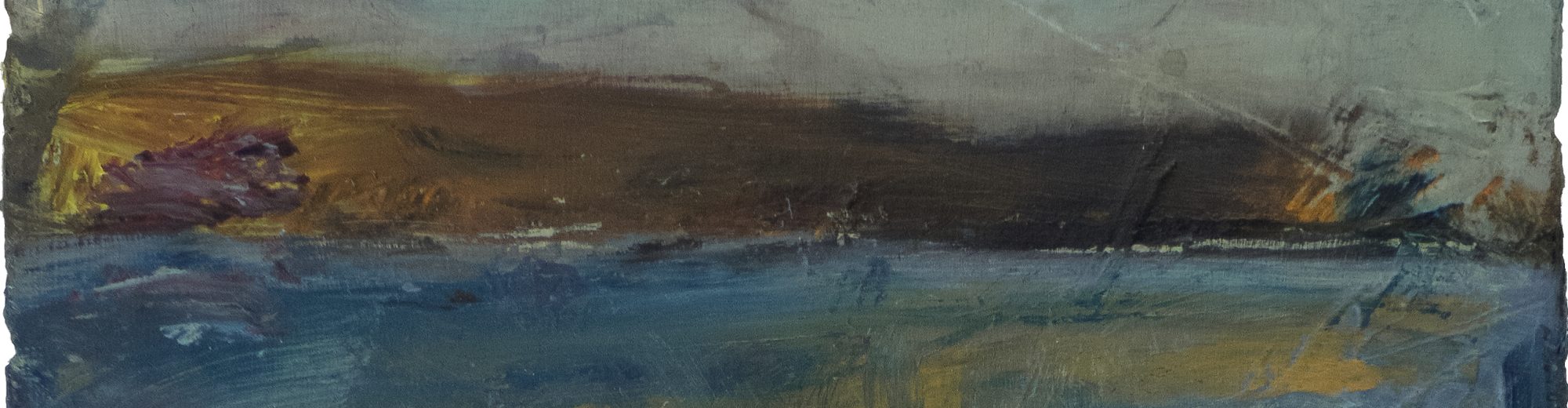
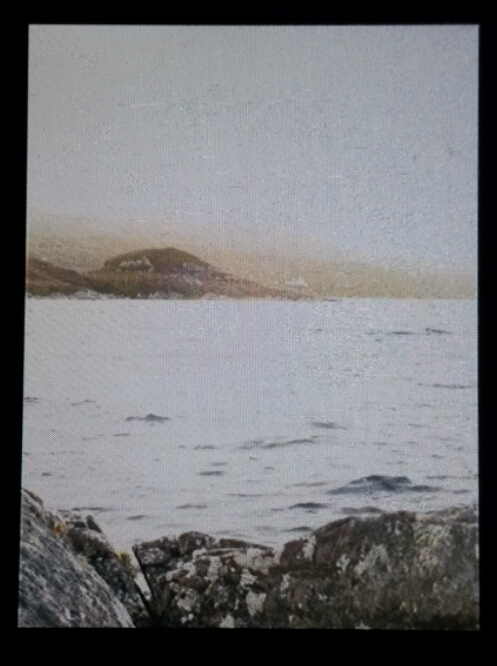
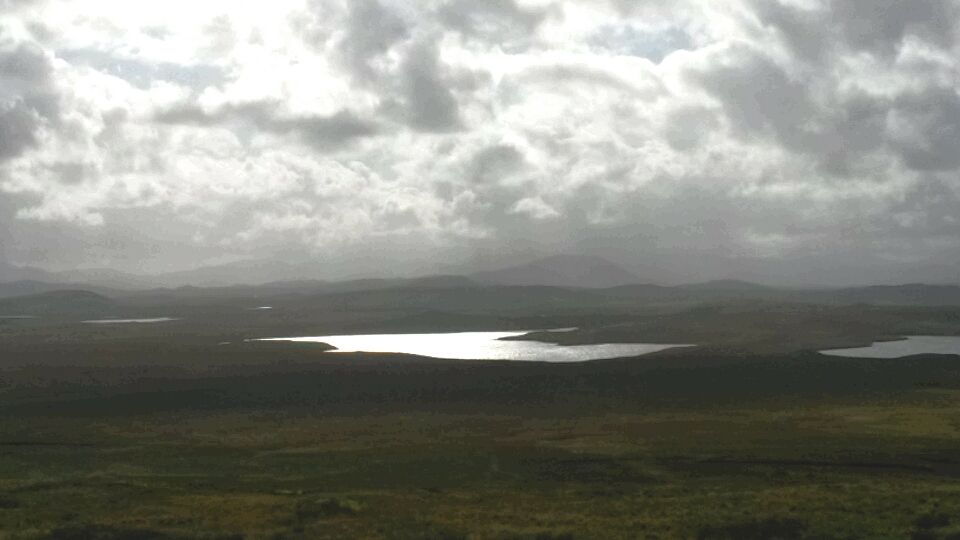
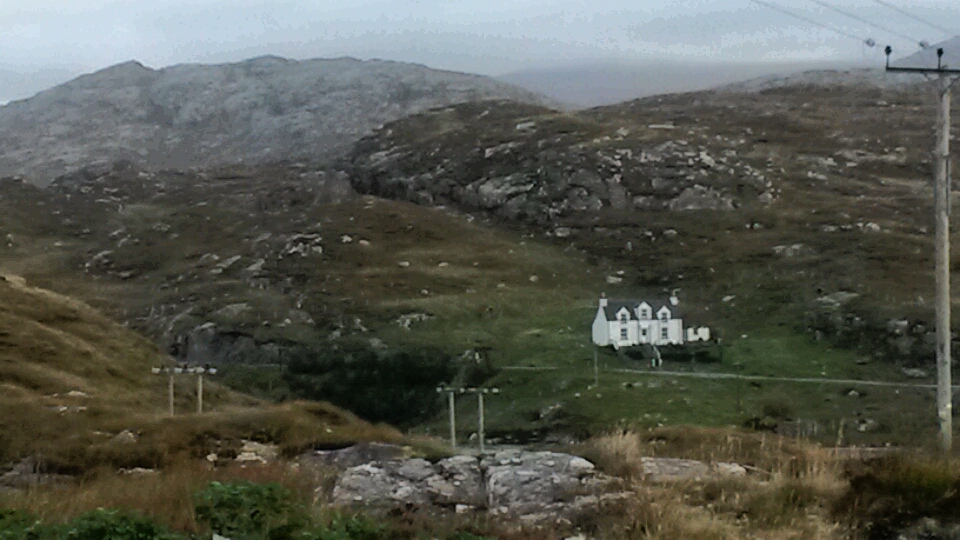 on the Isle of Harris) an extraordinary moonscape-like coastline (which our host told us was the setting for ‘2000 A Space Odyssey’) an otherwordly, peaty landscape carpeted in spongy sphagnum moss, strewn with ‘incidentals’ – boulders randomly dispersed thousands of years ago as glaciers melted and receded.
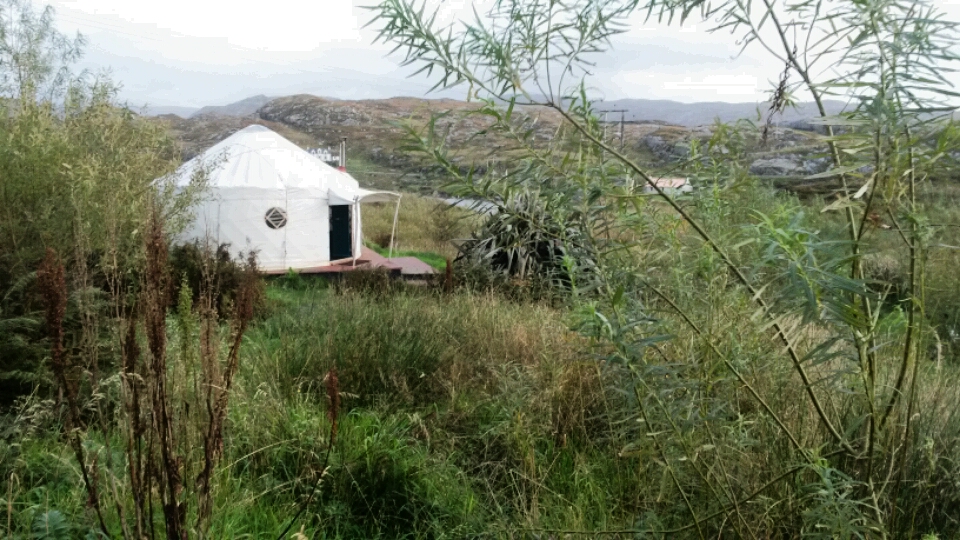 marshland rushes, each having a little stove with smoke drifting into the low clouds. I was reminded of marshwiggle country, the feel of utter peace and remoteness. Utterly magical.
 We were inspired and heart warmed by the conversation – it’s been a few years since I last saw Ian (we were working on a live art project called Transitstation, which originated in Berlin).
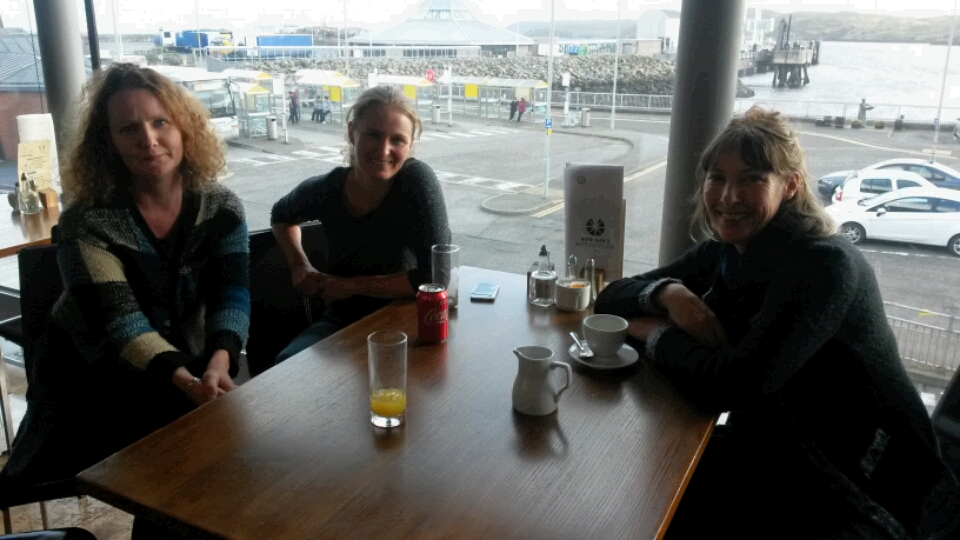 Ellie Fletcher about potential exhibitions and projects.








 Rose Strang Artworks