Author Archives: rosestrang

Unknown's avatar

About rosestrang

Artist, Painter

Planet series – Jupiter (in progress) day 3

‘Jupiter’ (in progress).

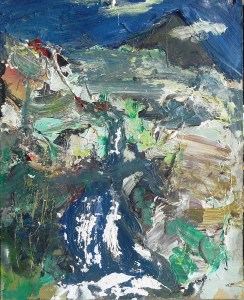
Today’s progress on ‘Jupiter’. I wanted to create a luminous backdrop for the painting – the sea is a glaze of blues and gloss varnish, which you can see slightly better in this image ..

(This is the second in a series of seven paintings inspired by the seven planets as understood in Medieval cosmology, and the seven books of Narnia, which as the writer Michael Ward discovered, were themselves inspired by the seven planets. For more about the series, click on ‘Home’, above, and scroll through previous posts).

As mentioned in a previous post, I decided to paint Castle Tioram as the theme for ‘Jupiter’. Jupiter rules the months of February and March and I’ll be including trees, flora and fauna related to the planet as the painting progresses.

Fairy Tales ..

Castle Tioram, photo Rose Strang September 2018

I first visited Castle Tioram (pronounced ‘Cheerum’) in the Ardnamurchan Peninsula in 1992, and returned again for the first time since then in September last year. It was a beautiful, entrancing place back then, and still is. The Ardnamurchan Peninsula is one of Scotland’s most remote and un-spoiled areas of landscape. Ancient forests grow right down to the coast. Mosses, lichens and rare plants flourish in the relatively unpolluted atmosphere – the forest’s ecosystem is more or less untouched, save for a very few pathways and single track roads that weave through the area.

If you’re interested in forest ecosystems you’ll know that forest trees ‘talk’ to one-another in a sense. ( https://en.wikipedia.org/wiki/Suzanne_Simard) .They communicate via their complex root system, so that younger trees, or weaker trees are fed nutrients by older trees – they’re interdependent. Before a tree dies, it sends nutrients to the roots of nearby trees. When the forest root-system is disturbed by, for example, motorways cutting one area off from another, the forest ecosystem is destroyed. An ancient forest is a sort of entity in a sense (or a community if you like)

So Tolkien wasn’t far wrong, and C.S. Lewis (a close friend of Tolkien for decades) shared this reverence for nature – both author’s books featured the idea of conscious trees. Lewis’s stories featured dryads (tree spirits) able to ‘leave’ the physical tree and travel far distances to communicate important news. (in The Last Battle for example a dryad tells King Rillian that her tree, miles away, is being destroyed along with the rest of the forest).

In the east part of Ardnamurchan, further inland, is one of Europe’s rare original oak forests. It’s called Ariundle (derived from Scottish Gaelic Àiridh –  meaning a shieling or collection of small huts and Fhionndail – a fair meadow). So, ‘a collection of huts in the fair meadow’. Ariundle is a remnant of the ancient coastal oakwood that formerly stretched along the Atlantic coast from Spain and Portugal to Norway.

Ariundle Oak Forest in Ardnamurchan

In early medieval times Castle Tioram and Ardnamurchan were far busier places than nowadays. The highways of the ancient world across Scandinavia and the north of Scotland were sea-routes – quicker to navigate than land before modern times when roads were cut through mountains and forests.

The north and west of Scotland as a whole was teeming with activity. There were numerous wars of independence and during the Middle ages, Scottish castles were often burned and destroyed during war-times to prevent them being occupied by incoming armies (which is what happened to Castle Tioram).

Towards the end of the 18th century (post-Culloden) Highland clearances, then the industrial revolution almost entirely emptied some areas of the west coast. Anyone who hadn’t emigrated, or been forced to emigrate, to America and Canada moved to the cities and towns for work.

The one upside of this is that the landscape has been left untouched. Castle Tioram, situated on a rocky outcrop in a glass-like sea surrounded by wild forest, can have quite an impact on visitors to the place –  it does look almost other-worldy, or mythical.

Maybe it’s just nostalgia that makes people respond with emotion to the castle, a sentiment or belief that things were better in times past. Looking into early Scottish history though, there are as always two stories – one from ruling leaders, post war, and the story discovered in ancient Gaelic manuscripts. Tioram was never defeated in battle, for hundreds of years it was relatively peaceable (for those times at least, when feuds were common throughout Europe).

The castle and surrounding area was home to a large community ruled by the MacDonalds under the complex laws of the early clan system. This society enjoyed thriving art, literary and music traditions, and although the more democratic approach to running society appeared chaotic or ‘barbaric’ to outsiders, it now looks ahead of its time. Men and women inherited title and property, children of the ruling monarchs were often placed in the poorest households of the clan, while poorer children in the community were adopted temporarily by the ruling family. This encouraged connections, the learning of skills, and a balanced community.

It wasn’t all peaceable of course, there were the numerous complex feuds between clans, and the wars of independence which occurred between the 13th to 18th centuries. In 1715 the then chief of Clan Donald, Allan MacDonald, torched the castle before joining the battle at Sherriffmuir (1715 Jacobite rebellion – thanks for correction Murdo MacDonald!) He expected to lose, and didn’t want the castle to fall in to government hands. The final battle took place in 1745 at Culloden, and after this the Scottish clan system was destroyed (also due to the fact that many Scottish clan chiefs bought into the new feudal system as it offered unlimited opportunities for wealth and land) and Scotland never regained independence.

All of that explains some of the historical reasons why we respond to such places, but maybe our response to castle ruins in a wild remote landscape is also related to the power of fairy tale or archetypes – it ‘speaks’ to us of something important and valuable. In Ardnamurchan the air feels different because it is different – it’s clean, scented with salty brine, sun-warmed wood, mossy forest floors and the honey of heather throughout summer – it feels idyllic. Nowadays we understand the environmental fragility of such places.

In an earlier post I described C.S. Lewis’s fascination with Medieval mythology and cosmology – an era in which he believed imagination held an important philosophical role. From a different perspective Jung also explored this area – focusing on the importance of archetypes in the collective human psyche. Early Medieval thinking hadn’t yet lost that sense of universality, and connection to nature.

A castle on a remote island reminds us of a thousand different myths and fairy tales – tangled forests, ogres, battles, knights, magicians, princesses plotting escape, not to mention Camelot – a legend based on dreams of a lost golden age and the search for a mysterious holy grail. One conflict of the story is the battle of Pagan and Christian religions – neither of which comes out on top, interestingly. The myth goes (of course!) that both Merlin (Pagan) and Arthur (Christian) will return again.

It all reminds me of this sort of art …

From ‘Très Riches Heures’. 15th cent’  French illuminated manuscript

From ‘Très Riches Heures’. 15th cent’ French illuminated manuscript

This Gothic or pre-renaissance style of painting is a continuation of Byzantine art. It made way for new ideas of realism in art – perspective and so on – leading to high renaissance art and ‘the age of reason’. Boticelli was sn artistic bridge between these styles and Northern renaissance art sometimes referred back to this earlier era stylistically.

All of this is ideal subject matter for my Jupiter painting, relating also to the Jupiterian book from the Narnia Chronicles The Lion the Witch and the Wardrobe which centres on the idea of Winter passed, guilt forgiven – restoration of a golden age of peace in the sea-side castle of Cair Paravel after years of cold and brutality, but this comes after challenges, sacrifice and re-birth (the Christian element of the story – though there are many themes).

In this story, the dryads and trees of Narnia are still fully alive (in later books they have to be re-awakened) and since the oak is the tree most closely associated with Jupiter, that’s another reason to paint Ardnamurchan, one of the few places where you can enjoy fully living forests.

Here’s a link with more about Ariundle – https://www.wildlochaber.com/ardnamurchan/wildlife/ariundle-oakwood

Ariundle Forest . https://www.nnr.scot (Scotland’s National Nature Reserves, website)

Planets Series – Jupiter (in progress) day 2

‘Jupiter’ (painting in progress)

Above, today’s progress on ‘Jupiter’.

That’s just the background layer, so it looks a bit pantomime-backdrop at the moment, possibly a bit Visit Scotland, but it will look very different within a week. The raised marks are from a previous painting, but since I’ll be painting oak branches these will be incorporated as part of the gnarly texture of tree-bark.

It’s the same size as my previous painting Saturn, this image gives an idea of scale …

I hope there aren’t too many Medievalist experts reading my blog! Reading back over the past posts on this planet series, I need to correct a couple of details. It’s typical of my approach to a subject since I write as I explore, but I’ll get there!

(This is the second in a series of seven paintings inspired by the seven planets as understood in Medieval cosmology, and the seven books of Narnia, which as the writer Michael Ward discovered, were themselves inspired by the seven planets) …

I’ll write a description of the Medieval view of the cosmos below, then I’ll describe a little more about C.S. Lewis’s views on imagination and reason, as explained in Michael Ward’s excellent book Planet Narnia

Medieval view of the cosmos in everyday life and in art ..

Medieval philosophy, astrology, astronomy, science and religion in the western world all more or less interconnected, though it wouldn’t be described as a rigid or unchanging system of thought and belief.

Some religious groups – Gnostics for example, might accept aspects or theories prevalent in the Medieval view of the cosmos, but not others. Similar to any time including our own it would be misleading to say that Western society was ‘of a mind’, to use a Scottish-ism!

The Medieval view of the cosmos did feed in to every day life though, it was (as we might say nowadays) fairly mainstream. Ordinary working folks might pray to or invoke a planetary influence. Science of the time included the Medieval understanding of the cosmos, the practice of magic was wide-spread, and included evocation of planetary influence. Writers, musicians and artists would create cosmic and theological allegories, the most famous example probably being Dante’s Inferno.

Or more earthy in tone, Chaucer’s character in The Wife of Bath bewails the influence of Mars on her nature –  all Chaucer’s stories deal with the influence of the planets, some as entire allegories, woven imaginatively into the narrative so it can be enjoyed as a story, and as inspiration or contemplation.

Planetary influence was like a lens of myriad colourful and emotive aspects through which artists could explore and observe the world and human nature. It could be described also as a world of external influence playing on the human psyche (interesting to compare it to the influence of Freud on creativity in modern times – Hitchcock films etc).

C.S. Lewis’s interest in Medieval cosmology …

C.S. Lewis was a Medieval Classics scholar and teacher, who felt that society had lost something magical and profound in the post-Copernican world (i.e. when scientific discovery of space altered our view of the cosmos, and by association a certain way of believing, of faith), and although he spent most of his life writing on Christianity and classical literature, his creative output always dealt with planetary influences.

This is why it’s surprising that Michael Ward’s discovery –  that the seven books of Narnia were each influenced by the seven Medieval planets – wasn’t recognised sooner. He believes that this had much to do with the fact that most scholars studying the work of Lewis were Christians, so put simply they’d be a bit shifty about the mention of gods in the plural, not to mention astrology. (if you’ve got a strong stomach you can find numerous right-wing Christians of dubious sanity on Youtube declaiming that C.S. Lewis is an evil Pagan.) Or, atheist ‘rational’ scholars might dismiss the Medievalist aspects as superstition – they might view the form of romance, or fairy tale as not worthy of serious study – i.e. sci-fi or children’s novels.

C.S. Lewis had meaningful or profound reasons for writing in the form of a children’s story. Probably one of the most simple was that it was the only way he could successfully integrate  Medieval cosmology in a post-war literary climate where harsh realism was more zeitgeisty. As Ward observes, he opposed the harsh negative, or nihilist, tone of the literature of his time for philosophical reasons.

He knew too, that the Medieval view of the cosmos, which in many ways incorporated Pagan approaches to belief, did incorporate the concept of one god.

Medieval understanding of the Cosmos …

In Medieval thought, there were three layers: Earth, the Celestial Realm and the Empyrean.

‘As above so below’ referred to the idea that earth and everything in it was a reflection of the heavens, but the influence of the heavens could not be experienced directly because everything ‘sub-lunar’ – beneath the moon, was separated from the direct influence of the cosmos.

People sought harmony with the planetary influences: ‘as above-so below’, and it was believed their influence could be invoked via ‘talismans’ – objects, plants, animals places etc that related to, or were influenced by a certain planet.

(For example copper relates to Venus, tin to Jupiter, silver to the moon and so on) …

Above the earth, the moon drew a sort of veil between the celestial realms and earth. The celestial realms were where the planets resided. The planets, in turn, were influenced by what was termed ‘the divine’ – the realm beyond the planets –  the Emypyrean.

Going back farther in time, think of the mysterious inscription on the tomb of Isis: I am all that was, all that is, and all that shall ever be, and no man hath lifted the veil from my face. It’s interesting also to explore the mythology of Gnosticism, usually at odds with Christian belief, which has a ‘creation myth’ around the idea of this veil – ‘In Our Time – Gnosticism ).

To some branches of thought, the Divine, or the Empyrean, was the unknowable; the One God, ‘all that is’, veiled and beyond human comprehension. In Christian orthodox practice it might be referred to as ‘He’ or ‘our Father’, but the Gnostic view, for example, was that its actual form was unknown and unknowable.

A few posts ago, I described how I became interested in Medieval cosmology via  symbology and the Narniad. I’ve been amateurishly dipping in to these religious, esoteric or spiritually related subjects since the age of twenty or so, including religious beliefs of the Essenes, Cathars, Rosicrucians and Gnostics among several (I’ve still never felt compelled to actually join a religious or spiritual group though!) I do find a fascinating harmony in Medieval cosmology, and I’m finding this recent research rewarding, I think partly because exploring it helps clarify the interrelated patterns and connections between all these belief systems.

Influence of the planets in the Narnia Chronicles …

The process is made even more rewarding with the added clarity and insight of Michael Ward’s ‘Planet Narnia’. The book doesn’t just explore the planetary influence in the Narnia Chronicles, it also makes sense (to a lay person such as myself) of the experience Lewis is aiming for; he wants the reader to be immersed in these books, in a way that is quite unique.

Artists and writers often deal with different layers of meaning in their work, but Lewis’s incorporation of planetary influence went further because it was deliberately hidden –  unknowable by the reader even while they experience the influence of the planets as they read.

Ward observes that Lewis had a mischievous mind; though an honest and unusually self-effacing character, he did enjoy secrets and he might have wondered if the penny would drop for readers of his books in his own lifetime (in fact it was fifty years after his death!)

His intention was not just secrecy though, it was intended as a mystical experience – it had to be hidden in order to give that experience and not simply a one-dimensional intellectual understanding. Not only children but adults reading the Narnia Chronicles would be unaware that each was written ‘under the influence’ of each planet – stories, plots and characters woven from an understanding of the mythology and qualities of each planet, with no direct mention of the planets themselves.

The poetic effect feels profound while reading the stories, for example the Jupiterian theme of ‘The Lion the Witch and the Wardrobe’; Winter passed and guilt forgiven is (as Michael Ward explains) how Lewis put it when describing the influence of Jupiter in his poem ‘The Planets’.

This idea is woven into the pivotal moment  in the story when Edmund realises his guilt and regrets his allegiance both towards the witch, and his own selfish motivation – this is described at the same time as the melting snow, appearance of flowers and long-awaited arrival of spring.

Lewis had come to question a purely rational approach to understanding faith, and that’s a huge subject to get into and best understood by reading Michael Ward’s, or C.S. Lewis’s books, but something that occurred to me as I was reading this subject was the notion of an initiation – a ritual that’s experienced in, for example, the freemasonic tradition (as mentioned before I do believe that freemasonary organisations have unfair influence, and I question the organisation’s practices, just to be clear!) Part of the esoteric or hidden aspect of freemasonry is the initiation ceremony, which must remain secret because otherwise it’s rational, no longer an experience. And that brings it back to Lewis’s ‘Contemplation and Enjoyment’.

The difference between the two is more complex than ‘Subjectivity/Enjoyment’ and ‘Objectivity/Contemplation’. (I mentioned this in the previous post as a way to paraphrase C.S. Lewis’s quote from ‘Meditation in a Toolshed’, but that’s an oversimplification) . Among other things, it’s an acknowledgement of imagination – rationality places us outside an experience, ‘knowing’, Lewis argues, is deeper – it’s all-encompassing, eluding reason, because rational understanding separates us from experiencing, or as C.S. Lewis would say – Enjoyment.

I’m not giving these ideas their proper due; better that people read the sources themselves, but to me it offers a deeper appreciation of a more holistic, imaginative understanding and perception, which feeds into my work as an artist.

I’ll leave it there just now – that’s a long read for a person casually dropping in to this blog! But it’s also helpful to write here so I don’t forget. I might write up these posts as a booklet at some point …

Planets Series, Jupiter – day 1

Above – a preliminary rough sketch for the Jupiter painting.

Every moment the patches of green grew bigger and the patches of snow grew smaller. Every moment more and more of the trees shook off their robes of snow. Soon, wherever you looked, instead of white shapes you saw the dark green of firs or the black prickly branches of bare oaks and beeches and elms. Then the mist turned from white to gold and presently cleared away all together. Shafts of delicious sunlight struck down on to the forest floor and overhead you could see the blue sky through the treetops.

C.S. Lewis, The Lion, the Witch and the Wardrobe

I’m sketching ideas for my new painting ‘Jupiter’, second in a series of seven paintings inspired by the seven planets as understood in Medieval cosmology, and the seven books of Narnia, which (as the writer Michael Ward discovered) were themselves inspired by the seven planets.

(you can view all the previous posts from my home page – ‘Home’ menu above)

What’s Jupiterian about the painting and excerpt above you may ask! Firstly, the planet associated with the Lion the Witch and the Wardrobe is Jupiter, secondly it’s coming up to the right time of year; in the order of Medieval planets Jupiter comes after Saturn. Saturn is associated with winter, Jupiter represents the overcoming of Saturn and long winter. Not quite the arrival of spring (associated with Mars) but around now the days become longer, we see the first snowdrops, and in the wildest most ancient woodlands the arrival of the beautiful star-like seven-petaled wood anemone (associated with the north wind and Jupiter). Winter is losing its hold at last.

Snowdrop illustration by Pauline Baynes, Narnia Chronicles.


Jupiter, ruler of Sagittarius and Pisces (this is the Medieval view of planets, so Neptune, Uranus and Pluto were not viewable at the time) was seen as the ruler of all the planets. Jove (Roman title) also relates to Zeus (Greek title) and Thor, god of thunder, storm and the north wind.

Subjects associated with Jupiter were higher learning, the law, theology,  the cosmos and the sea. Qualities – joviality (optimism, laughter), honesty and kingship. Colours – azure, purple. Animals – horses, dolphins and various others including the mythical centaur. Plants – wood anenome, dandelions (among many others). Trees – Oak mainly (associated with Thor). Day – Thursday. Order of planets …

(image from website http://www.planetnarnia.com )


Also … wardrobes – you can look it up yourself in Medieval planet associations!

‘The Lion, the Witch and the Wardrobe’. ‘Ward Robes’ – robes worn by kings and members of the court. Fur coats worn by Peter, Susan, Edmund and Lucy discovered in the wardrobe before they enter the land of Narnia through the wardrobe. In the book, Tumnus the faun asks Lucy how she got into Narnia ‘I – I got in through the wardrobe in the spare room’. Tumnus replies – ‘Daughter of Eve from the far land of Spare Oom where eternal summer reigns around the bright city of War Drobe, how would it be if you came and had tea with me?’.  All appropriately ‘jovial’ – Lewis was himself a Sagittarian!

My painting sketch above is a simple, stylised painting of the ruined Castle Tioram in Ardnamaurchan on the west coast of Scotland (which, incidentally is where the Resipole Gallery is situated, which exhibits my paintings).

Castle Tioram, photo Rose Strang September 2018


Jupiterian themes in the sketch include oak trees, moss, azure, sea, kingship (castle), some snow, and a suggestion of wood anemones.

Ardnamurchan is wild – one of the most un-touched areas of the west coast of Scotland. I associate the castle imaginatively with the Narnian castle of Cair Paravel (also the Jupiterian idea of kingship or rulership) particularly as it’s experienced in Prince Caspian, in the spine-tingling passage when the children find themselves near the sea, surrounded by a thicket of ancient trees growing down to the beach, up above on the rocks they discover the ruins of a castle, and decide to camp there for the night, then gradually realise it is in fact Cair Paravel where they once ruled as kings and queens, but while they’ve been back in England for a year or so, hundreds of years have passed in Narnia  …

In my previous painting, ‘Saturn’, there’s a reference to the castle there too, but it’s night so you can’t see its form. Once I paint the large version of Jupiter, there will be more Jupiterean themes – wood anemones among the snow will be a clear foreground feature, and hopefully I’ll be able to paint the feeling of wind in the treetops (Jupiter ruling wind and thunder).

Planets Series – Saturn

‘Planet Series, Saturn’. Oil and mixed media on 40×40″ wood panel. Rose Strang 2019

Above – the final, definitive actually complete version of ‘Planet Series, Saturn’!

I’ve struggled a lot with this painting, which is the first in a series of seven paintings inspired by a Medieval view of ‘the Planets’, and the seven books of Narnia (which, as the writer and philosopher Michael Ward discovered in 2008, are each inspired by one of the seven planets).

Black is a tricky colour, or tone, to work with when the entire painting is based on black, and the trick to feeling happier with this final painting is deciding to focus on texture.  I used some indigo pigment, salt and an area of gloss varnish as well as black oil paint, other areas are given a cloudy feel with gesso. I think it makes the painting interesting from a variety of angles depending on light …


The reflection of a mysterious source of light in the water refers to something I’ll include in all the planet series, I’ll post more about that later.

It was something of a challenge to work with black every day. I do love black and the way it enhances textures of matt and gloss, but there’s no denying that brighter colours are more uplifting, so I’m very happy to be into Jupiter subject matter now. I started the Jupiter painting today and will explore ideas about Jupiter in the next post

Bye bye Saturn!

Planet series – day 6

‘Planet Series, Saturn’. Oil and mixed media on 40×40″ wood panel. Rose Strang 2019

The Saturn painting updated. I felt it going a bit sci-fi so I’ve simplified it and it works better for me! Its really difficult to colour-balance and contrast with very dark paintings, but this is close. It’s less obviously Saturnine, but the constellation of Capricorn is back in there!

Here are stages of its development …


Planets series in progress – day 5

‘January, Nightscape (Planets Series – Saturn)’. Oils and mixed media on 40×40″ wood panel. Rose Strang 2019.

Above – today’s painting in progress – January, Nightscape.

This painting is part of my ‘planets series’, inspired by ‘the Narniad’ and the Medieval view of the cosmos, which you can read about in these previous posts 1  2, 3 and

I think the painting is pretty much there now, which is a relief. I wanted to have it finished by the end of this month since this painting relates to the planet Saturn –  connected to December and January. A bit more detail maybe (I might pick out the constellations of Capricorn and Aquarius in very fine lines) then a couple of layers of varnish will give it a rich, glossy finish.

I feel it’s suitably Saturnine, without being too oppressive, and maybe there’s also a subtly medieval atmosphere. I think the finely scratched lines bring metal-plate etchings to mind anyway.

Here are a few photos showing its development …


I’m not only relieved about this painting nearing completion, I’m also glad that January is on its way out as I find it an oppressive time here in the northern hemisphere. The next planet in focus is Jupiter which rules Pisces and Sagittarius. (Medieval astronomers were limited in what they could see , so Pluto, Neptune and Uranus had not yet been named as planets, hence why nowadays Pisces is said to be ruled by Neptune).

Just to confuse matters further, there’s Sidereal astrology (Indian Vedic approach, and some western astrologers use it) and Tropical astrology. Tropical astrology uses a constellation map from around 2000 years ago, but due to the earth’s wobble this is now about 30 degrees out.

Modern-day astrologers using the Tropical charts say that the constellations relate still to time of year, therefore seasonal influence, sidereal astrologers claim that the influence of the planets is important, therefore a current map of astronomy is important.

If this interests you, I recommend the Skymap mobile app, which shows you the exact position of the stars and planets in real time. You can also search by date going back or forwards in time. I’m a Sagittarius going by the Tropical system, but according to Sidereal astrology I’d be born with the sun in Scorpius (in real time/our time the sun is in Scorpio from the 23rd to 29th November). But, the old-school Tropical system splits all the zodiac constellations into equal segments of the night sky so each is given approximately 30 days.

Make of all that what you will! I’m no expert and I have no idea if planets can actually influence our birth and personality. I am interested in the moon though, which does influence the earth.

The next planet in my series is Jupiter – the medieval planet associated with learning, theology, philosophy and joviality, which governs Sagittarius (centaur) and Pisces (fish). Its associated colours are greens, blues, aqua, silver, purple and blue, its animals horses and fishes, also dolphins – I find these subjects and colours very appealing ! I’ll begin the new painting next week.

I’ll leave this series of posts about Saturn with a suitably profound, mysterious and decidedly eery video (below) by (Capricornian) David Bowie from his last album Black Star (which is in fact an alternate name for Saturn) .

The video and song are laden with symbology and hidden meaning (there are thousands of Bowie fans out there busily attempting to decipher all of this. Good luck to them, ha!) Remember though, that among the themes of Saturn are death, renewal and liberation, giving way to the influence of Jove, Jupiter and happier days! The Narnia book relating to Jupiter is The Lion the Witch and the Wardrobe – the end of long winter and the coming of Spring.

A quick sketch, made in biro this very minute ..

Flower illustration, copied from sketch by Pauline Baynes from the Narnia Chronicles.


Planets series in progress – 4

(In progress) January. Nightscape. Oil on 40×40″ wood panel. Rose Strang

Above – today’s continuing experimentation on the painting – ‘January’.

I’m currently painting a series of seven paintings inspired by the Medieval view of the cosmos and the Narniad. You can read the earlier posts here – 1 , 2  and 3

The current planet I’m exploring is Saturn, related to December and January. In the last post I described my interest in the planets as a subject, and I’m not too structured about this, so other than exploring the planets in their Medieval order I wouldn’t be described as academic in my approach! It’s simply inspiration for painting a new series.

My painting process is usually quite experimental – often I’ll create layers then scrape back to reveal earlier parts of the work and I tend to feel my way through a subject – there’s a certain amount of planning and preparation but usually it’s a messy process, so although today’s painting looks like a wave, that might change by tomorrow.

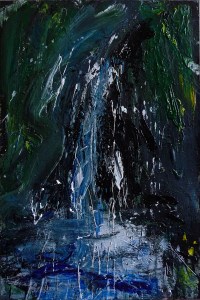
The painting (which is about 3.5×3.5 feet on wood) started with a thin layer of green onto white gesso, then a layer of black, followed by droplets to suggest stars. I experimented with Saturn-appropriate constellations (Capricorn and Aquarius) but it didn’t quite work for me visually, so I scraped back a few layers at the bottom to reveal interesting green patterns below, suggesting a nocturnal seascape, today’s layer of wet gesso will be left to dry, then I’ll scrape back to more layers beneath, possibly add in a few details and then I’ll see how it looks/feels.


(In progress) January. Nightscape. Oil on 40×40″ wood panel. Rose Strang


Atmosphere is the elusive thing I try to capture in paintings, so with the melancholic, heavy associations with Saturn this is going to be a fairly moody dark painting let’s face it, but I do want it to evoke a sense of mystery or magic.

As mentioned in previous posts, I’m reading several books at the moment related to the subject of the Medieval view of the planets, in particular Michael Ward’s Planet Narnia , in which he describes and explores his discovery that the seven books of Narnia are each inspired by the seven planets as understood in medieval times, also the philosophy and mythology that surrounded their view of the cosmos.

C.S. Lewis felt that myth was one of the most effective means of conveying the more abstract themes of spirituality or metaphysical ideas, partly because he felt that myth and story sparked imagination – abstract perception beyond the purely factual or observable (that’s an epic subject in itself – one I explored way back in the mists of time at art college, but I’m not writing in any sort of academic capacity here, thankfully for me!). He began the Narnia Chronicles in the early 1950’s,having decided that children’s stories were the ideal form for what he wanted to communicate.

He’d also been inspired by George MacDonald’s writing, and when you read MacDonald’s books you do see the influence. Like MacDonald, Lewis had also written fiction for adults, but similarly their children’s stories had the most popular and enduring appeal.

The sense of depth behind the apparently simple tales in books such as The Lion, the Witch and the Wardrobe and The Princess and the Goblin (by MacDonald) is partly due to the underlying wealth of mythology and philosophy, and the magical atmosphere created is also partly due to this underlying (or hidden) meaning, but I think it’s also the fact both authors were (to use a contemporary literary term ) ‘show not tell’ writers.

It’s maybe best described as magic realism –  grounded in the senses and more effective in some ways than writing pure fantasy or a form of science fiction which might alienate the reader with too heavy a slant on stranger, or unknown aspects (though Lewis’s ‘Space Trilogy’ written in the 1930’s was classed as sci-fi).

It’s different from pure allegory, in as much as the reader isn’t required to spot and understand obvious parallels to enjoy the story, though the stories touch on subjects that refer to myths (for example Norse and Greek), or Christian biblical themes. Lewis wanted to inspire imagination, so although the Narnia Chronicles often deal with moral issues or choices, it’s more about a search for truth. That’s a simple way of putting it though  – a way of becoming more fully conscious is maybe a better way to describe it.

I think I’ll explore that theme more when I tackle the subject of Jupiter in my next painting, because I think C.S. Lewis writes about it in a completely unique way that we easily (usually with a mixture of amusement and/or discomfort) recognise as all too human, it’s worth exploring.

On the subject of atmosphere though, Michael Ward explores this quality in some depth in Planet Narnia, he terms it donegality. I think his is a brilliant way of perceiving atmosphere in the Narniad – I won’t go into that here, but recommend you read his book since it’s a fairly complex, rewarding theme.

As a child, this atmospheric quality of the Narniad had a profound impact on me and it’s one I’ve noted in other people who grew up reading these books; whenever I’m in a landscape that feels magical, or particularly alive, I associate it with a ‘Narnian’ quality – for example the rich, cool-green dampness of mossy grass underfoot in a still forest, to me immediately conjures up one of my favourite passages from The Magician’s Nephew, from the chapter titled The Wood Between the Worlds:

The trees grew close together and were so leafy that he could get no glimpse of the sky. All the light was green light that came through the leaves: but there must have been a very strong sun overhead, for this green daylight was bright and warm. It was the quietest wood you could possibly imagine. There were no birds, no insects, no animals, and no wind. You could almost feel the trees growing. The pool he had just got out of was not the only pool. There were dozens of others – a pool every few yards as far as his eye could reach. You could almost feel the trees drinking the water up with their roots. This wood was very much alive.

Illustration: Pauline Baynes. The Narnia Chronicles. ‘The Magician’s Nephew’


The mood is enhanced by the beautiful illustrations by Pauline Baynes, which are so much part of the experience of reading these books.

The Magician’s Nephew is associated with the planet Venus, and the above description is very Venusian in feel, in complete contrast to the heavy dark energy of Saturn that influences The Last Battle – last of the Narnia Chronicles.

I’ve also realised that gradually my painting (atmosphere-wise) appears to be heading towards the end of the book where the stars fall out of the sky and Father Time crushes the sun in his hand so the world of Narnia turns black and icy cold.

Illustration: Pauline Baynes. The Narnia Chronicles. ‘The Last Battle’


It’s a stark, haunting vision, but described by Lewis it’s nonetheless beautifully atmospheric. And, as I’m writing this, I’m thinking ‘of course Rose – paint a scene from imagination from each of the books’.

Whatever I paint I’d better get on with it as these first three planet paintings have to be submitted to the upcoming Battersea Art Fair by the 24th Of February (I’m showing with the Limetree Gallery) and I still have Jupiter and Mars to complete! Towards June I’ll be creating a Sun-themed painting, to coincide with an exhibition and event I’ll be holding at Abbeyhill Studio on the summer solstice (I’ll post more nearer the time).

Planets series in progress – 3

(In progress) January. Nightscape. Oil on 40x40" wood panel. Rose Strang

(In progress) January. Nightscape. Oil on 40×40″ wood panel. Rose Strang

Above, today’s progress on ‘January. Nightscape’, which needs a few more days work …

As mentioned in the last two posts, I’m working on a series inspired by the Medieval view of the planets and cosmos – a complicated yet harmonious and imaginatively inspiring view of the ‘heavens’ as they were known.

My current painting in progress is on the theme of Saturn and its related qualities. (the themes of this post are also entirely related incidentally!)

I’m currently reading Michael Ward’s ‘Planet Narnia’ in which he describes and explores his discovery that each of C.S. Lewis’s Narnia Chronicles correspond to each of the seven planets.

In Medieval times these were:

Sol (Sun), Luna (Moon), Mercury, Mars, Venus, Jupiter and Saturn. (Neptune, Uranus and Pluto weren’t viewable with the naked eye).

‘Planet’ meant ‘wandering star’, so they classed the sun and moon as planets in that sense. These were the objects in the night sky that moved in regular patterns, against a fixed, un-moving backdrop of stars, which were mapped into recognisable patterns or constellations. This was a world-wide practice of course, given that watching planets and stars enabled people to predict seasons, or navigate seas and so on.

Names of the constellations varied around the world, but it’s fascinating to read about the equally varying myths that surrounded, for example, constellations such as Orion. I’m exploring western ideas and mythology for now though, which is enough to be going on with!

I’m currently absorbing a wealth of complicated information about the Medieval view of the cosmos, from a variety of sources – not just Michael Ward’s excellent book, but also books, ideas and explanations suggested by several people I’ve encountered in the last five months or so. The mythology is enchanting, and my exploration has led me back to the Narniad, but by way of explanation on how I became interested ..

In October 2018 I was heading off to Iona for a two week artist’s residency at the Iona Youth Hostel at Lagandorain. Knowing about my interest in symbology someone had lent me a copy of Agrippa’s Three Books of Occult Philosophy. It was an important book of its time and valuabe now for its insight into Renaissance philisophical ideas about magic and religion. The magical aspects weren’t so much of interest to me as the symbols relating to the cosmos, but a verse by Virgil in the intro enchanted me:

The Number and the Nature of those

things, Cal’d Elements, what Fire, Earth,

Aire forth brings: From whence the Heavens

their beginnings had; Whence Tide, whence

Rainbow, in gay colours clad. What makes

the Clouds that gathered are, and black, To

send forth Lightnings, and a Thundring

crack; What doth the Nightly Flames, and

Comets make; What makes the Earth to

swell, and then to quake: What is the seed of

Metals, and of Gold What Vertues, Wealth,

doth Nature’s Coffer hold.

Rainbow on Iona, Rose Strang Oct’ 2018

Dipping randomly into the book, it also explored the planets, and influence or phases of the moon. Chatting about this with the manager at Iona Hostel, he mentioned that he used a mobile app called ‘Skymap’ to observe phases of the moon, also that on this evening the moon was entering full moon phase, and going  from Pisces to Aries.

I forgot all about that, carried on with my painting, then, at about 5:20, went to clean up and have a lie down for half an hour. I couldn’t rest though and after ten minutes, feeling emotionally agitated and restless, I decided to take the two minute walk to the north beach of the island.

If you’ve observed the sea at high tide, or during changes in tide, you’ll maybe have observed the strange shifting effect – it looks almost hallucinogenic. I stood entranced, gazing at the sea for half an hour until it got dark, then returned to the hostel, checked the Skymap app and realised that the moon became full at precisely 5:45pm. I’d walked on to the beach at about 5:40pm!

North Beach Iona. Photo, Rose Strang October 2018.

Sold. ‘Pisces Moon, Isle of Iona’. Mixed media on 10×10 inch wood panel. Rose Strang 2018 (£450)

‘Moonscape, Isle of Iona’. Oil and acrylic on 10×10″ wood panel. Rose Strang 2018/2019

It was an interesting experience – at least a reminder of the moon’s effect on the tides and this felt valuable to me as an artist.

On my return to Edinburgh, I learned more about the Medieval view of the cosmos – it’s a complicated system, but here is a brief overview for now …

Medieval philosophers believed that the cosmos had three levels; the heavens – beyond the planets, where the gods resided, or ‘the divine realm’, the celestial realm where the planets resided, and the earth where everything was a reflection of the heavens.

Anything beneath the moon is termed ‘sub-lunar’ and the gods are separate from this realm, but Medieval philosophers believed we connected with them through energies of the celestial bodies – planets and stars.

The term ‘as above, so below’ refers to the idea that on earth, everything (plants, animals, stones, minerals etc) is a reflection of the heavens. They classified these physical things according to each planet, then each planet connected to the divine realm – the planets were in a sense ‘go-betweens’. So, to evoke their influence by using a talisman (i.e. objects/plants/minerals etc related to a particular planet) you could bring that planet’s influence to bear on your life or events.

That’s it very briefly for today, but since my current painting related to Saturn, below is a very brief description, or flavour at least, of its qualities and related things on earth.

In the next post I’ll explore the mytholgy surrounding Saturn, and C.S. lewis’s literary treatment of it in ‘The Panet’s Trilogy’ and ‘the Last Battle’.

Saturn:

January. Winter. Winter Solstice (21st December). Saturday. Black

Qualities and associations: Time (father time), structure, form, renewal and liberation, brooding, melancholy, death, the occult (hidden, veiled, secret), teaching, pedantry, oppression, rules and boundaries.

Earth, water, lead, all ‘dark, weighty things’, ‘those things which stupifie’, dark berries, the black fig tree, pine, cypress, trees used at burials, owls, crows, animals that live by night.

Zodiac signs of Capricorn and Aquarius.

Roman feast of Saturnalia: held at winter solstice on 21st – all people celebrated, executions were cancelled or postponed, gifts were exchanged.

Capricorn and Aquarius contsellations.

Exhibitions and available paintings Jan’ 2019

Current round-up of current exhibitions and (as yet) unsold paintings  …


Limetree Gallery, Bristol. (Contact gallery for enquiries Here)

Paintings available from the Limetree Gallery …

Winter Show. Resipole Gallery, 10th Nov’ to 22nd March. Ardnamurchan, Scotland. (Contact gallery for enquiries Here)

Paintings at the Resipole …


Small Paintings. Morningside Gallery, Edinburgh.  (contact gallery for enquiries Here)

Paintings at the Morningside Gallery …

Planets Series in progress – 2

(In progress) January. Nightscape. Oil on 40×40″ wood panel. Rose Strang 2019

I was standing today in the dark toolshed. The sun was shining outside and through the crack at the top of the door there came a sunbeam. From where I stood that beam of light, with the specks of dust floating in it, was the most striking thing in the place. Everything else was almost pitch-black. I was seeing the beam, not seeing things by it.

Then I moved, so that the beam fell on my eyes. Instantly the whole previous picture vanished. I saw no toolshed, and (above all) no beam. Instead I saw, framed in the irregular cranny at the top of the door, green leaves moving on the branches of a tree outside and beyond that, ninety-odd million miles away, the sun. Looking along the beam, and looking at the beam are very different experiences.

Quote: C.S. Lewis, ‘Meditation in a Toolshed’ (from essays collection). Planet Narnia, by Michael Ward

As mentioned in yesterday’s post, I’m painting a new series inspired by the classic Medieval view of the universe, in particular the planets. It’s a complicated picture and (though scientifically inaccurate!) quite beautiful in its imagery, mythology, associations and sense of unified harmony.

I’ve long been inspired by Medievalism, no doubt originally inspired by reading the Narniad, as it’s known today, by C.S. Lewis

The above quote by C.S. Lewis (left, enjoying a cigarette – absolutely unacceptable in these times!) is a wonderful illustration of his way of explaining philosophical concepts through lived experience and imaginative observation. It’s probably one reason for the enduring appeal of his Narnia Chronicles and writings on Theology.


Lewis had read the philosopher Samuel Alexander’s theory of Enjoyment and Contemplation, which crystallised ideas he’d been exploring. The quote above illustrates the difference beautifully; contemplation of the beam of light is a different experience to being in the beam of light – you’re no longer looking at light, you’re in it, or in other words experiencing it subjectively (enjoyment) not objectively (contemplation).

For Lewis this concept informed his writing and way of life. It’s well-known that Lewis was a committed Christian (incidentally if it’s of interest this is not how I’d describe myself – I’m not a member of any religious group, though I find Lewis’s exploration of Christianity fascinating and inspiring).

As an academic he specialised in Medieval and Renaissance literature and one of his expressed regrets was the way that Medieval myth and imagination had been sidestepped or rejected by later religious practice or theology.

It wasn’t just that he found Norse, Roman, Greek, Hindu (or any source of ancient mythology) fascinating, he also felt as a Christian that exploring these myths, or finding them spiritually inspirational was as valid an aspect of worship as following Christian religious doctrine. Similar to Blake in some ways, he profoundly appreciated the power of imagination – for Lewis this partly informed ideas about Enjoyment, as opposed to Contemplation.

At the moment, I’m reading Michael Ward’s Planet Narnia, (for which I’m grateful for providing much of the information about Lewis described above) in which Michael Ward describes and philosophically explores his discovery that each of the Narnia Chronicles was in fact inspired by the seven planets as understood from a Medieval perspective. C.S. Lewis never stated this as his partial inspiration at the time, though in retrospect, once explained, it’s startlingly obvious. It is as he states himself, surprising that he was the first person (publicly at least) to recognise it.


My painting in progress (at the top of this post) is the first in a series of seven I’ll be painting this year. I’ll write more about the inspiration as I go, but this one, titled ‘January. Nightscape’ is inspired by the planet Saturn – a somewhat dark and heavy energy by all Medieval accounts! I’ll write more about  Saturn and its influence according to Medieval mythology as the painting progresses this month.

Of interest to C.S. Lewis appreciators, the correspondingly Saturnine Narnia book is ‘The Last Battle’ (last of the series). Lewis, in keeping with the quote at the top of this post, doesn’t mention Saturn (as far as I recall) in the book, but the book is saturated with its influence throughout. I’ll explore this more as my January/Saturn painting develops.


These dark January days, I’m finding it therapeutic to light the fire, of an evening, switch off all the wifi, mobile and other distractions, and immerse myself in a book. I also really enjoy keeping an arts diary (this blog) as a way of recording my inspirations.

Also, on a pragmatic note, the resulting paintings will be for sale in the galleries that currently represent my work, namely the Limetree Gallery (Bristol), Resipole Gallery (Acharacle, Scotland) and Morningside Gallery (Edinburgh). I appreciate their support, also the supportive creative ethos of these galleries to artists they represent.

In the meantime, Happy January to readers of this blog – it is indeed a dark month here in the Northern hemisphere, I hope you’re finding ways to enjoy it!