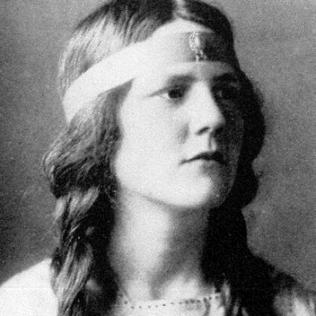
Author of The Living Mountain, Nan Shepherd, was born on the 11th February 1893. To celebrate her birthday, the Scottish Poetry Library, Edinburgh, has organised an exhibition and panel discussion, all details below …
The Living Mountain. Dreaming a Response
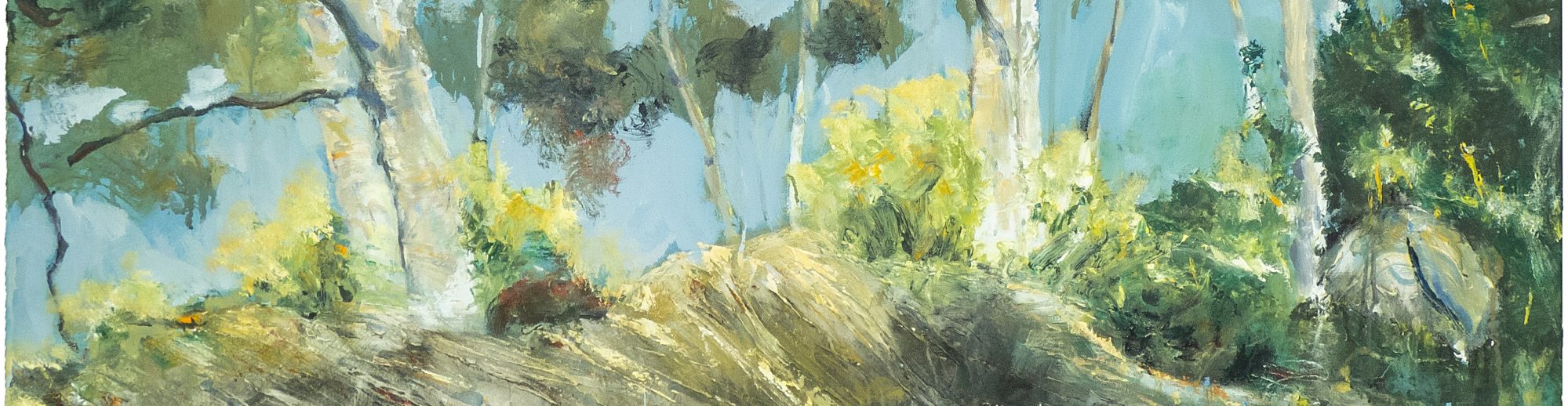
The Living Mountain. Dreaming a Response showcases new paintings by Rose Strang and goes on exhibition at the Scottish Poetry Library then the Heriot Gallery, Edinburgh, in 2023.
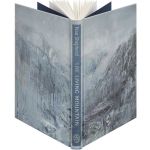
A response to one of Scotland’s best-loved classics of landscape literature, this series of paintings was commissioned by the Folio Society Londonfor their 2021 publication of The Living Mountain by Nan Shepherd.
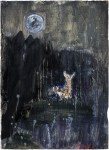
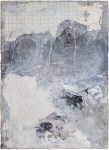
‘But did I dream that roe? The Living Mountain Series’. Oil on on on 37x27x2 cm antique pine. Rose Strang 2021
‘For not getting lost is a matter of the mind. The Living Mountain Series’. Grid paper, and acrylic on on 37x27x2 cm antique pine. Rose Strang 2021
Robert MacFarlane, award-winning author of best-selling books The Lost Words and The Wild Places and one of the UK’s best-known devotees of The Living Mountain, writes in the introduction to this Folio publication of the book:
Strang’s paintings are intensely dynamic, seethingly alive with stroke, dab, scratch and drip. Each of Strang’s seven paintings takes a phrase from The Living Mountain and dreams a response to it.
7pm, 17th February: Panel discussion (ticketed, 310, see link below) Scottish Poetry Library and audience Q+A with Erlend Clouson (Nan Shepherd’s literary executor, Rose Strang, Merryn Glover (author of A House Called Askival, currently writing a book inspired by Nan Shepherd) and Kerri Andrews (author of A History of Women Walking, currently editing a volume of Nan’s letters). Chaired by Anna Fleming (author of Time on Rock).
The Scottish Poetry Library, Crichton Close, Royal Mile, Edinburgh.
The Living Mountain. Dreaming a Response
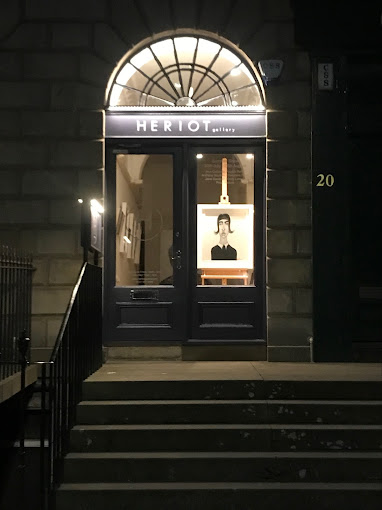
17th to 23rd April. The Heriot Gallery, Dundas Street, Edinburgh. The Living Mountain. Dreaming a Response (in collaboration with The Limetree Gallery, Bristol).*
Exhibition of the original paintings commissioned by the Folio Society for their 2021 publication of The Living Mountain by Nan Shepherd.
*The series of paintings will be for sale and exclusively available from the Heriot Gallery during the one-week exhibition.
(Please contact the Heriot Gallery with any enquiries about the exhibition. art@heriotgallery.com).
I’ll be posting more soon on two up-coming exhibitions for February and April this year, but in the meantime …
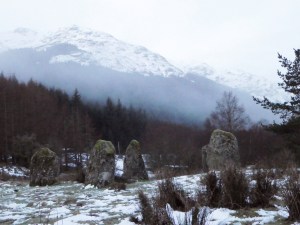
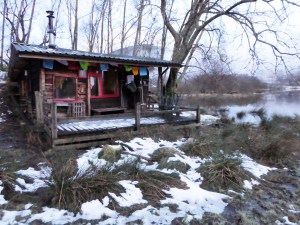
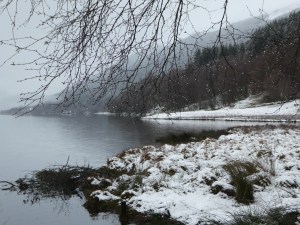
This year my partner Adam and I wanted a quiet new year so we booked ourselves into the Retreat Hut on Loch Voil near Balquhidder. We arrived just before dark, having driven along the four-mile rough track, and were greeted by the son of the owner who walked us to our hut, through what appeared to be an ancient stone circle. ‘Oooh, amazing’ I enthused, ‘how old is it?’. ‘Well the stones themselves are very old’ he laughed. ‘Ah, eccentric Victorians then?’. ‘Well, us in fact’ he replied!
They looked convincing though. ‘It’s on a leyline’ he assured us. Leylines are considered arbitrary by the sceptics – lines drawn between ancient sacred sites that just happen to line up (some people have lined up Tescos across the UK as evidence it’s all very random and part of our very human tendency to seek patterns!) Others say that stone circles are sited on areas of special energy evidenced by the fact that dousing rods start to spin as you walk through the centre. I haven’t tried this myself and have no idea what causes this, but electro magnetic energy is suggested, or ‘magnetic field anomolies’.
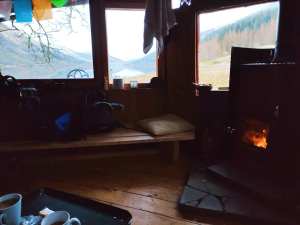
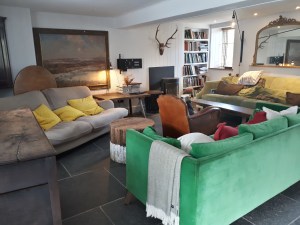
Our hut was freezing when we arrived, it being a December evening in a Highland valley, so I got a nice blaze going in the wood-burning stove and soon the place felt like a sauna, which in fact was its original purpose – it was built by a German artist friend of the family.
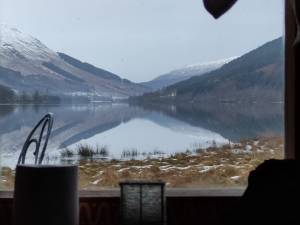
Many people enjoy creating a steaming sauna in the hut, followed by a dip in the icy lake, I’m not one of them, so instead we heated up a stew of bacon, passata, potatoes, char-grilled peppers and smoky paprika I’d made up earlier (inspired by one of the nicest soups I’ve ever enjoyed in freezing weather on a trip to Berlin some years ago). There are few things more satisfying than a wood fire and warming dinner while you enjoy views of the snow outside!
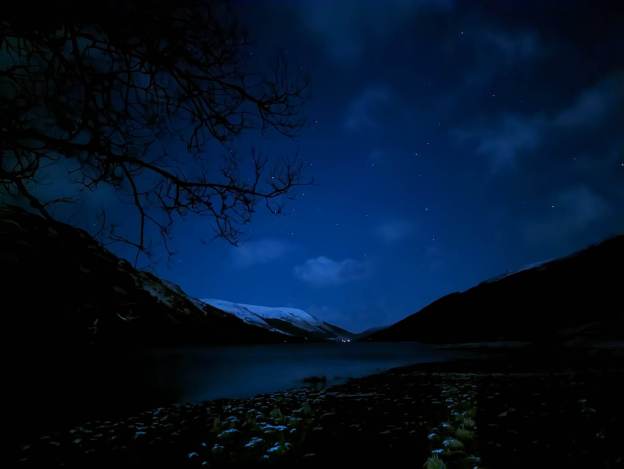
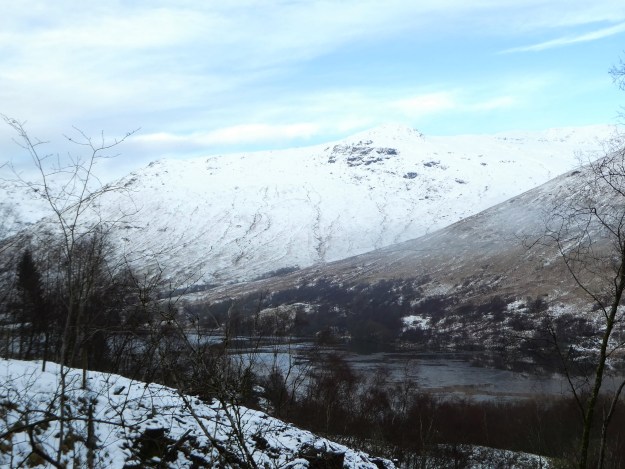
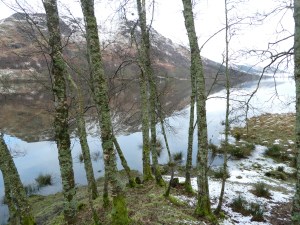
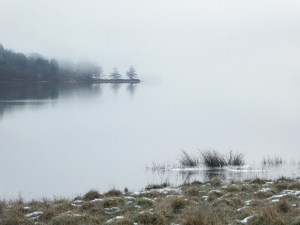
The next day we wandered along the loch up a track to enjoy the views of the opposite side (we were on the south of the loch, always the more mysterious side since the north side gets the sunlight and tends to be more inhabited).
The village of Balquhhider is on the north shore of Loch Voil, famous as Rob Roy’s alleged burial place. There’s also the wonderful Monachyle Mor Hotel – an old farmhouse dating back to the 1700’s, now owned by chef Tom Lewis, who is a whirlwind of creativity as evidenced by the fantastic art collection, wonderfully eclectic decor and tiny house building projects dotted around outside the hotel. We’ve gone there for lunch a few times and he’ll sometimes come over have a friendly chat while you eat.
Monachyle Mhor in summer 2022
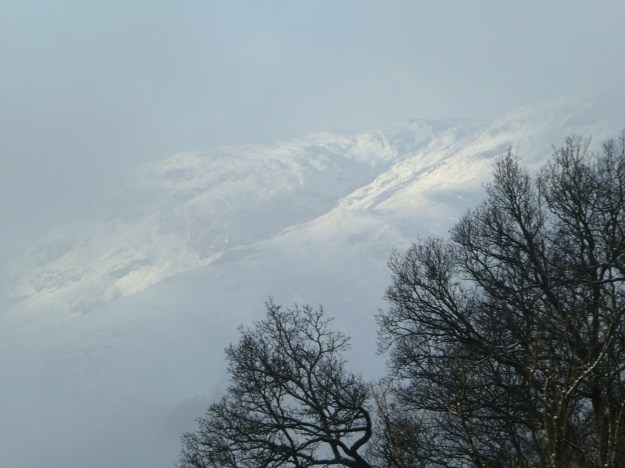
Later that evening when it was dark, we watched from the other side of the loch as a steady stream of cars made their way along the valley to the Monachyle Mor Hotel for the new year firework display. It was one of the most beautiful I’ve ever experienced with the loch and snowy mountains lighting up in green, gold and pink and the krrrRRR-BOOOOMS!! echoing along the valley.
It all sounds idyllic, and for a few days it is, but very soon you start to miss the ease of city-living. A hut becomes rapidly cold unless you constantly feed the hungry stove (there was a big log-pile outside but we had to chop up logs for smaller pieces to get the stove started in the morning). The loo was a walk away over snow and mud, and of course it’s small so you must be super-organised if you don’t want to descend into muddy chaos. That’s the beauty of a simple stay in a small country cabin though, you feel more connected to nature, you benefit from the fresh air and it all restores the soul, but you go back home appreciating the luxuries you’re used to. Though sadly of course those come at a higher price these days, but I won’t get into the political mess of the UK just now!
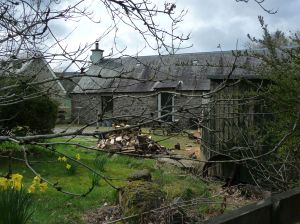
Some of my ancestors lived around Balquhidder and nearby Loch Venachar – Andrew Strang married Catherine Fergusson from Balquhidder in 1750 and they lived in a farmhouse on Loch Venachar. Catherine Strang married Duncan Fergusson from Balquhidder in the early 1800s and they lived on his family farm near Balquhidder. I can’t imagine how hard their lives were. Lots of children, laundry without electricity, snowed-in every winter, no local shops or a drive into Callander for supplies, no freezers – they were considerably tougher than this generation. They too must have loved the beauty of this place though. Many of them would eventually settle further south for work, mining near Kirkaldy, then engineering in Edinburgh.
My ancestors’ cottage in the 1700s (taken in spring 2022)
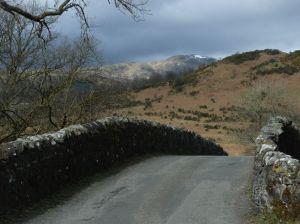
Bridge across the river nearby
I discovered that the other side of the family, the Kerrs, were also country people who moved to Glasgow in the 1800s for work, and the Sutherlands, who’d lived in Orkney since who knows when since records are scarce pre 1600s. It seems a shame they had to leave rural life, but it’s an indication of how tough rural life was, especially in parts of Scotland affected by conditions post-Culloden and the Highland Clearances. One family moved back to the country – after my great great grandfather Robert Kerr died, his wife and children moved to Pertshire where they survived by making fishing tackle – beautiful artificial flies. It can’t have brought much money in though.
I feel grateful for my ancestors and the hard lives they lived, none were landed or well-off, as far as I know. I said a little prayer for them before we left Loch Voil on New Year’s Day.
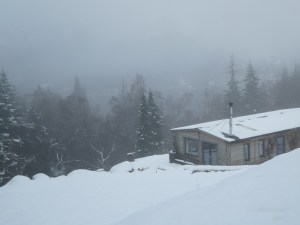
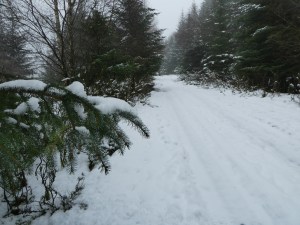
Then, just as a reminder of what it means to be snowed in, we discovered our car was barely capable of driving up the four mile track on our way out. The owner of the hut came out to help and we were given an advanced driving lesson in snowy conditions. He went ahead of us all the way to create tyre tracks, which was another occassion for gratitude!
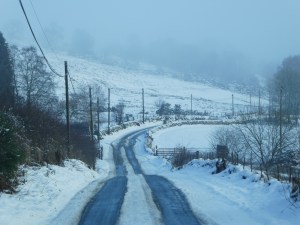
Several times we had to reverse back down a hill, taking care not to slide off down the steep valley sides into the trees, to create enough volition to get up the hill. It was pretty hairy and took more than an hour, but as with all the little hardships, it felt wonderful afterwards – to be back on tarmac. A French family who’d followed behind us (they’d stayed in another little hut further up the loch) stopped their car when we reached the road and there were relieved new year handshakes all round! Then we celebrated with haddock and chips in a little hotel in Callander.
Back on the tarmac!
Wishing everyone a Happy New Year! May all your hardships be small, surmountable, or non-existent in 2023!






 Rose Strang Artworks