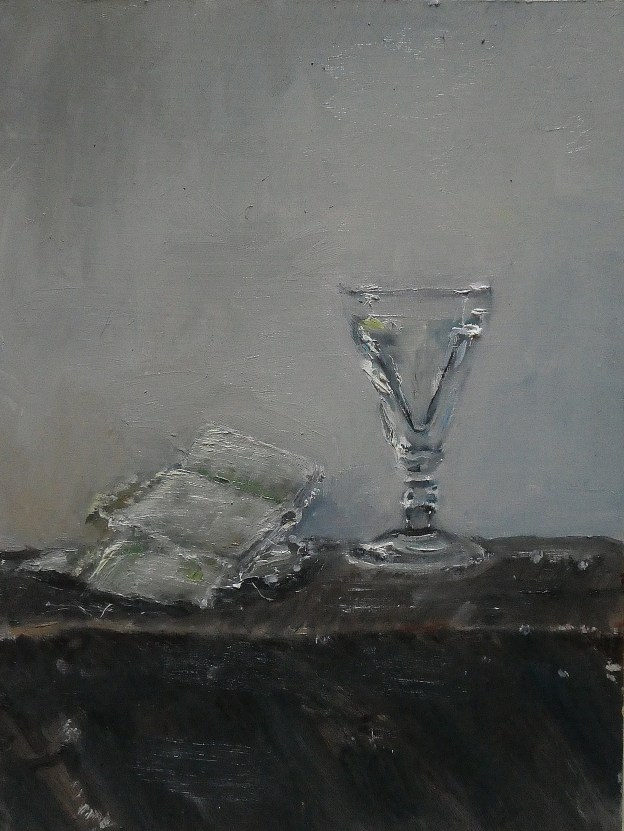
Above: 18th Century Toasting Glass with Scrap of Linen. Oil on 12×9″ wood panel. Rose Strang 2025
Below: Nuit de Noël (Caron/Baccarat). Oil on 12×9″ wood panel. Rose Strang 2026 and 18th Century Toasting Glass with Scrap of Linen. Oil on 12×9″ wood panel. Rose Strang 2025
-
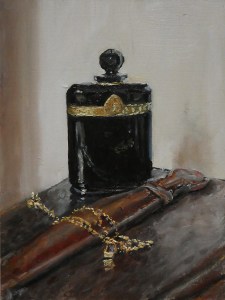
- Nuit de Noël (Caron/Baccarat). Oil on 12×9″ wood panel. Rose Strang 2026
-
- 18th Century Toasting Glass with Scrap of Linen. Oil on 12×9″ wood panel. Rose Strang 2025
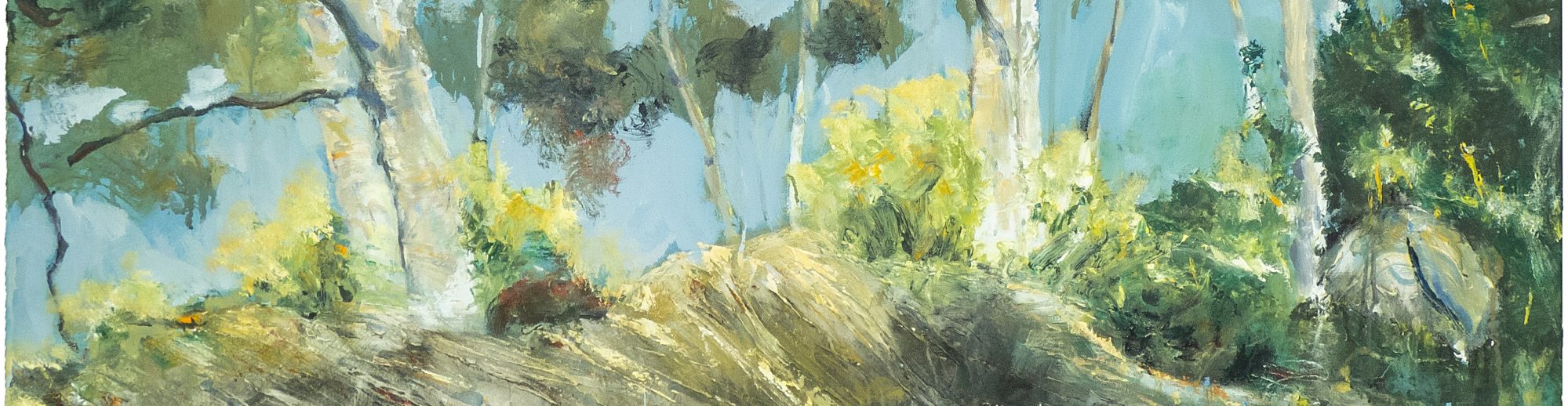
Two still lifes for the Limetree Gallery‘s upcoming show; Anew which launches 20th February
“The devil is in the detail” to quote Mies Van Der Rohe!
Still lifes might seem an unusual subject for an artist mostly known for painting landscape, but to me it’s the same exploration; what the subject tells me, the presence, energy and the way light falls on form and texture.
When I paint these objects I become steeped in their story; every tiniest twist of their making, so they become alive for me. “Is a river alive?” asks the author Robert MacFarlane in his latest book. It’s a question that would have struck the 14th century mind as odd, because they believed everything was alive.
With daylight hours being shorter, I want to focus in on a smaller scale. Large canvases are suited to the long hours and energy of spring and summer. That smal panel of twelve by nine inches of wood becomes a universe; a toasting glass made from lead crystal in the 1740s, a piece of scrap linen and the way both of these objects disappear against the neutral-toned plaster wall in my studio, the tones barely differing.
Highlights on glass and the way light catches the edges of frayed cloth offer clues to what’s there, though it’s not immediately obvious on first encounter.
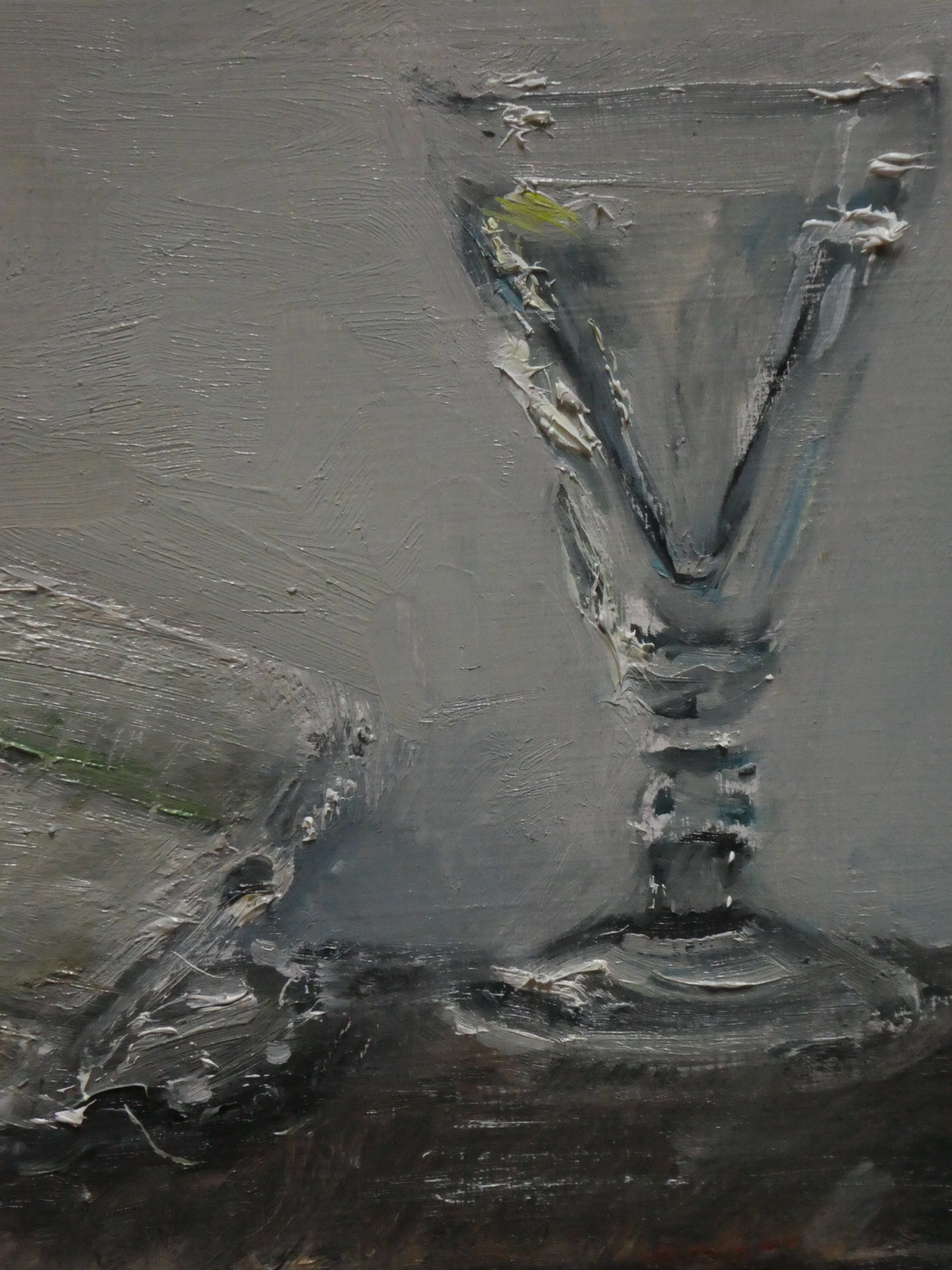
I like the humble, undeclarative amost monastic feel of it. It looks to me as though this glass lay forgotten, maybe on an old pantry shelf (how else does a fragile 18th century glass survive?) I placed it next to a strip of linen; a cut-off from canvas-making in the summer of last year.
The linen doesn’t detract from the subtlety of the glass, the neutral colour hues and the low-key, ordinary setting. The shelf is a weathered, found plank attached to my studio wall by Adam a couple of years ago.
The other painting: Nuit de Noël (Caron/Baccarat) is in deliberate contrast. The subject announces itself assertively, the glamorous black glass, designed by the house of Caron and made by high-end glass-makers Baccarat, placed on a leather vanity case on which a gold necklace with amethyst stone is draped.
The Baccarat glass bottle announces its art nouveau elegance immediately, but I suspect only the makers of this bottle, and those who obsessed over its design, can truly appreciate the beauty of its angles and the story it tells.
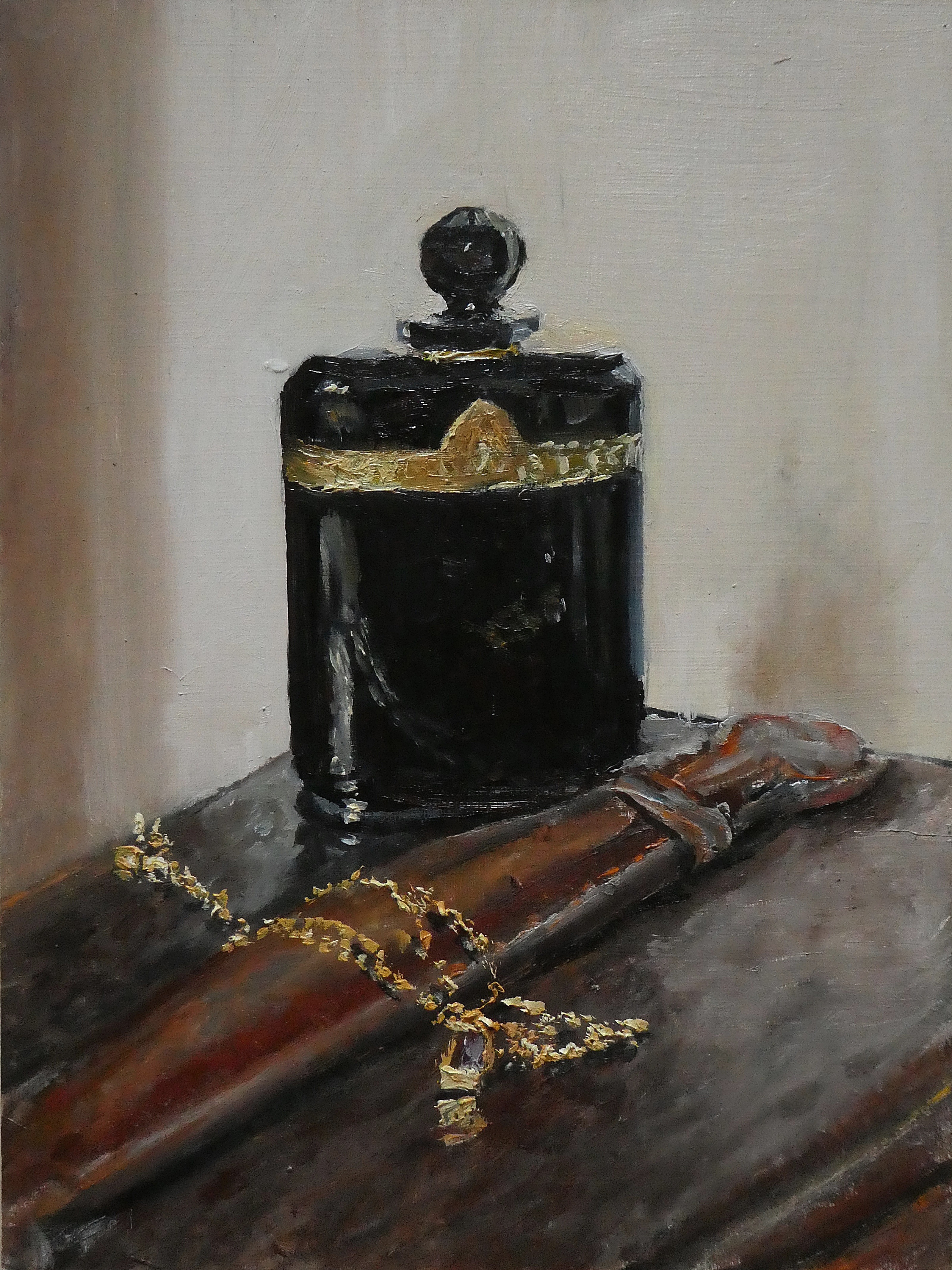
I can’t really capture them in paint in a sense, because the viewer knows it’s a painting, they don’t know if I’ve subtly tweaked those angles. In fact I’ve just tried to meticulously copy them and in the process become lost in admiration, and frustration at not being able to reproduce them perfectly!
The designer of this exquisite bottle was Félicie Vanpouille, the artistic director of perfume house Caron, also the lover and muse of Caron’s owner Ernest Daltroff, a highly talented perfumer. Ernest had the perfumer’s equivalent of perfect pitch; the ability to remember thousands of individual scents in order to compose a perfume (an absolutely neccessary skill to become a talented ‘nose’).

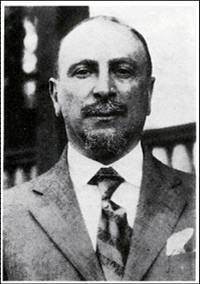
Daltroff created a perfume to evoke Félicie’s favourite time of year, Christmas eve, hence the title Nuit de Noel. I know from descriptions that the perfume is darker than might be expected, more sombre, with a dark Mousse de Saxe (Saxon Moss) base and heart, lightened with sweet floral accords.
It was meant rather to evoke a more introspective Midnight Mass mood than the festive oranges and cloves aesthetic we might expect from a winter perfume.
(I will in fact be sampling it soon as I’ve just ordered 1.5 ml from a reputable vintage perfume sample company. For those interested in my life as a perfume sampler and writer of stories inspired by perfume, have a look at my new Substack page here – Rose Strang. Substack )
Most poigantly, this little bottle captures a perfect moment in time; two sparklingly talented people met, fell in love, worked together and became inseperable as lovers, mutual muses and business partners.
It’s impossible to extract Caron myth and legend from fact when it comes to the finer details of their relationship, but what I do know is that Ernest Daltroff and Félicie Wanpouille created Nuit de Noel (perfume and bottle) at the height of their love affair, though really it was much more than an affair, they were together perhaps twenty years.
It was no doubt described as ‘an affair’ at the time because relationships outside of marriage were believed to be sinful and usually caused a great scandal. Nonetheless, Félicie signed herself Madame Daltroff in all busines correspondence.
It’s suggested she wished to marry Ernest, but he refused, or vice versa. What’s known for sure is that, while he’d been born into wealth and privilege, she had been born into poverty. She had nothing but talent and wit. When they first met she’d already established herself as a designer in Paris. It’s a classic 1920s tale really from the depression era; women were becoming somewhat more emancipated, yet, if they married their money was no longer theirs. Not a great prospect for a woman who had experienced the instability and hunger of terrible poverty.
Around the time that Nuit de Noel was created, Ernest and Félicie signed a 50/50 ownership ‘Tontine’ agreement. This meant that if one outlived the other, the survivor would inherit the wealth and ownership of Caron, but just four years later, Félicie married another man and had moved out of the flat she shared with Ernest.
In some accounts, he’s described as devastated by this change. It leads me to speculate on whether they’d had a falling out. Had he refused to marry? Or had she refused, knowing that to marry would mean handing over the stability and everything she’d worked so hard for?
Interestingly, her husband appears to have been seventeen years younger than her. And when Ernest finally married, years later, at the age of 65, his new wife, Madeleine, was also twenty years younger.
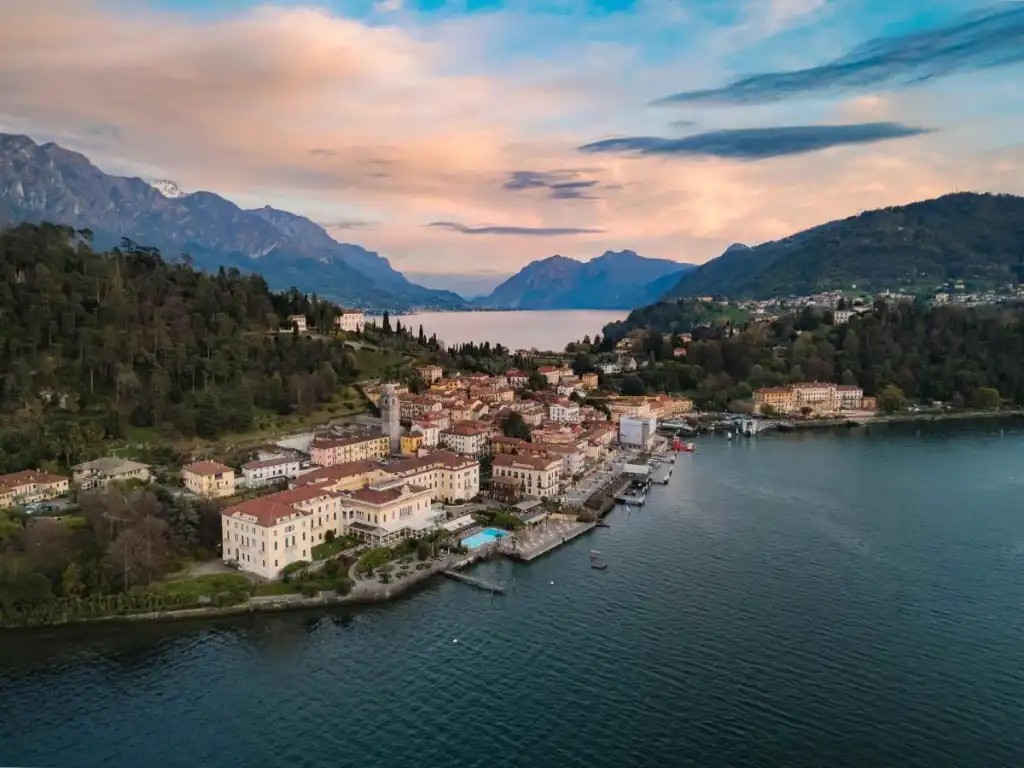
When Ernest and Félicie were together, they’d often visit the Bellagio (in the beautiful area of Lake Como, Italy). I find it telling that decades later, just a year before his death, Ernest Daltroff visited one last time before leaving for the US. As a Russian with Jewish origins he was in danger from the Nazi occupation of France. He moved to the US with his new wife Madeleine and died just a year later in 1941.
Félicie Vanpouille kept Caron alive during the Nazi occupation since she wasn’t under threat from the Nazi regime, or not in the same sense as Ernest Daltroff.
Their last perfume before embarking on their separate marriages, was Bellodgia, inspired by thier love of Bellagia on Lake Como..
It’s a poignant story and it’s redolent of so many I read about this era of beautiful creativity set against the backdrop of brutal war. This was in fact the ‘Golden Age’ of perfumery. These bottles and perfumes are truly works of art. I see Félicie’s exquisite sense of design in every angle of that bottle. In a couple of weeks, when my perfume sample arrives, I’ll understand a little more of Ernest Daltroff’s talent as a perfumer too.
It’s also worth mentioning the process that created such a beautiful object.
For this particular Baccarat ‘onyx’ black glass, components were melted together at an astonishing 1450-1500°C (this temperature takes a month to prepare). Once the glass is removed from heat it rapidly cools to 500°C, and the master glassblower has only a few minutes to shape it before it hardens. This particular bottle though, was blown in a mold, to the specifications of Félicie Vanpouille’s design.
Lastly, a note on composition; I placed the bottle on top of my own Noel present; a vintage leather vanity case from my husband Adam. The 18th century glasses are a present from my niece and her partner. Beautiful Christmas presents, among others from all the family, my much-loved in-laws, and friends too that make me feel very grateful indeed for the relationships in my life, (not least my mum’s love of perfume that inspired me to love perfume – hound-like noses run in our family!) and for the peace we live in which means we can enjoy them.
Wishing everyone a wonderful, peaceful Happy New Year!
 Rose Strang Artworks