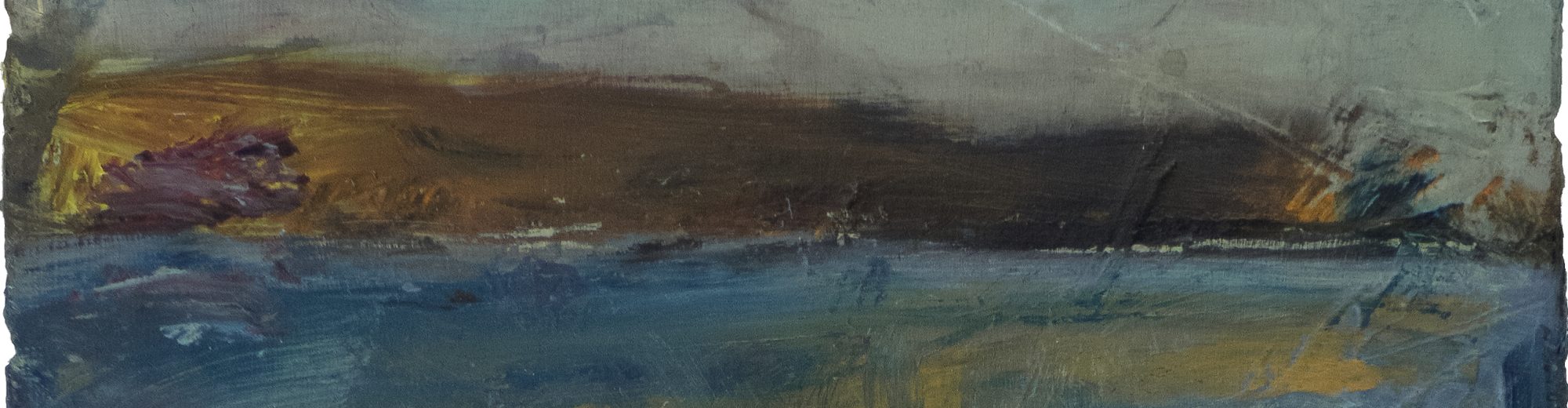
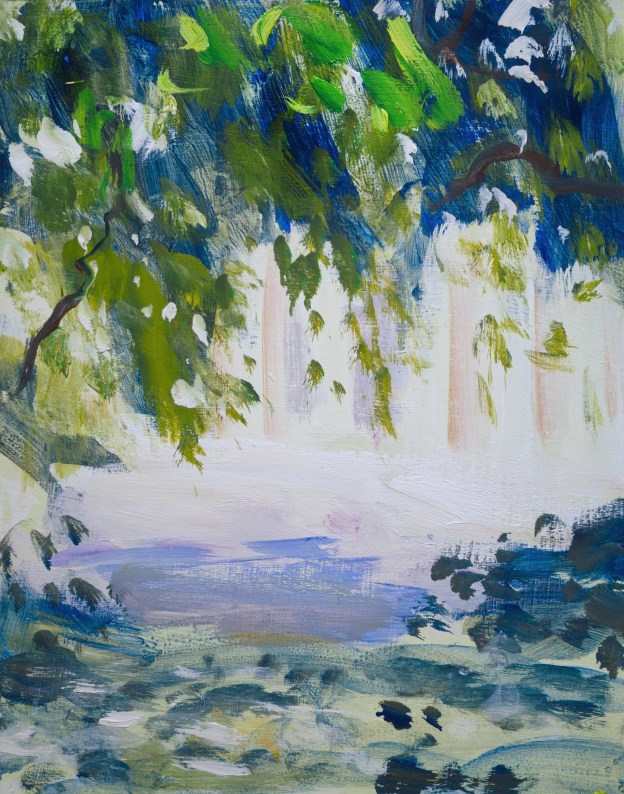
Above: Lime Tree. Leopold Place. Acrylic on 14×11″ wood. Rose Strang 2026
By the fountain, near the gate,
There stands a linden tree;
I have dreamt in its shadows
so many sweet dreams.
Thus wrote Wilhelm Müller in the 1820s, a few years before Schubert set it to music in his 24-song cycle, Winterreise. Der Lindenbaum (The Linden Tree, or Lime Tree) was the 5th song.
Müller’s poem goes on from summer reverie to melancholy when he passes the tree in winter. So it feels an appropriate quote for the start of this blog since I’m painting a lime tree in June in late September and I can feel the chill hand of winter in the air! Limes look surprisingly gothy in winter, with twisty, spindly black branches. You’d never guess they could become so gloriously lush and heavy with foliage.
Lime trees have become a bit of an obsession of mine recently. Their scent has always enchanted me, but this year I decided to explore them thoroughly and holistically; photographing and drawing the tree in its seasonal stages and paying attention to all facets of the scent. This year the beautifully fragranced blossoms arrived later than last year and seemed even more ephemeral. Probably because I was too busy to appreciate them, then summer’s gone in a flash.
I bought several samples of perfumes inspired by lime blossom, including a tiny half ml of pure lime blossom absolute. You can read about that on my perfume-related Substack page if you like! Lime Blossom at Leopold Place
Closely observing nature is a particular interest this year, and you can read about my interest in Goethean observation here Fairhill, but for this particular blog I want to explore the other inspiration behind today’s painting; Sargent.
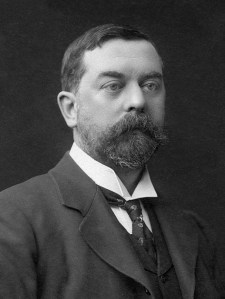
John Singer Sargent. One of the most overlooked (in terms of posthumous accolade) painters that ever existed. He was at his height in the late 1800s and early 1900s, then impressionism, fauvism, futurism etc all happened, and Sargent’s beautiful painterly expression and observation was kind of dismissed as irrelevant.
Inevitably though, his work is enjoying a resurgence, in America anyway (where he lived part of his life) which will no doubt spread to the UK and Europe. He was born in Florence, Italy, to well-travelled American parents, and Europe was a huge influence. He enjoyed huge commercial success with his beautiful, flattering portraits of the upper classes, the most famous being Portrait of Madame X. Or his portrait of Lady Agnew.
If you only looked at the portraits, you would tend to agree that his work, while stunningly beautiful, isn’t heavy with meaning. It’s the watercolours and quick sketches of his later years that really entrance us now.
If you’re an artist who’s interested in painting light, his brilliance is dazzling, moving even. His brushstrokes, so fluid and seemingly effortless, seem to capture the very essence of what he observes, fleetingly and effortlessly. That’s always the way of truly brilliant people; to make it look effortless, when it’s not.
Then there’s the way you can lose yourself in the subtlety of tone he brings in to depict a wall. It’s mesmerising. He clearly felt free in watercolour, often capturing the beauty of men in an erotic sense, as he was gay. He always captured beauty, in all his subjects, and this was simply too ‘nice’.
He was also criticised for the fact that he didn’t use watercolours ‘properly’. Hilarious to us now, the idea of a ‘proper’ way to paint. I mean, there are rules for things like preventing ageing in terms of materials, or damage to paintings, but the idea that there has to be a technique such as ‘light to dark’, or that you shouldn’t use gouache on top of water colour appears ridiculous to us now.
Given I had a deadline for today’s painting I decided to paint in fast-drying acrylics rather than oils. I also decided to use acrylics like water colour, in transparent washes, but using Sargent’s approach of dark to light, then adding opaques. I didn’t really stick to that in the end, but it gave some lovely fresh results that help me understand how he worked so rapidly.
With that in mind it’s interesting to look at one of his watercolours – I’ve added this as I think it’s ok to post the link and credit here:
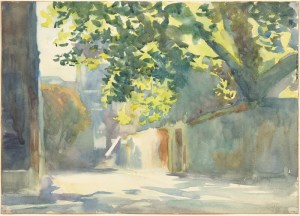
(Landscape Watercolor Study by John Singer Sargent. Source nga.gov. https://www.nga.gov/artworks/129320-sunlit-wall-under-tree )
You can maybe see how I’ve attempted his technique here …
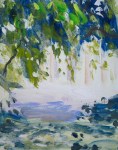
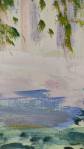
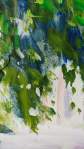
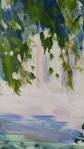
My own painting (main painting and details above) doesn’t have those incredibly silky, fluid patches of colour of Sargent’s, and the tones are much cooler, though that’s fine since it’s Edinburgh, but basically (if you’re interested in technique) I started with a wash of very pale lemon yellow, let it dry then blocked in shapes with ultramarine and ochre. After those dried I mixed up some white, ochre, cadmium red and yellow to make a very pale warm cream, and added in the suggestion of architecture with slightly darker shade of the same. When that dried, I mixed ultramarine and lemon yellow to create a mid-chartreuse lime to create the lighter splashes of the trees. I then blobbed in dashes of light lemon yellow just at the top. The violet shadow on the street was rose madder/ultramarine, then lastly I mixed very light off white to create the dapples in the ground and to break up the trees. Done. It was fun! It was absolutely an exercise in depicting light. The only structures were the suggestions of pillars and the twisty branches.
More about why I painted this in a couple of weeks. In the meantime, I’ll be creating a series of of Fairhill/Pishwanton in this style of painting over the next couple of weeks, for the Graystone Gallery.

