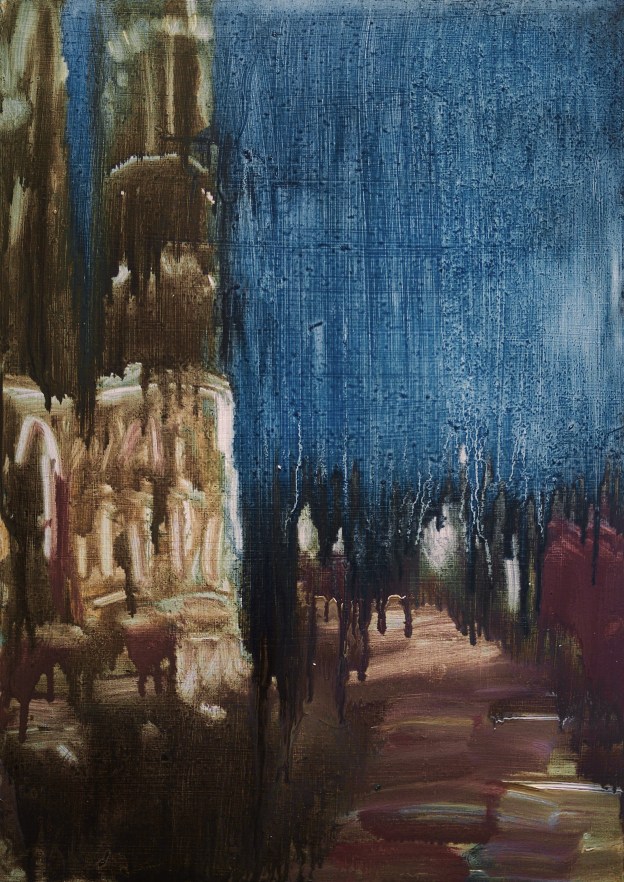
Above: Vesper I. Oil on wood. 42 x 30cms. (16.5 by 11.5 inches). Rose Strang 2026
“What we want to tell the world is this: that Christ is born again in our hearts today, and we are trying, hard as it may be, to banish all thoughts of revenge…”
— Provost Richard Howard, BBC Christmas Day Broadcast from the ruins of Coventry Cathedral, 1940
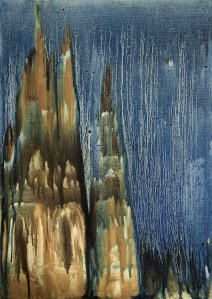
Vesper I and Vesper II, on exhibition at the Graystone Gallery Edinburgh from 14th November 2026
These two paintings began as an evocation of winter moods but grew into something more as I painted. They were partly inspired by Lincoln Cathedral, not because I have any particular attachment to that cathedral but rather because I wanted to paint something that made me think of winter and my feelings about Christmas this year. I’d visited Lincoln Cathedral and it’s an enchanting building at night, with gold lights illuminating or rather under-lighting its architecture.
Somehow though, when I painted them, other experiences came in, and the mood became more mixed. More on that later.
The technique is odd, the process experimental. I love Whistler’s Nocturnes, especially The Falling Rocket. And the paintings of Arthur Melville, such as The Blue Night, Venice Both have a sense of mystery I wanted to capture with velvety blue skies and the earthed warmth of buildings.
My technique turned out totally different. Of course. I had no idea how my new Dammer glaze would behave. It behaved in fact like a wayward teenager and ran erratically, which in a way I found fun to contain and to work into, creating the highlights by wiping off areas with a rag. Then it took ages to dry, or oxidise as oil doesn’t dry in a sense.
Afterwards though, over the two weeks it took for them to become touch-dry, I gazed at them and wondered what they truly evoked. It wasn’t what I’d intended. There was a melancholy as well as mystery. Then I remembered Coventry Cathedral.
Recently I showed my Traces project at the kind invitation of Richard Demarco. It was part of his Edinburgh festival programme titled ‘The Artist as Pilgrim’. The exhibition focussed on the work of the wonderful glass artist Patrick Reyntiens. A man who had, like Richard, witnessed or lived through the effects of WW2 as a child and teenager. Reyntien’s observations on pilgrimage and what it means ran parallel to Richard’s vision.
One of Reyntien’s early and most famous works, designed with John Piper, was the Coventry Cathedral stained glass window Baptistry Window. An astonishing, affecting and completely unique art work made as part of Basil Spence’s design for the new Coventry Cathedral after the original building was completely destroyed in WW2.
On the night of 14 to 15th November 1940, an operation codenamed Moonlight Sonata devastated Coventry. As bombs rained down on top of the cathedral, Reverend Arthur Wales, the cathedral’s Precentor, climbed to the top of the Cathedral and physically threw the bombs off the roof as they landed. People joined him but they were unable to keep up with the falling bombs.
500 innocent citizens of Coventry died that night. The reverend survived. In the aftermath of the bombing, Provost Richard Howard famously wrote on the charred remains: Father Forgive.
He chose not to say the lines from scripture Father Forgive Them, because he believed that we’re collectively responsible for violence and destruction. (Some understood the 12 hour attack on Coventry as Hitler’s revenge for the bombing of Munich).
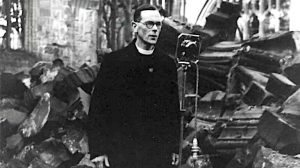
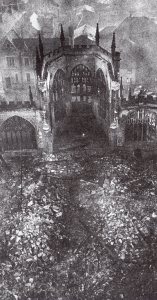
Richard Demarco asked back in August if I’d visited Coventry cathedral. I hadn’t. Given that I’d been given billing alongside an artist such as Reyntiens, as part of Richard’s programme, I felt I must go there as soon as possible.
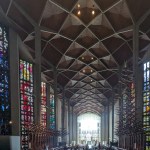
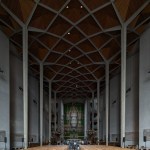
Adam and I visited at the end of September and, luckily, our visit coincided with an exhibition of all the architectural designs that had been submitted in the early 1950’s, fascinating for Adam as a former architect. They were all wonderful, but looking around the breathtaking, vast space, I could not imagine any other design than Spence’s.
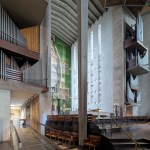
Moving in to the space feels like entering a huge concrete, brutalist chamber. Then, as you walk forward, light and colour are revealed, on your right Reyntiens and Piper’s magnificent stained glass Baptistry Window reveals itself as a burst of light that could equally be sunrise or a flaming explosion in the deep blue. At the end of the cathedral when you look back, you understand what Spence intended because this view reveals the hidden floor-to-ceiling glass walls that flank the sides of the cathedral, and suddenly you’re in a place of light and transparency.
This space felt, to me, like the manifestations of all those emotions, the terrible fear and anger as well as hope made into material form. I think anyone paying attention in that space would feel deeply moved. As I stood, processing the experience, a troop of children were led by their teacher into a side chapel where they presumably learned about these terrible experiences, though the teacher must have presented it in ways palatable for such young ears because they were smiling and singing when I spotted them again outside in the rainy ruins of the original cathedral. They sang:
Rain rain, go away, come again another day
All this is to explain why there’s a sense of melancholy and defiance in my paintings. In a small way, I think I channelled some of my response to Coventry. The melancholy and hope, the rain and the fact of the spire from the ruins still climbing into the sky.
These two paintings will be available at the Graystone Gallery Edinburgh, for their winter exhibition, which launches on Saturday 14th November, which it just so happens, quite hauntingly, coincides with that fateful night in Coventry.
Lastly, I chose the title Vesper to reflect evening prayers in the darkness. The word comes from the Latin for ‘evening’, and the Latin word ‘Vesper’ also refers to the evening star; Venus, the cosmic symbol of love.
https://www.coventrycathedral.org.uk/building-hope
Venus in medieval cosmology – http://www.planetnarnia.com/planet-narnia/the-seven-heavens/venus/