I N T R O
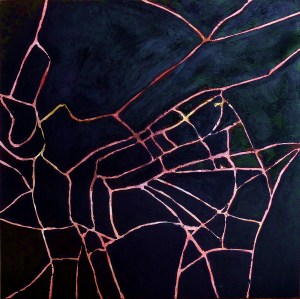
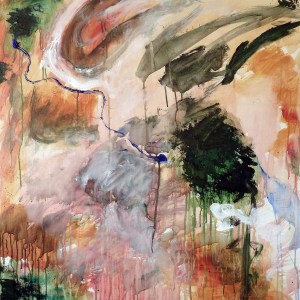
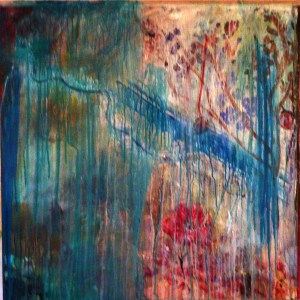
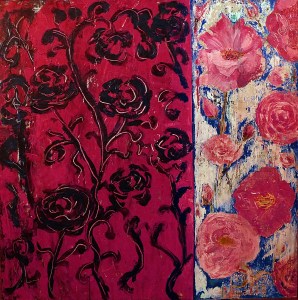
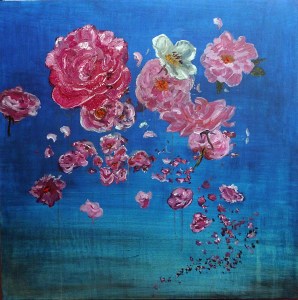
The Damascus Rose series (paintings below), painted in the winter of 2016, marked a temporary departure from my usual Scottish landscapes. Watching the war in Syria unfold from a distance, through a screen, I was moved to respond, and found my way into the subject when I learned that the Damascus rose, rosa damascena, had all but ceased production as fighting spread. The rose became a way to approach something I could not claim to understand from the inside, only witness as one human among others: a means of asking how we come to see a people, their culture and their identity, and how policy and propaganda shape that seeing.
The series took the form of three large paintings, each roughly three feet square, worked in layers on deep plywood panels. One drew on the stylised rose motifs that adorn the mosques and old buildings of Aleppo and Damascus, some of them damaged or destroyed in the bombing, and on the way citizens began almost at once to rebuild, as the people of Mostar once rebuilt their bridge. Another was loosely based on an aerial map of the city, a military eye’s view, in which the streets glow rose-red beneath thick, bitumen-black layers, the River Barada threading down from the Lebanese mountains to the Umayyad Mosque. Reading that the oldest, narrowest streets had offered the best shelter, I thought of the deep closes of Edinburgh’s Old Town, and how it might be to watch such a place, and the people in it, come under threat.
Around the paintings ran a wider meditation on the rose as a symbol claimed by many causes: from Hugh MacDiarmid’s little white rose of Scotland, by way of the Jacobites and the independence movement, to the rose of love that has threaded through Middle Eastern poetry for centuries, in the work of the Kurdish poet Bejan Matur and the medieval Andalusian mystic Ibn Arabi. That thread, of connection across apparent division, ran back to my own city, and to Leith, where I grew up, long a first landfall for newcomers to Scotland.
It found fuller expression in a related essay, Roses of the World, which I wrote for the Scottish journal of politics and culture Bella Caledonia in March 2017.
A final element was to be carried not by the eye but by scent. Having obtained a little pure Damascus rose absolute, sweeter and deeper than the light tea rose familiar in Britain, with its peppery, Turkish-delight warmth, I intended to offer a trace of it to each visitor on arrival, so that the room would slowly fill with the perfume of the very rose whose loss had begun the work.
P A I N T I N G S
E S S A Y
Roses of the World (published in Bella Caledonia, 2026)
B L O G L I N K S
“A time before time
A morning of peace
Of roses
And fountains” . The Rose of All the World
This first painting in progress loosely follows a map of Damascus from above … Damascus Rose
I did in fact order a couple of mls of pure absolute of rosa damascena recently, so instead of mixing it with paint (which would taint the perfume anyway) I’d most likely dab a bit on the hand of each viewer as they entered the exhibition … Damascus Rose 2

